
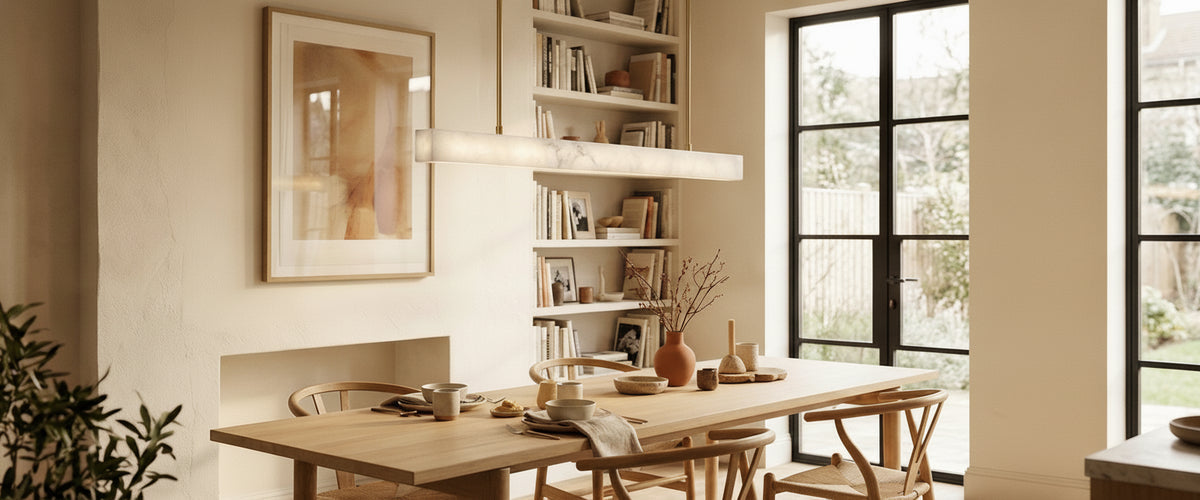

The best ceiling lights dining room designers specify are chosen around the table, not the ceiling. Follow four rules: center the fitting on the table rather than the room, size it to roughly half to two-thirds of the table's width, hang it 30 to 36in (75 to 90cm) above the tabletop, and run it on an LED-rated dimmer. Get those right and almost any style works. Get them wrong and even a beautiful fitting looks lost. Most dining rooms are lit from the wrong end: people fall for a fitting, find the center of the ceiling, then wheel the table underneath and hope. Our dining room ceiling lights are designed to work the other way around, and an alabaster or natural-stone fitting rewards that approach with a warm, even glow across faces and plates and no hard spots on the middle of the tablecloth.
This guide takes each rule in turn, then shows how ceiling height and wall lights change the plan for ceiling lights dining room layouts of every size.

At a Glance: Ceiling Lights Dining Room Rules
Center on the table, not the room. If the table sits off-center, the dining room ceiling light follows it.
Hang low. The bottom of a pendant usually sits 30 to 36in (75 to 90cm) above the tabletop.
Match the arrangement to the table. Round and square tables suit one statement piece. Long tables suit a linear fitting or a row of two or three.
Let ceiling height choose the category. Flush and semi-flush for low rooms, pendants for standard heights, chandeliers once you pass about 9ft (2.7m).
Add wall lights so the room keeps its mood after the plates are cleared.
Dim everything with a trailing-edge dimmer matched to your LED lamps.

Why the Table Should Drive Every Ceiling Light Decision
The table is the only fixed point that matters in a dining room. Chairs move and sideboards get swapped, but the table is where the light has to land. So measure it before you look at a single fitting. Measure the length you use most often, not the fully extended length you open twice a year at Christmas. The ceiling lights dining room tables really need are sized to that everyday number.
For a round or square table, a single fitting roughly half to two-thirds of the table's width looks balanced. A 4ft (120cm) round table therefore suits something in the region of 24 to 31in (60 to 80cm) across. With dining room ceiling lights over a rectangular table, keep the fitting at least 6in (15cm) inside the table edge on every side, so nobody standing up from their chair clips it with their head. A linear fitting or a row of pendants should cover around two-thirds of the table's length.
Alabaster changes the math slightly. The stone diffuses light through its body rather than letting the bulb glare out, so you can often go a size larger with an alabaster bowl than you would with clear glass, and the table still won't feel interrogated. Ceiling lights dining room buyers choose in dense marble or onyx, by contrast, tend to read heavier at the same size, so stay at the smaller end of the range.
How High Should Ceiling Lights Hang Over a Dining Table?
Nine times out of ten, the dining room ceiling light is hung too high. Electricians often leave the flex long, installers rarely want to shorten it on the day, and the light ends up floating 3ft (1m) or more above the table. At that height a pendant stops being a dining light and becomes a general room light. The glow spreads across the floor and walls, the table loses its pool of warmth, and the atmosphere goes flat.
For the ceiling lights dining room tables sit beneath, aim for 30 to 36in (75 to 90cm) between tabletop and the underside of the fitting. Then test it properly. In the studio we hang samples over a test table and sit down before we decide anything, because the seated view is the one that counts. You should be able to see the person opposite without the fitting cutting through their face, and you should not be able to see the lamp itself.
That second point catches out many ceiling lights dining room shoppers. Diners look up into a pendant from below, so check the underside. A deep alabaster bowl hides the bulb well. A shallow dish or an open-bottomed shade may need a frosted or opal lamp. We once shipped a large alabaster bowl pendant to a client in an Edinburgh New Town flat with ceilings close to 11ft (3.4m). It had been hung at around 4ft 3in (1.3m) above the table, and they felt the room looked like a grand corridor. Dropping it to roughly 33in (85cm) was the whole fix. Same fitting, same bulb, completely different room.
Single Statement, Cluster or Linear: Which Arrangement Suits Which Table
The right arrangement of ceiling lights dining room tables need depends mostly on the table's shape and length.
Single Statement
Round, oval and square tables want one strong center. A generous alabaster bowl pendant or a tiered chandelier gives a single focal point that every seat relates to equally. This is the most forgiving arrangement for the ceiling lights dining room tables of this shape need, and the easiest to dim well.
Cluster
Two or three pendants in a row suit rectangular tables for six to eight, spaced roughly 24 to 30in (60 to 75cm) apart center to center. Over a round table in a tall room, a loose cluster at slightly varied drops works too, provided the lowest piece still respects the hanging height above. Keep the material consistent across the group. Mixing alabaster with glass in one cluster usually looks undecided.
Linear
Long tables and open kitchen-diners suit a linear bar, ideally with the light diffused through stone or opal glass so the table is evenly lit end to end. Brass detailing on a linear fitting helps it sit comfortably near kitchen hardware, which matters when your dining room ceiling lights share sightlines with the kitchen. If you are weighing up shapes side by side, browse the alabaster lighting collection by form to see how bowls, tiers and bars compare at different scales.
How Ceiling Height Shifts the Category of Fitting That Makes Sense
Below about 8ft (2.4m), which is common in post-war houses and many flats, flush and semi-flush alabaster dishes come into their own for general room light. The same logic applies to other diffusing materials. For the far end of a low dining room, a shallow drum such as the Bloom LED Wood Drum Flush Wall & Ceiling Light in Ash gives an even, softened spread that sits closer to the warmth of the table light than a grid of bare downlights would. There is a useful loophole for ceiling lights in a low dining room, though. Nobody walks under a dining table, so a modest pendant can still hang over it. The table protects the headroom.
Between 8 and 9ft (2.4 and 2.7m), most pendants work without fuss. Above 9ft, typical of Victorian and Georgian townhouses, a chandelier or a larger pendant on a longer suspension fills the vertical space without looking stranded. Keep the drop to the table the same. In tall rooms, dining room ceiling lights should put the extra height into the rod or chain, not into the gap above the plates.
Stone is heavy. A substantial alabaster or marble fitting can weigh far more than the plastic ceiling rose it replaces. A standard rose such as the White Ceiling Rose with Integral Terminal Block (88mm) is fine for a lightweight flex pendant. It is a wiring connection point rather than a structural mount, though, so ask a qualified, registered electrician to check the fixing point before installation. Heavier pieces, which describes most of the stone ceiling lights dining room schemes call for, usually need a secure mount into a joist or a purpose-fitted support rather than plasterboard alone.
Layering Dining Room Ceiling Lights With Wall Lights
A pendant on its own handles the meal. It does nothing for the hour afterwards, when the plates are gone and people are still talking. That is the job of the walls. Wall lights mounted at around 5ft to 5ft 6in (1.5 to 1.7m) either side of a sideboard, a fireplace or a large mirror give the room a soft perimeter. The ceiling lights dining room guests sit under can then be dimmed right down without the space going gloomy.
Guidance from the Society of Light and Lighting makes the point that comfortable interiors depend on light at several levels, not just from overhead. In a dining room that translates simply: ceiling light over the table, wall light at eye level, and perhaps a table lamp on the sideboard. Alabaster wall lights are especially useful here because the stone glows on its own surface, so even at low output they read as warm points of light rather than dim bulbs. Where there is artwork above the sideboard and no space for wall lights, a small adjustable ceiling spot such as the Nari Cylinder Adjustable Ceiling Light in Matt Black can wash the wall from above, provided it is angled away from the table and out of diners' eyelines. Our wider lighting range includes wall, table and floor pieces that pair with a pendant in the same stone.
Put the wall lights and the dining room ceiling lights on separate circuits. One switch for everything defeats the point of layering.
Dimming in the Dining Room, and Why a Trailing-Edge Dimmer Is Not Optional
Dining is the one room where you will use the full range of a dimmer: bright for laying the table, low for dinner, lower still for the last glass. Most homes now run LED lamps, and LEDs are fussy about dimmers. Older leading-edge dimmers were designed for incandescent and halogen loads. Paired with LEDs, they often cause flicker, a faint buzz, or a sudden drop to nothing at the bottom of the dial.
A trailing-edge dimmer, rated for LED loads and with a minimum load your circuit actually meets, gives smooth control down to a gentle glow. Check that the lamps themselves are marked as dimmable, since the Energy Saving Trust's lighting advice notes that not every LED is. For any ceiling lights dining room scheme, choose a warm color temperature, around 2700K, and a high color rendering lamp (CRI 90 or above) so food and skin look natural. Warm lamps behind alabaster bring out the honey and cream tones in the stone. Cool white flattens it to gray. Dimmer installation is a job for a qualified electrician, not a weekend project.
Buyer Checklist for Ceiling Lights Dining Room Projects
Measure the table at its everyday length and note its center relative to the ceiling.
Choose arrangement by shape: one statement piece for round or square, linear or a row for rectangular.
Check ceiling height and decide how much suspension the fitting needs to reach 30 to 36in (75 to 90cm) above the table.
Look at the underside of any dining room ceiling light you shortlist and confirm the lamp will be hidden from a seated view.
Ask about weight and have an electrician confirm the ceiling fixing can carry it.
Plan separate circuits for ceiling and wall lights, each on an LED-rated trailing-edge dimmer.
Specify warm, high-CRI dimmable lamps and keep spares of the same type so the color stays consistent.
Plan for care: alabaster is soft and porous, so dust it with a dry, soft cloth and keep water, sprays and cleaning chemicals away from the stone.
Request a tailored quote for larger or bespoke pieces. Budget depends on material, scale, carving complexity, engineering, finishing and installation.
Getting the Room to Hold Its Mood
The best dining rooms feel right at eight o'clock and still feel right at eleven. That comes from dining room ceiling lights sized to the table, hung low enough to gather people in, backed by wall light and controlled by a dimmer that behaves. Niori designs alabaster and natural-stone lighting with exactly that kind of room in mind, where the stone itself does the softening and the placement does the rest. Start with the table, and every other choice, from the ceiling lights dining room layouts depend on to the wall lights and dimmers around them, becomes much easier to make.