
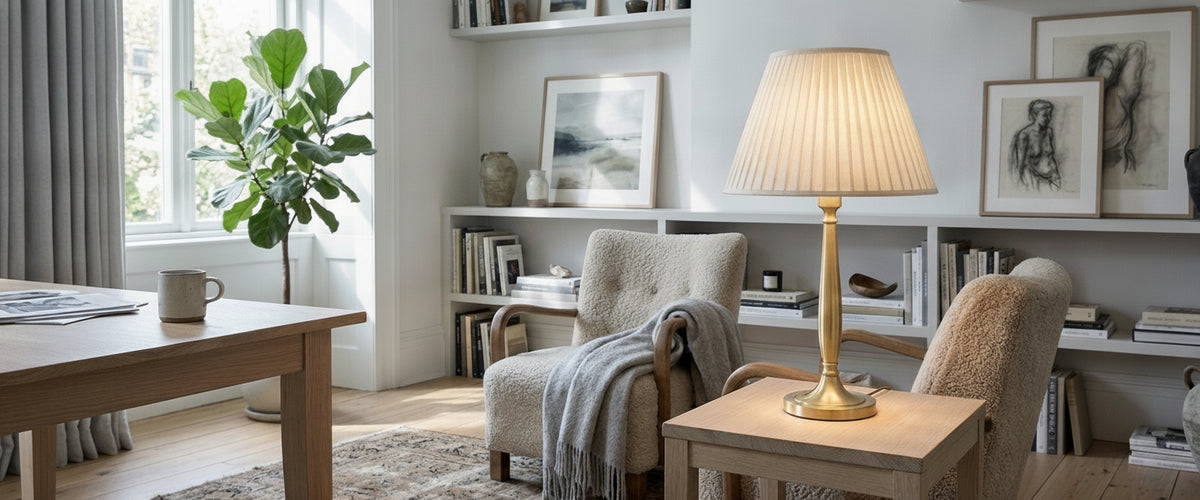

A brass table lamp behaves like a small mirror that also happens to have a switch. Most buyers choose one by colour and silhouette, then wonder why it looks flat at night or glaring by the sofa. The finish, the shade and the bulb decide how brass table lamps actually perform once the main lights go off, and those three choices matter far more than whether the base is fluted or plain.

Quick Answer: Brass Table Lamps at a Glance
- Polished brass throws sparkle and hotspots. It suits low, warm rooms and needs a dense shade.
- Brushed, satin and aged brass spread reflections softly and forgive glare, fingerprints and imperfect bulbs.
- Shade width should usually be close to the height of the base, with the bottom edge hiding the bulb from a seated eye.
- Bulb: a dimmable 2700K LED with high colour rendering (CRI 90 or above) keeps brass golden rather than greenish.
- Build: solid or heavy-gauge brass, a weighted foot and a properly earthed fitting are the quiet signs of a lamp that lasts.

Polished, Brushed, Antique, Satin: How Each Finish Changes the Light Pool
Brass is a copper and zinc alloy, and the ratio sets its colour before any finish is applied. More copper reads pinker, and more zinc reads paler and more lemon. The Copper Development Association publishes useful background on how these alloys are made and why they age the way they do. On brass table lamps, the finish then decides what that colour does to light.
Polished brass is specular. It returns a crisp reflection of the bulb, the shade lining and anything bright in the room, so the base becomes a second light source. In a dim library that is lovely. Beside a television it is a distraction.
Brushed brass has fine directional scratches that break reflections into a soft streak. The light pool on the table looks calmer, and the base glows rather than glints.
Satin brass sits between the two: a low, even sheen with almost no hard highlight. It is the safest choice for reading lamps, where glare at eye level quickly becomes tiring.
Antique or aged brass is darkened chemically or by patination, then often relieved by hand so the high points stay brighter. It absorbs more light than it reflects, which deepens the shadows around the lamp and makes the pool of light on the tabletop feel more concentrated.
Base Proportion and Shade Shape: Pairings That Balance and Pairings That Fight
A useful starting rule: the shade's widest diameter should be roughly equal to the height of the base from foot to lampholder, and the shade itself should stand about two thirds of the base's height. A base of around 16 inches (40 cm) generally wants a shade of 14 to 16 inches (35 to 40 cm) across. Treat these as starting points, then judge by eye.
Pairings that balance:
- Slim column with a tapered drum. The vertical line carries through, and the taper pushes light down onto the table.
- Round or gourd base with an empire or bell shade. Curves answer curves, and the flared hem softens a heavy polished body.
- Low, wide base with a shallow dome or mushroom shade in alabaster or glass. The whole lamp glows, which suits brushed and aged brass especially well.
Pairings that fight: a skinny stem under an oversized drum, which makes the lamp look like it might topple; a chunky polished base with a tiny coolie shade, which gives all glare and no glow; and a pleated fabric shade on a sharply architectural base, where the two languages talk over each other.
This is where natural stone earns its place. An alabaster shade on a brass stem turns the shade itself into the light source, so the brass reads as warm framing instead of competing for attention. If you are weighing a stone shade against fabric, browsing our alabaster lighting range gives a quick sense of how translucent stone and brass detailing sit together at different scales.
Warm White Bulbs on Polished versus Aged Brass
Because brass table lamps sit at close range, the bulb's colour temperature and colour rendering change the metal more than most people expect. Under a 2700K LED with high CRI, polished brass reads honeyed and rich. Push to 3000K and it starts looking yellow. At 4000K it turns brassy in the unflattering sense, almost greenish at the edges.
Aged brass is more forgiving of colour temperature because its darker surface reflects less of the bulb directly. It is less forgiving of poor colour rendering. A low-CRI bulb flattens the brown and bronze tones in an antiqued finish into a muddy grey, and the hand-relieved highlights disappear.
The difference is easy to see side by side. Put the same aged base under a good 2700K bulb and a cheap 2700K bulb with poor rendering, and it looks like two different finishes, the second noticeably duller. Dimming matters as well. Dim-to-warm LEDs that drift towards 2200K as they dim make brass look candlelit at low levels, which is the whole point of a table lamp in the evening. Check that the bulb and the switch or dimmer are rated to work together.
Where Brass Table Lamps Sing (and Where They Disappear)
Living rooms with timber, wool and plaster. Warm, matt surroundings let brass table lamps carry the shine in the room. A pair on a console behind a sofa does more for evening atmosphere than any overhead fitting. Where the room already leans towards natural, textured materials, a brushed aged base under a woven shade suits it better than high polish. The Ombressa Table Lamp with Raffia Shade is a good example: it keeps the brass soft and earthy rather than glossy.
Bedrooms. Satin or brushed brass at the bedside, with an opaque or stone shade, avoids the point of glare you see when lying down. Aim for the shade hem to sit at roughly chin height when you are sitting up in bed, so the bulb stays hidden.
Studies and libraries. Polished brass and green or oxblood walls are a classic pairing for good reason. Dark colour absorbs stray reflections and leaves the lamp as the focal point.
Some rooms make the finish invisible. Bright, white-on-white spaces flooded with cool daylight make brass look merely yellow. In kitchens with a lot of chrome or stainless steel, it reads as a mismatch. North-facing rooms show the effect most clearly: a polished lamp can look lifeless under flat, cool daylight and glorious once the curtains are drawn. Brass needs warm light hitting it to show its colour, so in rooms like these it often comes alive only after dusk.
Mixing Brass Into Existing Metalwork
You do not need every metal in the room to be brass. You need a reason for each one. The simplest approach is to let one metal dominate, taking up perhaps two thirds of the visible metalwork, and give brass a supporting role, or the other way round.
- Match the tone of your brass to one other element in the room, such as picture-light trim or a cabinet handle, so the lamp looks intentional.
- Vary the finish deliberately. A satin lamp next to polished door furniture looks considered. Two slightly different polished brasses side by side look like an accident.
- Use black, bronze or stone as a bridge. A marble foot or alabaster shade separates brass from nearby chrome so the two never touch visually. On a desk, a black lamp with gold-toned detailing ties brass accents to darker hardware without adding another full metal to the room. The Tessa Articulated Dome Adjustable Table Lamp works this way.
Over-coordination is the more common mistake. When lamp, mirror frame, curtain pole and coffee table legs all share one shiny brass, the room starts to look bought in a single afternoon.
Construction Details That Separate a Brass Lamp Worth Buying
Plenty of brass table lamps on the market are actually steel or zinc alloy with a thin plated coat. Plating is not automatically bad, but it wears through at edges and around the switch, and it cannot be refinished the way solid brass can. Here are the decision criteria we use when assessing a lamp:
- Weight. A medium table lamp in solid or heavy-gauge brass should feel noticeably heavy for its size. A lamp that feels light, or gets all its heft from a hidden plate in the foot, often has a thin-wall tube stem.
- Magnet test. Brass is not magnetic. If a fridge magnet sticks firmly to the stem, there is steel underneath. Plated zinc alloy will not attract a magnet either, so use this test alongside weight rather than instead of it.
- Joints and threads. Look for neat, tight threaded joints and clean solder lines. Visible glue, gaps or cross-threading suggest a lamp that will wobble within a year.
- Lacquer. Lacquered brass holds its colour, while unlacquered brass patinates. Both are valid, but you should know which you are buying. Patchy or orange-peel lacquer is a quality warning.
- Electrical fit-out. A metal lamp should be properly earthed, with a secure cable grip at the base and a fitting rated for the bulb you intend to use. Any rewiring, or adding a dimmer to a hardwired circuit, should be done by a qualified electrician.
- Foot. A felt or cork pad protects furniture and stops the lamp skating when someone brushes past.
A Short Buyer's Checklist
- Decide the lamp's job: reading, mood or display.
- Pick the finish for that job: satin or brushed for reading, polished or aged for mood.
- Measure the furniture, and aim for a shade hem near seated eye level.
- Choose a shade that suits the base's geometry, and consider stone or glass for an all-over glow.
- Buy a dimmable 2700K, high-CRI LED at the same time as the lamp.
- Confirm the build: weight, earthing, lacquer status and a protective foot.
Living With the Finish
Unlacquered brass will darken where hands touch it. On a bedside lamp that usually means a soft, darker ring around the switch within a few months, a quiet record of every night it has been used. Plenty of owners love that. If you would not, choose lacquered brass and dust it with a dry microfibre cloth. Avoid abrasive polishes on lacquer, as they strip the coat. Conservators at the Institute of Conservation advise gentle, minimal cleaning for historic metalwork, which is good guidance for a lamp you plan to keep for decades. If an alabaster shade is part of the design, keep it dry and dust it only, because stone and water do not mix.
Choose the finish for the room, the shade for the base and the bulb for the brass, and a good lamp will look better each year. For a broader look at pendants, wall lights and lamps that pair brass with stone, the full niori lighting collection is a sensible next stop.