
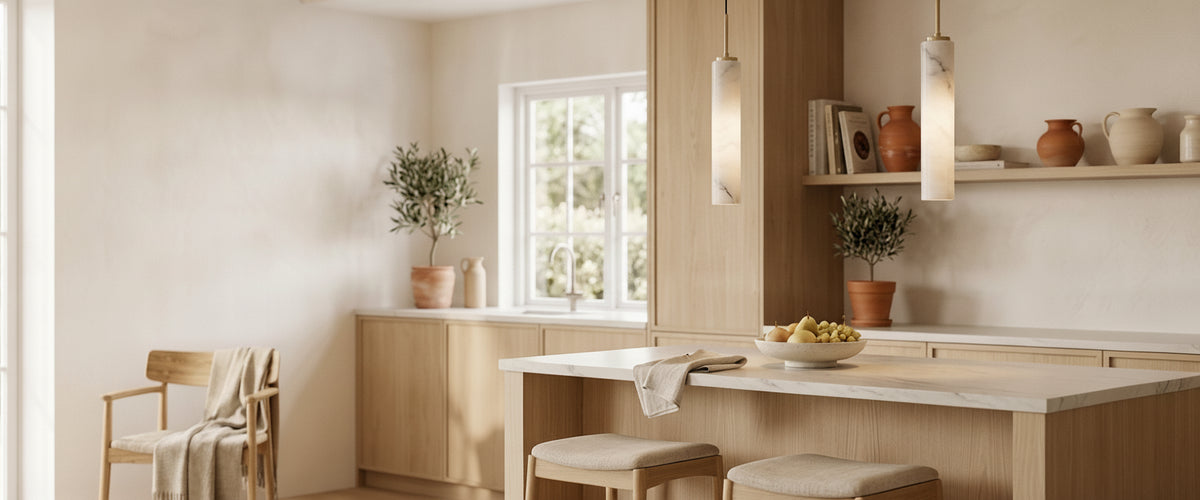

Most kitchen pendants are chosen for how they look switched off. That works for metal and clear glass. With alabaster pendant lights it gets things backwards, because the stone only shows its real character once a bulb is burning inside it. A shade that looks quiet and milky in a showroom can turn honey-gold over an island at night, or show a dark seam of veining you never noticed in daylight. Choose for the lit state first and almost everything else follows.

Key Takeaways
- Light quality: alabaster turns the whole shade into a soft light source, with a warmer tint than opal glass.
- Stone matters: thinner walls glow brighter; heavier veining adds character but darkens patches of the shade.
- Spacing: one generous drop suits a short island; longer islands need two or three, or a cluster.
- Height: hang lower over a seated dining island than over a prep worktop.
- Bulbs: 2700K, high colour rendering, dimmable LED.
- Safety: stone is heavy and dislikes steam. Fix into structure and keep it away from the hob.

Why Alabaster Pendant Lights Glow Differently from Glass and Ceramic
Clear glass lets light straight through, so you see the bulb. Opal glass scatters it evenly, which is pleasant but uniform. Ceramic mostly blocks it and throws light out of the open ends only. Alabaster behaves differently. It is a fine-grained, translucent form of gypsum (Britannica has a useful summary of the mineral), and light entering the stone bounces between its tiny crystals before it leaves. The result is a glow that seems to sit inside the material rather than on its surface.
Two things follow for a kitchen. First, the shade itself becomes a gentle ambient light, so the pendant lights the room as well as the worktop below. Second, the stone nudges colour warmer. White light passing through a creamy alabaster wall comes out a touch more golden, which flatters timber, brass and painted cabinetry in a way that opal glass rarely manages.
Veining, Thickness and the Line Between Warm and Harsh
We test every shade the same way: switch off the overheads and hold a phone torch against the inside wall. It takes ten seconds and tells you more than any product photograph. Thin stone lights up almost edge to edge. Thick stone glows more softly and evenly, with less brightness overall. Heavy veining shows as darker rivers and patches, because denser mineral bands let less light through.
None of that is a fault. It is the reason people buy natural stone. But it should guide where a piece hangs. Over a prep zone where you are slicing and reading recipes, calmer stone with lighter veining gives cleaner, more even light. Over a dining end or a breakfast bar, a boldly figured shade earns its place, because nobody needs perfect task light to drink coffee.
Watch for the opposite problem too. A very thin wall paired with a bright, clear bulb can show a hotspot, a visible bright disc where the bulb sits closest to the stone. A frosted or opal LED lamp usually cures it. When you buy, ask to see the actual piece lit, not a catalogue shot. Every shade is cut from a different block, so two alabaster pendant lights from the same range rarely glow alike, and the photo of one is not a promise about the next.
Sizing Alabaster Pendant Lights to Your Island
The island-length rule is simple and prevents most of the regret we hear about. Measure the length of the island, then work back from these starting points:
- Under about 1.5 m (5 ft): one generously sized pendant usually convinces. Two small ones tend to look apologetic.
- About 1.5 to 2.4 m (5 to 8 ft): two pendants, spaced so each sits over its own working zone.
- Over about 2.4 m (8 ft): three in a row, or a multi-light cluster gathered over the centre.
Leave at least 15 cm (6 in) between the outer edge of the end shades and the end of the island, and roughly 60 to 75 cm (24 to 30 in) between shade centres, so each shade reads as its own glow while the light still overlaps evenly on the worktop. A cluster works well when the ceiling is high or the island is wide rather than long, because it reads as a single sculptural object. A row suits long, narrow islands and lower ceilings. If you are unsure how much ceiling a gathered arrangement really occupies, a compact three-light format such as the Agzar 3 Light E14 Cluster Pendant in white is a useful reference for a cluster's footprint over a wide island, before you translate that scale into stone.
A common mistake on long islands: two large shades over a 3 m run, chosen because three felt crowded on paper. Lit, the middle third of the island sits in a dim gap and the pair looks stranded. A third drop fixes it. If you are torn between two and three on a long island, three is usually right. You can browse scale and silhouette across our alabaster lighting collection to compare single drops with clusters before you commit to a layout.
Mounting Height: Prep Worktop Versus Dining Island
These are not the same number, and treating them as one is the most common installation mistake we see with alabaster kitchen pendant lights.
Over a Prep Worktop
Where people stand and work, hang the base of the shade roughly 75 to 90 cm (30 to 36 in) above the surface. That keeps heads clear, spreads light across chopping boards, and stops tall cooks from staring into the underside of the stone. On a standard UK ceiling of around 2.4 m (7 ft 10 in), that is a fairly short drop, so check the suspension length before ordering.
Over a Dining Island or Breakfast Bar
When people sit, the eye line drops, so the light can come down too, often to about 70 to 80 cm (28 to 31 in) above the surface. Lower shades frame faces and make a long island feel like a table. The glowing stone also becomes part of the view across the room rather than something overhead, which is exactly where alabaster looks its best.
If one island does both jobs, set the height for the zone used most, and resist the urge to stagger drops along a single run. It rarely looks deliberate.
Bulb Temperature Inside a Natural Stone Shade: Why 2700K Rarely Fails
Because alabaster pendant lights already warm the light passing through them, the bulb choice compounds. A 2700K LED reads as soft, warm white once filtered by stone, close to the glow of an old incandescent bulb. Go down to 2200K and the effect can tip into amber, pretty at dinner but murky for prep. Go up to 4000K and the stone looks grey and slightly clinical, which defeats the reason for choosing it.
Three further points matter more than wattage:
- Colour rendering: choose CRI 90 or above so food, timber and skin tones look true.
- Dimming: fit dimmable LEDs on a compatible LED dimmer. A pendant that is right for cooking at full output is too bright for supper.
- Heat: modern LEDs run far cooler than old filament bulbs, which is kinder to the stone over years of use. Always stay within the fitting's stated maximum.
Settle the cap size at the same time, because it limits which lamps you can use. Smaller cluster heads usually take E14, while a larger multi-light fitting over a long island, such as the JASMIN W/M 470 3-Light E27 Wood Pendant in matte white, takes the wider E27 cap, which offers a broader choice of high-CRI, dimmable LEDs.
Weight, Fixings and Kitchen Humidity: The Checks Most Buyers Skip
Kitchen alabaster pendant lights face two problems most living-room fittings never meet: weight and steam.
Solid stone is heavy, and a cluster of alabaster pendant lights with brass hardware can be considerably heavier than a glass equivalent. A plasterboard ceiling alone is not a fixing. The pendant needs to be anchored into a joist or a properly installed noggin, with a ceiling plate rated for the load. Wiring and fixing should be carried out by a qualified electrician, who will also know whether the work is notifiable under Part P of the Building Regulations in England and Wales (the Planning Portal explains when that applies). Replacing a fitting on an existing circuit is usually straightforward; adding a new circuit for an island is a different job.
Humidity is the quieter risk. Because alabaster is gypsum, it is softer and slightly more sensitive to water than marble or onyx. Repeated steam and airborne cooking grease can dull the surface over time. Keep shades away from directly above the hob, run the extractor when cooking, and never spray cleaners at the stone. A dry, soft microfibre cloth is all the routine care it needs; for anything stubborn, ask your supplier before reaching for a product.
A Buyer's Checklist for Alabaster Kitchen Pendant Lights
Before you order, run through these decision points. They cover most of the problems we are asked to sort out after installation.
- Have you seen the stone lit? Ask for a photo or video of the actual shade with a bulb inside.
- Does the veining suit the zone? Calmer stone over prep, bolder figure over dining.
- Is the count right for the island length? One, two, three or a cluster, using the length rule above.
- Is the drop length adjustable? Confirm the suspension suits your ceiling height and the working or seated height you want.
- Is the ceiling ready for the weight? Joist or noggin fixing confirmed by your electrician.
- Are the shades clear of the hob? Steam and grease are the stone's main enemies in a kitchen.
- Is the lamp spec decided? 2700K, CRI 90+, dimmable LED, correct cap size.
- Is the rest of the scheme planned? Pendants rarely light a kitchen on their own.
Budget depends on the stone, scale, the number of shades, metalwork and finishing, and the installation itself, so for a bespoke or multi-light alabaster pendant light kitchen layout, the sensible route is to request a tailored quote with your island dimensions to hand.
Making the Pendants Part of a Whole Scheme
Alabaster pendant lights do their best work as the warm centre of a layered kitchen, not the only source in it. Pair them with discreet task lighting under wall cabinets and a softer wall light or table lamp at the far end of an open-plan room, so the island glows without carrying the whole evening alone. At Niori, our alabaster and natural-stone pieces are designed to sit together in exactly that way, and the wider lighting collection is the place to plan the supporting cast once the island is settled. Get the stone, the spacing and the drop right, and the pendants will earn their place every evening the kitchen is used.