
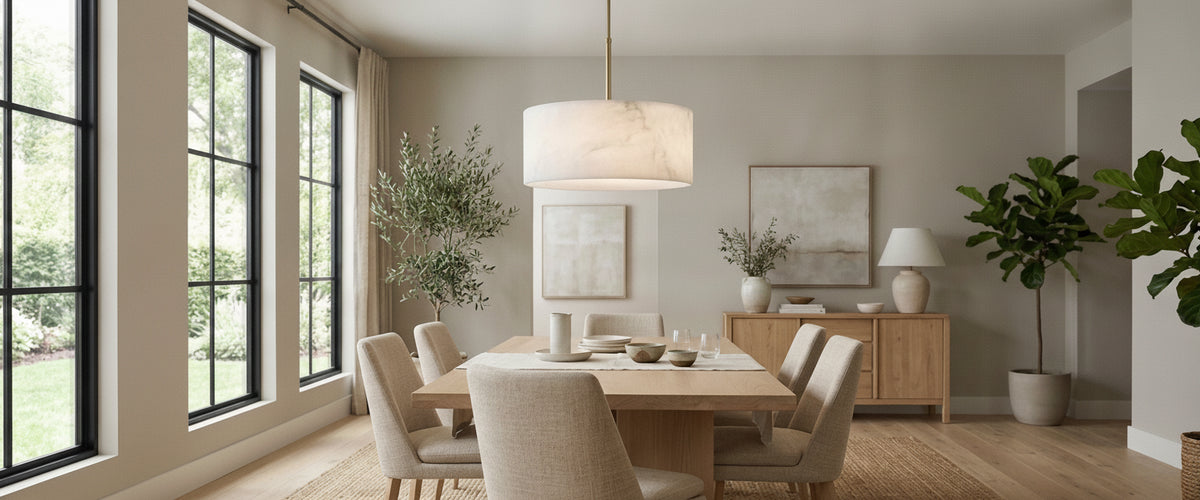

Switch on two alabaster pendants cut from the same block, one polished and one frosted antique, and they will not look like siblings. The polished shade throws a brighter, slightly patchy glow with a visible hot spot where the bulb sits. The frosted antique alabaster shade looks as though the light is coming from inside the stone itself. That difference is the whole reason people ask for this finish, and it is also where most buying mistakes begin.

At a Glance
- Frosted antique alabaster scatters light at the surface, so the glow reads softer and more even than on polished stone.
- Texture depth matters. Too shallow and you lose the effect; too deep and the shade starts to look grubby when lit.
- Heavy veining interrupts the glow. Choose lighter, more open grain if even diffusion is the priority.
- A warm white bulb around 2700K flatters the finish. Go much warmer and the stone tips into amber.
- Inspect surface consistency, mount integrity and finish durability before you commit, especially on an alabaster globe chandelier.

Frosted Antique versus Polished Alabaster: What the Surface Is Doing to Light
Alabaster used in lighting is a fine-grained form of gypsum, a soft mineral that sits at around 2 on the Mohs scale (the Mindat entry for gypsum covers its properties in detail). Its translucency comes from tightly packed crystals that let light travel some distance through the stone before it escapes. What happens at the outer face decides how that light reaches your eye.
A polished surface is close to optically smooth. Light that has passed through the stone exits more directly, so you see more of the internal structure: brighter zones, darker veins and a clear sense of where the bulb is. A frosted antique alabaster surface has been honed into a fine matt texture, often finished with a soft wax or a light tonal wash. Every microscopic ridge bends the exiting light a little, which blurs the hot spot and spreads brightness across the whole face of the shade.
The trade-off is output. Frosting absorbs and redirects a small amount of light, so a frosted shade will usually feel slightly dimmer than a polished one with the same bulb. In a dining room or stairwell that is often exactly what you want. In a kitchen where you need task light, it is something to plan for.
Texture Depth and Where Evenness Breaks Down
Not all frosting is equal. A shallow hone, the kind you can barely feel with a fingertip, softens glare but leaves the bulb position faintly visible. A medium texture is the sweet spot for most pendants and wall lights: the shade glows as a single plane and the stone still reads as stone.
Push the texture deeper and two problems appear. First, the evenness starts to break down at the edges. Thin rims and the lower curve of a bowl pick up more light than the thicker centre, and a heavy texture exaggerates that contrast rather than smoothing it. Second, deep pitting traps wax, dust and kitchen grease. When lit from behind, those pits read as tiny dark specks, and the shade looks tired long before it is.
This matters most on long linear wall lights. A wide alabaster panel with uneven texture shows banding along its length in a way a small globe never would. On a long fitting such as the Albatre Alabaster LED Wall Light 800mm in brass, it is worth seeing the full length lit before you decide, because any inconsistency in the hone has 80cm of stone in which to show itself.
Veining Density: Why Heavier Grain Disrupts the Glow
Buyers often fall for heavily figured stone in daylight and then feel slightly let down at night. Veins are denser, often mineral-rich bands that transmit less light than the clear stone around them. Polished, they look dramatic. Under an antique finish, the honed surface already mutes contrast, so dense veining tends to read as muddy shadow rather than pattern.
Our rule of thumb in the studio is simple. If even diffusion is the reason you want frosted antique alabaster, choose open, pale grain with a few wandering veins. If you want the stone itself to be the statement, a polished or lightly honed finish will show the figure more honestly. Trying to get both from one shade usually means compromising on each.
The point matters more on an alabaster globe chandeliers, where every globe is cut from a different section of stone. A cluster in which one globe is far more heavily veined than the rest will look patchy when lit, even if each globe is beautiful on its own.
A Deliberate Antique Finish versus One That Simply Looks Old
A properly made antique finish is controlled work. The stone is honed through a sequence of grits so the texture is consistent across the whole surface, then sealed or waxed to resist handling marks. Any tonal warmth is applied lightly and evenly, sitting in the surface rather than on top of it. Lit, it looks like old stone that has been cared for.
A shortcut finish looks old in a different way. Common giveaways include:
- Tinted wash pooling in recesses, carvings or seams, which shows as dark lines when lit.
- Patchy matt and gloss areas where the hone was not carried through evenly.
- A plastic-feeling lacquer on the surface. Some lacquers yellow under heat and light over time.
- Scratches that run in one direction, a sign of a coarse single-grit pass.
A typical case: an antique-finish globe cluster that looks convincing in a daylight photograph, then shows a darker ring on every globe at night, where a tinted wash has settled around the fitting collar. Nothing is wrong with the stone itself. The finish simply was not designed with the light on, which is why lit inspection matters more than any product shot.
Choosing Bulb Temperature for Frosted Antique Alabaster
Alabaster already warms light as it passes through. Add a very warm bulb and the stone can drift from honey into something closer to orange. Go too cool and the frosted surface turns faintly grey and chalky.
- 2700K is the reliable default for frosted antique alabaster in living rooms, dining rooms and bedrooms.
- 3000K suits kitchens, bathrooms and hospitality spaces where clarity matters, and keeps whiter stone looking clean.
- 2200K to 2400K works for candlelit-style evening scenes, ideally as a dimmed state rather than the main setting.
- Choose a high colour-rendering LED (CRI 90 or above) so the subtle tonal variation in the stone survives.
Dimming is where frosted stone performs best, because the even surface stays even as output drops. Check that your LED lamps and dimmer are compatible, and have a qualified electrician fit or change any dimmer, switch or hard-wired fixture. Flicker at low levels is almost always a lamp and dimmer compatibility issue rather than a fault in the fitting.
Where the Finish Earns Its Place, Room by Room
Dining rooms: an alabaster globe chandelier with a frosted antique finish gives a soft, flattering light over the table without glare in anyone's eyes. Hang it so the lowest globe clears heads comfortably, and choose globes matched for grain.
Stairwells and double-height halls: alabaster globe cluster chandeliers in tiered or cascading forms suit these spaces well, because the frosted finish keeps each globe from reading as a bright dot when viewed from above or below.
Bedrooms and living rooms: frosted alabaster table lamps and wall lights give a low, wraparound glow that sits well with linen, plaster and timber. Brass detailing, whether polished or antique, warms the composition further. Beside a bed or flanking a chimney breast, two smaller shades on one backplate, as on the Velaris 2 Light Double Alabaster Wall Light in brushed brass, spread that glow more gently than a single larger shade working harder.
Bathrooms: be cautious. Gypsum alabaster is sensitive to water, so any bathroom fitting must carry the correct IP rating for its zone and be installed by a qualified electrician. Keep alabaster away from direct splash and steam.
If you are comparing forms side by side, our alabaster lighting collection is the easiest place to see how pendants, wall lights and chandeliers differ in scale and finish.
What to Inspect Before You Commit
Photos taken in daylight tell you very little about frosted stone. Ask for images or video of the fixture lit, ideally in a darkened room, and work through this list:
- Surface consistency: is the matt texture even from rim to centre, with no glossy patches or directional scratches?
- Lit evenness: does the shade glow as one plane, or can you see the bulb, banding or dark rings?
- Grain matching: on multi-globe pieces, are the globes broadly similar in vein density?
- Mount integrity: how is the stone held? Look for padded seats, secure collars and no direct metal-on-stone pressure points. Stone is heavy, so confirm the ceiling or wall fixing is suitable before installation.
- Finish durability: is it waxed, sealed or lacquered, and how should it be maintained?
- Lamp compatibility: what lamp type and maximum wattage does the fitting accept, and is it dimmable?
Budget depends on stone selection, scale, the complexity of carving and metalwork, engineering and finishing. For larger chandeliers or project quantities, a tailored quote is the honest way to compare like with like.
Living with the Finish
A good antique finish asks for very little. Dust with a soft, dry brush or microfibre cloth, always with the fitting switched off and cool. Never use water, sprays or household cleaners; gypsum is slightly water-soluble and will etch. The conservation guidance on stone from the Getty Conservation Institute is a useful reminder of how gentle stone care should be. If the surface dulls over years, a specialist can rewax it far more safely than any home remedy.
Frosted antique alabaster rewards buyers who judge it lit, not just admire it on a table. Get the texture, grain and bulb right and the stone does the rest. For pieces that pair alabaster with brass, glass and other natural materials, the wider niori lighting range is worth exploring.