
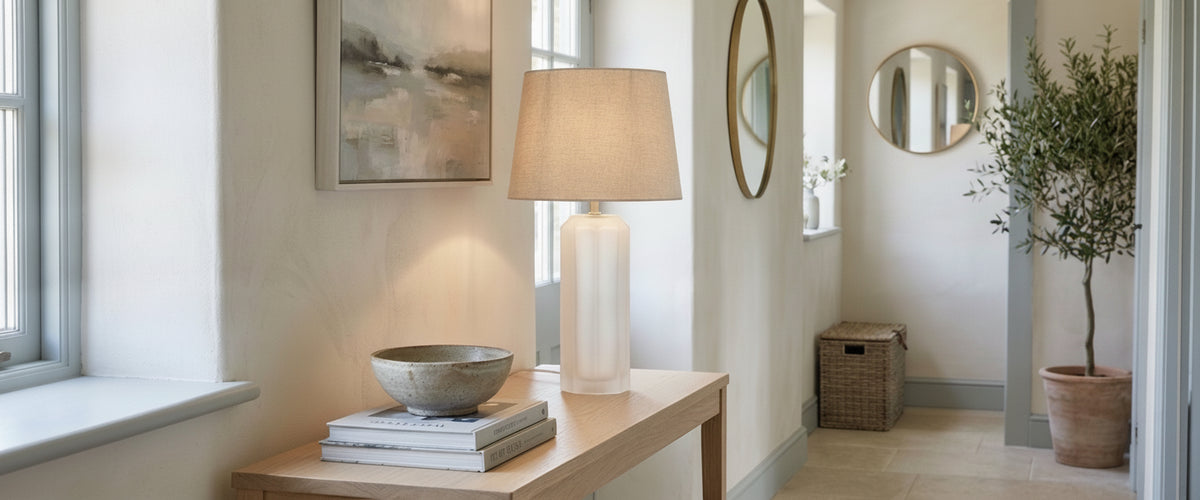

Most antique crystal table lamps listed online are photographed switched off, which is the worst way to judge them. Crystal produces nothing by itself. It needs a point of light, a clean facet and a shade that lets the beam reach the glass. Take away any one of those and you have a heavy ornament with a cord attached. This guide covers what separates a lamp that throws light across a room from one that just sits there. Niori makes alabaster and natural-stone lighting, so we also cover where we think crystal belongs beside softer materials.

Key Takeaways
Weight and ring are your first tests. Lead crystal feels heavy for its size and rings when tapped lightly. Acrylic gives a dull knock.
Sharp facet edges mean cut crystal. On antique crystal table lamps, rounded, slightly soft edges and faint seam lines point to pressed glass.
Some loss of brilliance is normal. Permanent etching or crizzling is a different matter.
The shade decides everything. If it hangs too low or blocks downward light, the crystal goes dark.
Old wiring needs a professional. Have any antique crystal table lamp checked or rewired by a qualified electrician before regular use.

How Lead Crystal Scatters Light Differently from Glass and Acrylic
The appeal of crystal comes down to two optical properties: how strongly it bends light (refraction) and how widely it splits light into color (dispersion). Adding lead oxide raises both. Under the long-standing European classification for crystal glass, "lead crystal" needs at least 24 percent lead oxide and "full lead crystal" at least 30 percent. That composition is what makes a well-cut prism on antique crystal table lamps throw small flecks of red and violet onto a wall. Lead also softens the glass, so a cutter can grind deeper, crisper facets.
Borosilicate is the tough, heat-resistant glass of laboratory beakers. It bends light less, splits it less and is hard to cut, so lamps made from it give a cleaner, cooler glint with little color. Pressed glass is shaped in a mold instead of cut, and its facets come out with slightly rounded edges. Light catches it, but the sparkle is softer and less precise. Acrylic is light, warm to the touch and scratches easily. After a few decades it often yellows. Many modern pieces sold as vintage crystal table lamps are acrylic or lead-free crystal (which typically uses barium, zinc or potassium instead), so ask the seller directly what the glass is.
A quick test when sorting antique crystal table lamps is to hold the piece next to a single clear bulb. Cut lead crystal breaks the bulb into dozens of sharp points with a hint of color. Pressed glass blurs them. Acrylic shows a slightly milky glow at the edges.
Reading the Base: Column, Cluster and Urn
On antique crystal table lamps, the shape of the base usually tells you which period the piece belongs to, and that sets fair expectations for its age and construction.
Column, cluster and urn: the three base forms you will meet most often, shown lit so the facets can do their work.
Column
Faceted columns and obelisks descend from Georgian and Regency candlesticks and returned strongly in mid-twentieth-century lamps. Look for a stack of cut sections threaded onto a central rod. The column is the easiest antique crystal table lamp to place because it stands upright, leaves space around it and suits a tall, plain shade.
Cluster
Clusters take their cue from Victorian girandoles and mantel lustres: a central stem hung with drops, prisms or chains of octagonal beads. This is the true table lamp with crystals, and it gives the most movement of light. It also has the most parts to lose, so count the drops and check that they match.
Urn
Urn and vase forms belong to the neoclassical revival, often on a square brass or marble plinth. On an urn-form antique crystal table lamp, the cutting tends to be shallow and repetitive, such as diamonds, flutes or hobnail, so the sparkle is even and calm. It sits well in formal rooms where a cluster would feel fussy.
What Aging Does to Crystal Clarity
Antique crystal table lamps rarely look as sharp as they did on the cutter's wheel, and that is fine. Decades of dusting round off the finest edges very slightly, and many old pieces have a faint gray or warm tone from impurities in older batches. Early pressed glass made with manganese can turn a light amethyst after years in sunlight. Collectors often read that shift as evidence of age.
Two problems are less forgivable when you are judging antique crystal table lamps. Etching is a permanent white bloom, usually caused by harsh dishwasher detergents, and no amount of polishing removes it. Crizzling is a network of fine cracks in the surface caused by unstable glass chemistry, and it gets worse over time. To tell film from damage, wipe a small area with a drop of white vinegar on a cotton swab. If the cloudiness lifts, it was limescale or surface residue. If it stays, it is in the glass.
Choosing a Shade That Lets the Crystal Work
This is where most otherwise good antique crystal table lamps fail. A crystal base sparkles when light from the bulb falls down onto it through the open bottom of the shade. So the lower edge of the shade should stop just above the top of the crystal, leaving the faceted section fully visible and lit.
The lower edge of the shade sits just above the crystal, so light falls straight onto the facets.
Works well: tapered or straight drums in linen, silk or card with a pale lining. They send light down onto the base and give a soft upward wash.
Works for tall crystal lamps: a tapered drum roughly two-thirds the height of the base, with a bottom diameter about equal to the base height. That keeps a slim column from looking top-heavy.
Smothers it: heavy pleated shades that drop past the fitting, frosted glass globes, dark interiors that trap light, and anything so wide it shadows the base.
In a bedroom, a more opaque shade on an antique crystal table lamp cuts glare at pillow height without hiding the crystal, because the light still escapes downward.
Condition Checks Before You Buy Antique Crystal Table Lamps
Old crystal lamps reward patience, and the best ones are often in mixed condition. Whether you are buying antique crystal table lamps from a dealer, at auction or online, ask for photographs in daylight and with the lamp switched on. Then work through these checks:
Run a fingertip along every facet edge. Small chips catch the skin before you can see them.
Check drill holes on drops and prisms. Hairline cracks start there.
Look for marriages. A base and column from different lamps often show mismatched glass tones or brass of different colors.
Shine a UV flashlight over joins. Modern adhesive repairs often glow under ultraviolet light.
Inspect the wiring. Cloth or perished rubber cord, cracked Bakelite sockets and metal parts with no ground are all reasons to have the lamp rewired. Use a qualified electrician for this, not a kit. The Health and Safety Executive's guidance on portable electrical equipment is useful if the lamp is going into a hotel, restaurant or office.
Test stability. A top-heavy cluster on a narrow foot will tip if a cat brushes past it.
Many older British-made antique crystal table lamps use a B22 bayonet fitting and many Continental pieces use E14 or E27 screw fittings, so check which one you have before ordering bulbs.
Bulbs and Dimming for Crystal
Crystal needs a small, bright source. A clear LED filament bulb at around 2700K gives warm light with enough sharpness to make facets glint. Opal or frosted bulbs flatten the effect. Fit a dimmable bulb with a compatible dimmer. An antique crystal table lamp looks its best at moderate brightness in the evening, when each point of light reads on its own instead of merging into glare.
Where an Antique Crystal Table Lamp Earns Its Place
An antique crystal table lamp works best as the one bright spot in a calm room. On a hall console, a dining sideboard or a pair of bedside tables against a plain wall, crystal gives the room a point of focus. Picture a 1950s faceted column lamp on a walnut bureau, set against limewashed walls, with alabaster wall lights providing the background glow. The stone gives the room its warmth and the crystal gives it its glint. Neither has to compete.
Crystal struggles in two settings. Next to mirrored furniture or under a ceiling full of spotlights, every surface sparkles at once and the lamp disappears. Beneath a crystal chandelier, the two fight for attention. In both cases a quieter ambient source does better, and diffusing materials suit that job well. Alabaster and onyx spread a warm, even light that crystal cannot. If you are building the rest of a scheme around antique crystal table lamps, our alabaster lighting collection includes pendants, wall lights and table lamps designed for that supporting role.
A Short Decision Checklist
Is it lead crystal, lead-free crystal, pressed glass or acrylic, and has the seller said so in writing?
Does the base form suit the room: column for flexibility, cluster for drama, urn for formality?
Is any cloudiness removable film or permanent etching?
Are all drops present and matched?
Has the wiring been checked, or will you budget for a qualified electrician to rewire it?
Do you have a shade that stops just above the crystal?
Will the lamp be the only sparkle in its part of the room?
If the answers are good, a well-chosen antique crystal table lamp will outlast most of the furniture around it. For the quieter light that lets it stand out, the wider Niori lighting range covers the supporting fixtures, and larger projects can be quoted individually on request.