
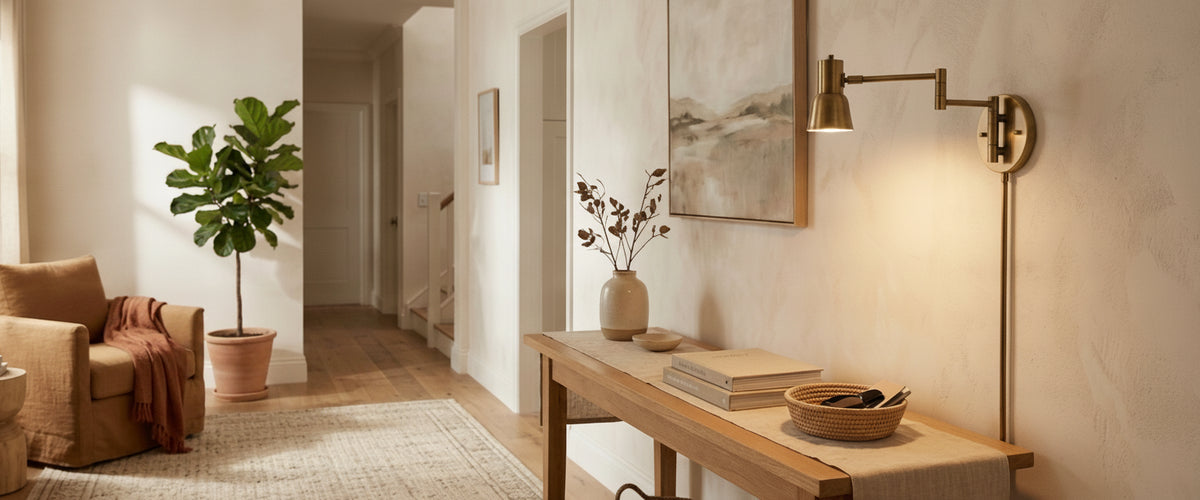

Antique brass is the finish most likely to look perfect in a product photograph and disappointing on your own wall at nine o'clock at night. In daylight, the darkened, slightly smoky surface reads as heritage warmth. Under the wrong bulb or against the wrong backdrop, it can turn flat, brown and faintly grubby. Antique brass wall lights are among the most forgiving fittings you can buy when they are placed well, and among the least forgiving when they are not. The difference comes down to the room, the height, the shade and the colour temperature of the light behind it.
At a glance
- Antique brass suits warm, textured rooms: hallways, dining rooms and bedrooms with painted plaster, timber or stone.
- Mount sconces at roughly 1.65 to 1.8 m (about 5 ft 6 in to 6 ft) to the centre of the fitting so the patina catches side light instead of glare.
- Use 2700K or warmer bulbs with a high colour rendering index (CRI 90 or above). Cool white makes the finish look grey.
- Alabaster and natural-stone shades lift antique brass. Clear glass with a bare bright bulb tends to flatten it.
- Mix metals by giving one finish the lead and keeping others to a supporting role.

Antique, Aged or Satin Brass: What a Lit Fitting Exposes
These three names get used interchangeably on product pages, and that confusion is behind a lot of disappointed buyers. In practice they behave very differently once the bulb is on.
Antique brass is darkened deliberately, usually with a chemical patina, and often relieved by hand so the high points show brighter metal. Lit up, the contrast between dark recesses and polished edges becomes the whole character of the fitting. Aged brass sits lighter and warmer, closer to brass that has softened naturally over years of handling, with less dark shadow in the detailing. Satin brass (sometimes sold as brushed brass) is bright metal with a fine directional grain; it reflects a soft, even glow and has no patina to speak of.
Switch the lamp on and the gap widens. Satin brass bounces light back toward you. Antique brass absorbs more of it, so the fitting reads darker and the light source itself becomes the focal point. That is why an antique brass wall sconce with a glowing alabaster shade looks so composed: the stone does the glowing, the metal frames it. Brass itself is a copper and zinc alloy, and the way it darkens with oxidation is well documented by the Copper Development Association. Factory patinas simply speed up and control that process.

Where Antique Brass Wall Lights Hold Their Warmth
The finish needs company. Antique brass wall lights look their best against surfaces with some depth of colour or texture, where the darker metal reads as intentional rather than tired.
Hallways
A hallway is the natural home for antique brass, especially in period properties. A pair of sconces either side of a console or mirror gives low, welcoming light, and the finish ties in with door furniture, stair rods and old floorboards. In a Victorian terrace in Manchester or a Georgian townhouse in Bath, the metal already belongs to the vocabulary of the building.
Dining Rooms
Dining rooms are where the finish earns its keep after dark. Wall lights at the perimeter, dimmed low, let a central pendant or chandelier carry the table while the walls glow gently. Deep greens, oxblood reds and warm putty tones all suit antique brass; the metal picks up the candle-like quality of a dimmed warm bulb.
Bedrooms
Bedside antique brass wall lights free up the bedside table and give a softer, more residential feel than chrome or matte black. Choose fittings with a shade that hides the bulb from a lying-down eye line. An alabaster shade works well here because it diffuses light in every direction with no hot spot.
Mounting Height Changes How the Patina Reads
Height affects the finish more than most buyers expect. Mount an antique brass wall sconce too high and you look up into the underside of the shade, mostly seeing the bulb and a dark silhouette of metal. Mount it too low and the fitting becomes something people brush past in a hallway.
For most rooms, the centre of the fitting at around 1.65 to 1.8 m (about 5 ft 6 in to 6 ft) from the finished floor puts the patina at eye level, where you can see the hand-relieved highlights catch the glow. In double-height spaces or stairwells, go higher and size up so the fitting holds its own visually. On a tall stairwell wall, a long linear piece such as the Albatre Alabaster LED Wall Light 800mm in Brass carries the scale of the space far better than a small single sconce, which tends to look marooned once it is lifted above eye level. Bedside lights usually sit lower, roughly level with your shoulder when you are sitting up against the headboard.
The same antique brass wall bracket can look rich at eye level and nearly black at 2.1 m (7 ft), because you lose sight of the relieved highlights and see mostly shadowed metal. If a wall light is going above a mirror or high on a chimney breast, choose a lighter aged finish instead. For lighting a painting or mirror from above, a fitting like the Chawton Medium Picture Light in Aged Brass keeps its warmth at that height where a darker antique patina would read as a black bar.
Where the Finish Loses the Argument
Some schemes simply work against antique brass, and no bulb will rescue them.
- Cool-white schemes. Brilliant white walls lit at 4000K make the patina look grey-green rather than warm. The metal needs warmth around it to read as brass at all.
- High-gloss tiles. Glossy metro or large-format porcelain throws bright, hard reflections around the room, exaggerating the darkness of the metal so it looks dull by comparison.
- Stark minimalism. In a room of flush plaster, handleless joinery and no texture, a darkened, hand-finished fitting can look like an import from a different house. Satin brass or plain stone usually sits more comfortably, and a cleaner brushed brass frame with alabaster shades, such as the Velaris 2 Light Double Alabaster Wall Light, is closer to the right design language.
One scenario comes up again and again. Antique brass sconces go into a newly renovated hallway, and within a week the owner is convinced the finish is faulty. It isn't. The electrician has fitted 4000K LED downlights in the same corridor, and the cool wash has turned every warm surface slightly grey. Swapping the downlights to 2700K fixes it overnight. The wall lights never changed at all.
Shade Material and Bulb Temperature After Dark
This is the pairing that makes or breaks the finish. The metal is only half the picture; the other half is what the light passes through.
Alabaster is the most sympathetic partner for antique brass. The stone's translucency and natural veining spread the light into a soft, honeyed glow, and that warmth carries across to the metal frame. Onyx gives a deeper, amber-toned glow with more pronounced banding. Marble is generally opaque at fitting thickness, so it works best as a base, backplate or detail, with light directed up or down. Opal or frosted glass is a reasonable lighter option. Clear glass with an exposed bright bulb is the least flattering; the glare overwhelms the patina.
For bulbs, 2700K is the safe default. Go to 2200K or 2400K in dining rooms and bedrooms if you want a lower, candle-like mood. Look for CRI 90 or above, because poor colour rendering makes warm metal look muddy even at the right temperature. If you plan to dim, use dimmable LED lamps with a compatible trailing-edge dimmer, and have a qualified electrician check the circuit and install it in line with the wiring regulations published by the Institution of Engineering and Technology. Most wall lights are hard-wired, so this is not a DIY job.
If you are weighing up shade options, our alabaster lighting collection is the quickest way to see how different stone thicknesses and veining change the glow against brass frames.
Mixing Antique Brass Wall Lights With Other Metals
Mixing metals works when it looks decided. The trick is hierarchy: one finish leads, and the others support.
Let antique brass take the lead on the walls, then repeat it once or twice elsewhere (a mirror frame, cabinet handles, a picture light) so it reads as a theme. Keep supporting metals in a different register entirely. Matte black or bronze sits comfortably beside antique brass because both are dark and low-sheen. Polished nickel and chrome are harder; their bright, cool reflection fights the patina. If you must use them, keep them away from the immediate sight line of your antique brass wall lights, for instance in an en suite rather than on the same bedroom wall.
Avoid putting antique, aged and satin brass side by side in one room. Three near-matches look like a mistake. Two clearly different metals look like a choice.
A Buyer's Checklist Before You Order
- Check the finish name carefully: antique, aged and satin brass are different products.
- Look at your wall colour and surface. Warm, textured or deep tones suit antique brass wall lights; gloss and stark white usually don't.
- Plan mounting height before the electrician runs cables, and mark it on the wall.
- Match the shade to the mood: alabaster or onyx for a soft glow, opal glass for a lighter look.
- Specify 2700K or warmer, CRI 90 or above, and dimmable lamps if you want control.
- Confirm every ceiling light in the same room uses a matching colour temperature.
- Decide which metal leads before you buy handles, mirrors and switch plates.
- Use a qualified electrician for installation and dimmer compatibility.
- For care, dust antique brass with a soft dry cloth and never use metal polish, which strips the patina.
Niori designs alabaster and natural-stone lighting to be lived with for decades, and brass detailing is a large part of how those pieces sit in a room. To compare frames, finishes and fitting types across wall lights, pendants and lamps, explore the full lighting range, or ask our team for a tailored quote on bespoke finishes and project quantities.