
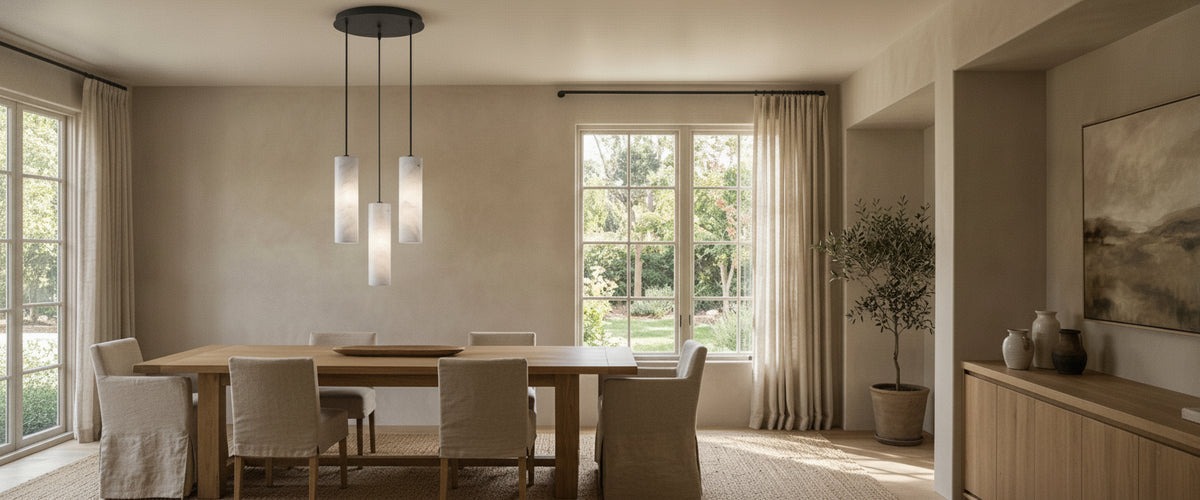

Fit a 2700K bulb from one brand beside a 2700K bulb from another. One will glow like candlelight. The other will look faintly like a chilled supermarket aisle. warm white lighting is sold as a single number on the packet, and that number tells you far less than it seems to. At Niori we design alabaster and natural-stone lighting, so we spend a lot of time on what happens to warm white light after it leaves the bulb: through a stone shade, onto a limewashed wall, down a dimmer curve, and across a room wired on three separate circuits.

At a Glance
- Kelvin is only a starting point. Two bulbs at 2700K can lean green or pink. Look for colour consistency of 3 SDCM or tighter.
- CRI decides whether warm reads as rich or as yellow. Aim for CRI 90 or above, with a strong R9 (red) value.
- Stone shades warm the light further. Alabaster and onyx tint what passes through them, so you may want a slightly cooler bulb than you expect.
- Standard LEDs do not warm as they dim. For dining rooms and bedrooms, consider dim-to-warm bulbs.
- Buy every bulb in a room from one product line, ideally one order.

Why 2700K from One Maker Looks Nothing Like 2700K from Another
The figure on the box is a correlated colour temperature. It names the point on the black-body curve, the colours an idealised heated object passes through as it gets hotter, that the bulb's light most closely resembles. Closely is the key word. An LED can sit slightly above that curve, which pushes it towards green, or slightly below it, which nudges it towards pink. Both get labelled 2700K.
Then there is binning. LED chips come off the production line with small variations, and manufacturers sort them into batches. How tightly they sort is expressed in MacAdam steps, written on better spec sheets as SDCM. At 3 steps or fewer, most people cannot see a difference between two bulbs. At 5 to 7 steps, you can, especially when the bulbs sit next to each other in a chandelier. If a warm white light bulbs does not state its SDCM at all, assume it is loose.
CRI and R9: Warm White Light Versus Light That Just Looks Yellow
Plenty of people tell us they dislike warm white light because it looks yellow. Usually what they dislike is low colour rendering. The Colour Rendering Index measures how faithfully a source shows colours compared with a reference light, and the headline figure (Ra) averages eight fairly muted test colours. It leaves out saturated red, which is reported separately as R9. The Lighting Research Center's explainer on colour rendering covers the method well.
A cheap warm LED often hits its 2700K target with a phosphor mix heavy in yellow and thin in red. Skin turns sallow, oak looks flat and tired, and the whole room takes on a slightly jaundiced cast. A high-CRI bulb at the same temperature carries enough red to make warm white light feel rich instead of tinted. Our rule of thumb: CRI 90 or higher, and an R9 value that is published and comfortably positive. If the manufacturer hides R9, there is usually a reason.
How Alabaster, Onyx and Glass Shades Shift Colour Temperature
In a well-shaded fixture, you never see the bulb's light directly. You see what the shade lets through. Opal glass is close to neutral; it softens the source without changing its colour much. Alabaster behaves differently. It is a fine-grained form of gypsum, translucent enough to glow, and its natural cream and honey tones filter the light on the way out. Onyx, with its banded calcite, goes further: amber bands warm the light noticeably, and paler zones let it through cleaner.
In the studio we keep one test pendant and swap shades around the same filament bulb. Through white alabaster, a 2700K bulb reads a touch warmer and much softer. Through honey onyx, the same bulb starts to look almost like firelight. That is lovely in a snug or a bar. In a kitchen it can look muddy. So with stone, we often suggest a 3000K bulb where you would otherwise choose 2700K, and we ask clients to judge the glow through the shade, not the bulb on the counter. If you are comparing pieces across the alabaster lighting collection, note whether the stone is pale and even or richly veined, because the veined pieces will warm the light more.
Timber, Plaster, Stone: Why Warm White Reads as a Different Hue on Every Surface
Most of the light in a room reaches you second-hand, bounced off walls, floors and furniture. Each surface keeps some wavelengths and returns others. Oak and walnut absorb a lot of blue and send back amber, so warm white light on a timber-panelled wall can tip into orange. Lime plaster and pinkish Venetian finishes are far more forgiving; they return a soft, slightly rosy warmth that flatters almost everyone.
Cool stone is the tricky one. Grey-veined marble, cool-toned limestone and blue-grey slate can look grubby or beige under low-CRI warm white, because the light has little blue to give back. Under a high-CRI 2700K or 3000K source, the same marble keeps its grey veining and simply looks warmer and calmer. Before you commit to a paint colour or worktop, check the sample at night under the bulb you actually plan to use. Daylight samples tell you very little about how a room will look at nine in the evening.
Dimming Warm White LEDs Without Colour Drift
An old incandescent bulb grows redder as it dims, dropping towards the colour of a candle. Our eyes expect that. A standard LED holds the same colour temperature all the way down, so at 10 percent output it looks grey and slightly ghostly instead of cosy. Cheaper drivers make it worse: at the bottom of the dimmer range some bulbs drift green, shimmer or flicker.
Two fixes help. First, dim-to-warm (sometimes called warm-dim) bulbs shift from around 2700K at full brightness towards 2000K or below as they dim, which mimics the old filament behaviour. They suit dining rooms, bedrooms and hospitality spaces where lights spend most of the evening low. Second, compatibility matters. Most LED bulbs perform best on a trailing-edge dimmer with a minimum load low enough for LED wattages, and good manufacturers publish a list of tested dimmers. For a pendant or table lamp that will spend its evenings turned down, a bulb built to dim, such as the B22 GLS Filament 12W Dimmable LED Bulb, Warm White, is a far safer starting point than a standard LED that was never designed for it; test one on your dimmer before fitting the whole room. Changing a dimmer switch is electrical work: use a qualified electrician, and give them the bulb's spec sheet before they choose the dimmer.
Here is how it catches people out. Picture a townhouse dining room with an alabaster chandelier fitted with dim-to-warm candle bulbs, while the ceiling downlights run fixed 2700K on a separate circuit. At full brightness it all matches. At dinner settings the chandelier goes to a deep amber and the downlights, unchanged, suddenly look blue-white beside it. Nothing is faulty. The two sources are simply following different rules.
Matching Warm White Light Across a Multi-Circuit Room
That dining room is typical. Most living and dining spaces now combine pendants, wall lights, lamps and recessed fittings, and the mismatches show at the seams: where a wall-light wash meets a downlight pool, or where a table lamp sits beneath a pendant.
- Pick one product line per colour behaviour. Mixing a filament bulb and a frosted SMD bulb at the same Kelvin rating almost always reveals a difference.
- Buy from one order. Bins vary between production runs. Order spares at the same time so replacements match.
- Make dimming behaviour consistent. If one circuit uses dim-to-warm, either do the same on the others or set evening scenes that switch the fixed-colour circuits off.
- Let the stone fixture be the warmest thing in the room. A 3000K reading lamp beside a warmly glowing alabaster pendant looks intentional. The reverse tends to look like a mistake.
- Consider tunable white for task zones. In kitchens and studies, a tunable system can sit cooler by day and warm up to match decorative pieces at night.
How to Choose a Warm White Light Bulb: A Buyer's Checklist
- Colour temperature: 2700K for living spaces and bedrooms; 3000K behind richly veined alabaster or onyx, or where you want a crisper warm.
- Consistency: SDCM of 3 or lower, printed on the spec sheet.
- Colour rendering: CRI 90 or above, with a published R9 value.
- Brightness in lumens, not watts: stone absorbs some output, so allow a little more than you would under a fabric shade. The Energy Saving Trust's lighting advice is a useful primer on lumens and LED efficiency.
- Dimming: confirm it is dimmable, check the dimmer compatibility list, and decide whether dim-to-warm suits the room.
- Cap and shape: E14 candle bulbs for chandelier arms and smaller wall lights, B22 or E27 GLS for most pendants and table lamps. A wide 200° beam angle helps a stone shade glow evenly without a hot spot, so on an alabaster chandelier a wide-beam candle such as the E14 Candle 6.5W 60W-eq 806lm 200° LED Bulb IDO, Warm White will spread light across the stone more evenly than a narrow, forward-facing bulb.
- Bulb style inside stone: an opal or frosted bulb reduces visible filament shadows through thinner alabaster, which is why an opal filament GLS like the B22 GLS 10W LED Filament Bulb Opal, Warm White sits more comfortably inside a stone pendant than a clear one; a clear filament bulb suits open fixtures where the bulb is part of the look.
- The night test: fit one bulb, switch it on after dark, dim it, and look at the shade, the wall and your own hand before buying the rest.
Get these right and warm white light stops being a gamble. The stone does what it should: it takes a good, consistent source and turns it into something softer and more generous than any bulb can manage on its own. If you are planning a whole room, it helps to look at pendants, wall lights and lamps together across the full lighting range, then specify bulbs once, for every fixture, from a single line.