
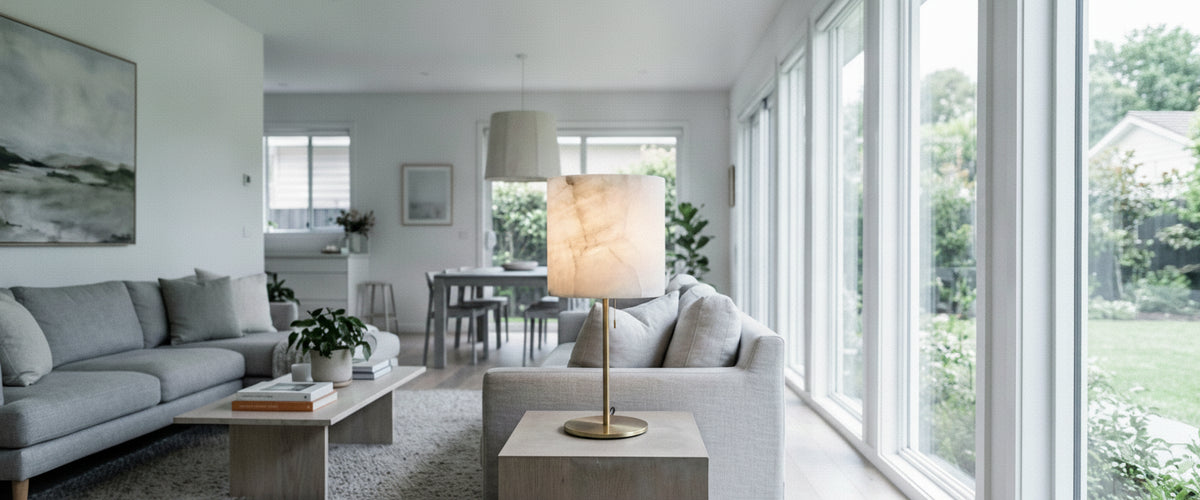

There is no socket under the dining table, and there never will be. That single fact explains most of the interest in the rechargeable table lamps, and it also explains why so many people buy the wrong one. Cordless lighting solves a wiring problem beautifully and then quietly introduces two new ones: how bright the lamp really is, and how long it stays that bright. Get those right and a cordless lamp becomes the most-used light in the house. Get them wrong and it lives in a drawer by February.

Key Takeaways Before You Buy
- Lumens matter more than watts. Around 100 to 200 lumens is plenty for pooled light on a table; anything claiming task-lamp brightness from a small battery will drain fast.
- Quoted runtime is almost always the dimmest setting. Ask for runtime at full output, not the headline figure.
- Look for regulated output. Better lamps hold brightness steady until the battery is nearly flat. Cheaper ones fade from about the halfway point.
- Weight is a feature. Without a flex to anchor it, a lamp needs a base heavy enough to survive a sleeve catching it.
- Confirm USB-C, charge time and whether the battery can be replaced. A sealed cell decides the lifespan of the whole piece.
- Warm, low-output LEDs suit translucent stone. Alabaster glows at brightness levels where thin glass looks grey and flat.

Where a Flex Is Genuinely Not an Option
Some positions in a home will never be wired, and pretending otherwise leads to trailing cables taped along skirting boards. The middle of a dining table is the obvious one. So is a kitchen island with a solid stone worktop, a windowsill in a bay, a console in a hallway with sockets only at the far end, a bathroom shelf, a bedside ledge in a guest room, and any outdoor table on a terrace or in a courtyard garden.
Period properties push the case further. We worked with a client in an Edinburgh flat in a listed Georgian building where chasing new circuits into the original plasterwork was not going to be approved, and the sitting room had exactly two usable sockets. Cordless rechargeable table lamps let them light the window recess and the drinks table without touching a wall. Hospitality clients reach the same conclusion for different reasons: restaurant tables get moved for private hire, and battery rechargeable table lamps move with them.
The other situation nobody plans for is the power cut. A charged lamp on a shelf is more civilised than a phone torch propped against a mug, and considerably better looking.
Battery Life and Lumens: The Two Numbers Suppliers Bury
Runtime is the figure most often quoted and least often qualified. A listing promising twenty hours is usually describing the lowest of three or four brightness settings, sometimes with a warm dim mode that produces little more than candlelight. At full output the same lamp might manage five or six hours. Neither number is dishonest on its own; the omission is what misleads.
Ask two questions before committing to any table lamp rechargeable battery design. First, what is the runtime at 100% brightness? Second, what is the battery capacity in milliamp-hours (mAh) or watt-hours (Wh)? Capacity plus LED wattage tells you more than any marketing claim. Hospitality buyers should note the Wh figure in particular, because it governs how batteries can be shipped and stored.
On lumens, resist the urge to over-specify. A rechargeable table lamp on a dinner table is doing atmospheric work, not reading work. Somewhere in the 100 to 200 lumen range gives you a defined pool of light without flattening the faces around the table. Pair that with a colour temperature between 2200K and 2700K and a colour rendering index of 90 or above, or skin tones and food both look tired. Anything cooler than 3000K on a dining surface reads clinical after dark.
Why Cordless Design Forces Better Decisions
Remove the flex and every other design decision has to work harder. There is no cable running to a wall to visually anchor the lamp, no plug to stop it sliding, and no excuse for a hollow base. The good cordless designs answer this with mass low down, usually in stone, marble or solid brass, so the centre of gravity sits below the widest point of the shade.
This is where natural stone has a real advantage over moulded plastic and thin metal. A carved alabaster or marble base gives a lamp the weight it needs to stay put on a linen tablecloth, typically several pounds rather than a few ounces. If you can lift the lamp with two fingers, it will tip. Around 1.5 to 3 kg (roughly 3 to 7 lb) feels stable on a dining table without being a nuisance to carry between rooms.
Shade scale changes too. A cordless lamp is short by necessity, so the shade needs to sit low and throw light downwards and outwards rather than up into the ceiling. The same scale logic applies across wired designs, and it is easier to judge by comparing two sizes of one form: a compact piece such as Global Globe Table Lamp, 20cm sits low enough to keep sightlines open across a dining table, while the 30cm version belongs on a console or sideboard where height is not competing with faces. Translucent stone behaves well here: the veining catches the LED and turns a modest output into something that looks generous. That is the quiet argument for alabaster in cordless design. At 150 lumens, opal glass can look weak; alabaster looks lit from within, because the light is scattering through crystalline gypsum rather than bouncing off a coating. The British Geological Survey describes gypsum alabaster as a fine-grained, soft and slightly translucent stone, which is exactly why it has been carved for lamps and window panes since antiquity.
Where a Rechargeable Table Lamp Earns Its Place, and Where It Disappoints
It earns its place on dining tables, bar tops, kitchen islands, bathroom shelves, garden tables, bedside ledges in rooms where the socket is behind the headboard, and anywhere you want light to move with the occasion. It also earns its place in rental flats and listed buildings where new wiring is off the table.
It disappoints as a reading lamp. Sustained output at the level you need beside an armchair drains a small cell quickly and shortens battery lifespan through frequent deep cycling. It disappoints as a permanent hall or console lamp, because you will forget to charge it, and it disappoints as the only light source in a large room. Cordless rechargeable table lamps are supplementary. Treat them as the last 20% of a scheme, sitting alongside mains-wired pendants, wall lights and floor lamps rather than replacing them. Where that wired layer needs a soft diffused glow beside a bed or on a hallway console rather than a hard downlight, a glass-bodied design such as Estro Globe Glass Table Lamp, 21cm is closer to the right design language. If you are building the wired layer first, the alabaster lighting collection is the sensible place to start, then add cordless pieces where a flex would look wrong.
The Dimming Drop After 50% Charge
Here is the performance detail most reviews skip. Lithium cells lose voltage as they discharge. In a lamp without a regulated driver, that voltage drop shows up directly as falling brightness, and the fade usually becomes visible somewhere past the halfway mark. Set the lamp at 60% brightness at 7pm and by 10pm it may be delivering closer to 40% while the indicator still shows charge remaining.
Better lamps use a constant-current driver that holds output flat until the battery is genuinely low, then steps down or warns you. Ask the supplier directly whether output is regulated. A second thing worth checking is how the dimmer behaves at the bottom of its range: cheap PWM dimming can flicker or shift colour towards green at low settings, which is unforgiving next to white stone. Run any lamp down to about a quarter charge during the return window and watch the dimmest setting for colour shift. It takes one evening and tells you everything.
USB-C, Charge Time and What UK Buyers Should Confirm
USB-C is now the sensible standard, and a lamp still shipping with micro-USB or a proprietary barrel connector is telling you something about its age. Confirm the following before you buy any cordless table lamps rechargeable enough to justify the premium:
- Connector type: USB-C, ideally with the port hidden under the base rather than on a visible flank.
- Charge time from empty: four to six hours is typical; anything much longer is awkward for daily use in hospitality.
- Can it run while charging? Useful for restaurants and for long parties.
- Plug supply: many lamps include a cable only, so check whether a UK three-pin USB adaptor is provided or needed.
- Safety marking: UKCA or CE marking, and a named battery cell type.
- Battery replaceability: a lamp with a serviceable cell can be kept for a decade; a sealed one becomes waste when the battery ages.
- Charging discipline: charge on a hard surface, not on soft furnishings or overnight in an unattended room. The London Fire Brigade publishes clear guidance on lithium battery charging that is worth reading once and applying to every rechargeable item in the house.
- Outdoor rating: if the lamp is going on a terrace, look for an IP44 rating or better, and bring it in before heavy rain regardless.
One more point specific to stone. A rechargeable table lamp cordless enough to live on a dining table will get splashed with wine, olive oil and candle wax. Natural stone is porous. Blot spills immediately, use a barely damp cloth and a soft brush for the carved detail, and skip glass cleaner, bleach and anything acidic. Ask whether the stone has been sealed and whether the maker recommends periodic resealing. Brass detailing will develop a patina; leave it or polish it, but keep polish off the stone.
How to Choose: A Short Decision Framework
- Define the position first. Dining table, bathroom shelf, garden table and bedside all want different heights and different IP ratings.
- Set your output target. Ambient pooling, 100 to 200 lumens. Anything above that needs mains power.
- Check runtime at full brightness and multiply by the number of evenings you expect between charges.
- Weigh it, literally. If a shop or supplier can give you the weight, use it as a proxy for build quality.
- Test the dimmer low and late in the charge cycle.
- Buy in pairs or fours for tables. A single cordless lamp on a long table looks stranded; two or three spaced along the run reads intentional.
Budget varies with material, scale, carving complexity, driver quality and battery engineering, so ask for a tailored quote rather than assuming cordless costs less than wired. Solid stone, a regulated driver and a serviceable cell cost more to make than a moulded shade over a generic battery pack, and the difference shows within a year of daily use.
Niori works in alabaster and natural stone across pendants, chandeliers, wall lights, table lamps and floor lamps, and the same principle governs all of them: light looks best when it passes through material with depth. If you are planning a whole scheme rather than a single lamp, start with the wired layer across the full lighting range and let the cordless pieces do the work that a flex cannot.