
 £1899Unit price Translation missing: en.products.product.price.unit_price_separatorUnavailable
1 Gang 2-Way Intelligent Dimmer 10-200W (5-150W LED) - Polished Brass Screwless
90 In Stock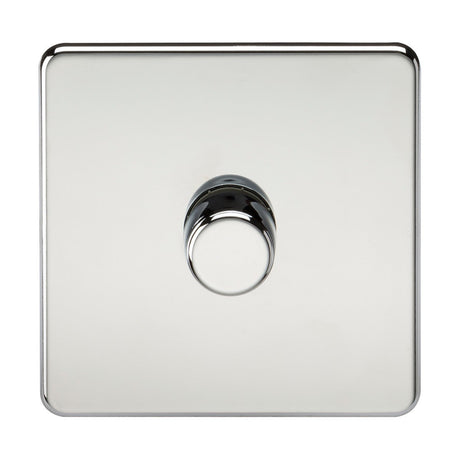 £1899Unit price Translation missing: en.products.product.price.unit_price_separatorUnavailable
1 Gang 2-Way Intelligent Dimmer 10-200W (5-150W LED) - Polished Chrome Screwless
120 In Stock £1899Unit price Translation missing: en.products.product.price.unit_price_separatorUnavailable
1 Gang 2-Way 10-200W (5-150W LED) Intelligent Dimmer - Matt White Screwless
180 In Stock £1899Unit price Translation missing: en.products.product.price.unit_price_separatorUnavailable
1 Gang 2-Way 10-200W (5-150W LED) Intelligent Dimmer - Brushed Chrome Screwless
150 In Stock £1799Unit price Translation missing: en.products.product.price.unit_price_separatorUnavailable
2-Way 10-150W Intelligent Dimmer Module - White (5-150W LED)
142 In Stock £1899Unit price Translation missing: en.products.product.price.unit_price_separatorUnavailable
2-Way 10-150W Intelligent Dimmer Module - Anthracite (5-150W LED)
57 In Stock


Why an LED lamp needs a different dimmer
A halogen lamp is a resistive load and behaves predictably as the voltage falls. An LED lamp is an electronic driver, it draws a fraction of the current, and it responds to being dimmed in whatever way its driver was designed to. That is the whole of the problem: a dimmer built for filament lamps often sits below its minimum load with LEDs on the circuit, and the symptoms are flicker, a buzz from the plate, lamps that will not strike at the bottom of the range, or a dimmer that runs hot. Replacing the dimmer rather than the lamps is usually the fix.
What intelligent means here
Almost everything in this range is described as intelligent, and that is a specific behaviour rather than marketing. The dimmer senses what it is driving and sets its own dimming method to suit, instead of asking you to pick one and hope. In practice that means one part number works across a mixed house, and it is why these are the safer choice when you do not know which driver is inside the lamps you already own.
Reading the load range
Every dimmer here carries two figures and both matter. The first is the range for ordinary lamps, the second the range for LED, and the LED figure is always the lower of the two because an LED circuit draws so much less. Add up the lamps on the circuit and check the total sits inside the LED range, not just under the top of it: falling below the minimum is what causes flicker at the dim end, and it is far commoner in a modern house than exceeding the maximum.
Two way dimming, and why only one end dims
Most of this range is two way, so a light can be controlled from two positions. What surprises people is that only one of the two positions is the dimmer. The other is an ordinary two way switch: it turns the light on and off at whatever level the dimmer was left at. Fitting dimmers at both ends of a two way pair does not give you two dimmers, it gives you an unreliable circuit.
One to four gangs
The range runs from single gang up to four, and the multi-gang plates are the reason a kitchen or an open-plan room can be controlled from one position. Worth knowing before you order: every gang has its own load range and they do not pool, so a four gang plate is four separate small dimmers rather than one big one. A heavily loaded circuit is better on its own single gang plate than crammed onto a four.
Plates, finishes and depth
Screwless, flat plate and curved edge profiles all appear across the finishes, so a dimmer can match the switches already on the wall rather than announcing itself. The practical constraint is depth: a dimmer is a bulkier mechanism than a switch and frequently needs a deeper back box than the plate it replaces. Check the box before ordering, because a dimmer forced into a shallow box runs hot, and heat is what shortens its life.
Frequently Asked Questions
Will any LED lamp work on these dimmers?
Will any LED lamp work on these dimmers?
My LEDs flicker at the bottom of the range. What is wrong?
My LEDs flicker at the bottom of the range. What is wrong?
Can I dim from two positions?
Can I dim from two positions?
Do the gangs on a multi-gang dimmer share their load?
Do the gangs on a multi-gang dimmer share their load?
Will a dimmer fit the back box my switch is in?
Will a dimmer fit the back box my switch is in?
Can I put a dimmer on my bathroom lighting?
Can I put a dimmer on my bathroom lighting?
Related Collections


BestSellers
-

 £49499Unit price Translation missing: en.products.product.price.unit_price_separatorUnavailable
Caelith 1 Light Medium Carved Alabaster Wall Light - Brushed Brass
 Free Delivery
 In our showroom
 -

 £63999Unit price Translation missing: en.products.product.price.unit_price_separatorUnavailable3 In StockFree Delivery
 -

 £11,87999Unit price Translation missing: en.products.product.price.unit_price_separatorUnavailableFree Delivery
 -

 £1,42999Unit price Translation missing: en.products.product.price.unit_price_separatorUnavailable
Seraphis LED Medium Alabaster Ring Chandelier - Brushed Brass
Free Delivery -

 £1,31999Unit price Translation missing: en.products.product.price.unit_price_separatorUnavailableFree Delivery
 -

 £80299Unit price Translation missing: en.products.product.price.unit_price_separatorUnavailableFree Delivery
 -

 £1,20999Unit price Translation missing: en.products.product.price.unit_price_separatorUnavailableFree Delivery
 -

 Save 25%£65199£87000Unit price Translation missing: en.products.product.price.unit_price_separatorUnavailableFree Delivery
 -

 £1,64999Unit price Translation missing: en.products.product.price.unit_price_separatorUnavailableFree Delivery
 -

 £2,96999Unit price Translation missing: en.products.product.price.unit_price_separatorUnavailableFree Delivery
 -

 £1,53999Unit price Translation missing: en.products.product.price.unit_price_separatorUnavailableFree Delivery
 -

 £2,30999Unit price Translation missing: en.products.product.price.unit_price_separatorUnavailable
Stratalux LED Stacked Alabaster Column Floor Lamp - Matt Black
Free Delivery


Recommended For You
Our Reviews
-

Birmingham Based
British heritage. Worldwide delivery.
