
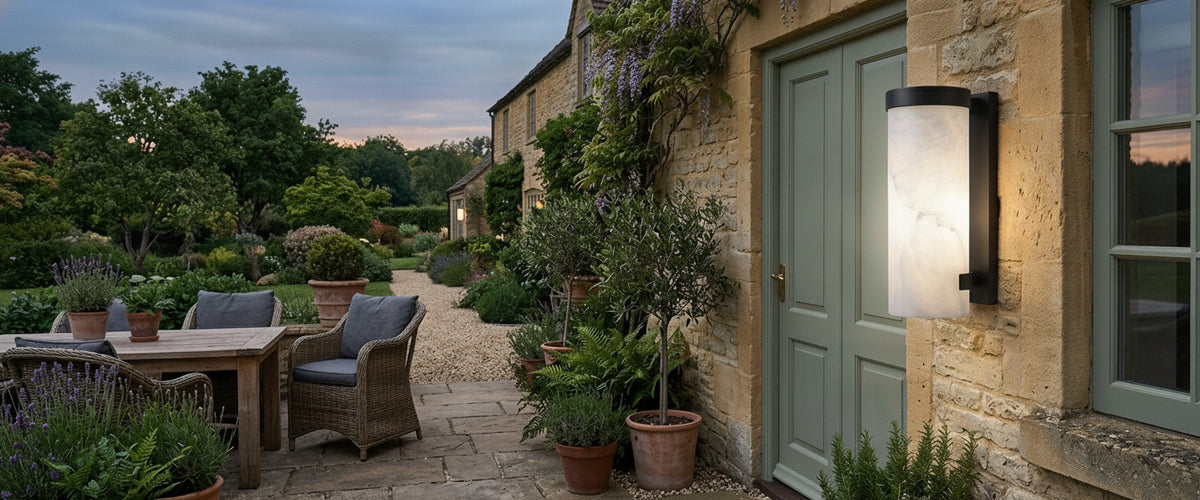

Most front doors are lit by a fixture that throws light onto the doormat and leaves the visitor's face in shadow. A globe outdoor wall lights fixes that with a simple shape. A sphere lights in every direction, so the step, the door, the house number and the person standing there all get their share. The same sphere can also go wrong. Choose the wrong size, glass or height and you get a glaring ball at eye level that the neighbours notice before they notice your door. At Niori we spend our days studying how alabaster and natural stone soften light, and the same thinking applies to the glass sphere by your entrance.
At a glance
- A globe gives all-round light, so choose glass that controls glare: opal, frosted or seeded rather than plain clear at eye level.
- Keep the back plate at roughly half to two-thirds of the globe's diameter for a balanced profile.
- Treat IP44 as the minimum for a sheltered porch. Choose IP65 for walls exposed to driving rain.
- Mount the centre of the globe at about 1.7 to 1.8 m (roughly 5 ft 6 in to 6 ft) above the step, then check the view from the gate.
- Pick the finish for the wall behind it, not for the fixture on its own.
- Use 2700K lamps and keep output modest. A sphere looks brighter than its lumen figure suggests.

How a Globe Outdoor Wall Light Lights an Entrance
A conventional up-down wall light sends two beams along the wall and leaves the space in front of it fairly dark. A globe does the reverse. It lights the space in front of the wall: the path, the step and anyone standing on it. That is why a globe outdoor wall light works so well at entrances. Faces read clearly on a doorbell camera, keys are easy to find, and the approach feels welcoming rather than floodlit.
That difference is also a useful way to divide up a facade. Where the job is to graze a stretch of brick or mark a side passage rather than light a face at the door, a narrow-beam fitting such as the Zevi EL 2GU10 Up Down Outdoor Wall Light in black is closer to the right design language. Many well-lit houses use both: the globe at the entrance, the paired beams further along the wall.
The downside is that the sphere itself becomes the brightest thing in view. With a narrow-beam fitting you see the light it casts. With a globe you see the source. Indoors, alabaster handles this by glowing as a whole surface instead of hiding a hot spot. Outdoors, the glass does that job, which is why the choice of glass matters more than almost anything else on this list.

Getting the Proportion Right: Globe to Wall Plate
Proportion is what separates a globe outdoor wall light that looks considered from one that looks bulbous. The ratio that matters is the diameter of the sphere against the width of the back plate and the length of the arm or gallery that holds it.
- Plate at half to two-thirds of the globe diameter: the fixture reads as a sphere supported by the wall, with visible but quiet hardware.
- Plate nearly as wide as the globe: the light looks squat and industrial, which can suit a warehouse conversion but rarely a period frontage.
- Tiny plate under a large globe: it looks top-heavy and slightly precarious, especially on a wide facade where the eye has room to judge it.
Scale against the door as well. Viewed from the pavement, the whole fixture should look roughly a quarter to a third of the door's height. On a standard door of about 2 m (6 ft 6 in), that usually points to a modest globe, not the largest one in the range. The most common mistake is a globe that looked right on a screen and looks like a beach ball on a terraced house.
Glass or Acrylic? How Each Holds Up in British Weather
An outdoor globe wall lights in the UK has to deal with horizontal rain, hard-water spotting, winter frost and, on coasts, salt. Each globe material handles that differently.
Mouth-Blown Glass
Mouth-blown glass has slightly uneven walls, which gives a softer, less mechanical glow, and it will not yellow in sunlight. Clear glass shows the lamp, so you need a decorative filament-style bulb or you are looking at a bare LED. It also shows water marks. Opal or acid-etched blown glass gets you the even, all-over glow closest to what alabaster does indoors.
Seeded Glass
Seeded glass contains small air bubbles that break up the bright point of the lamp into a scatter of highlights. It is a good compromise when you want clear glass character without full glare, and the texture hides rain spotting far better than plain clear glass. It suits brick cottages and traditional porches.
Opal Acrylic
Acrylic is lighter and shatter-resistant, which makes sense on low walls, beside play areas or anywhere a football might land. The trade-off is UV. Cheap acrylic on a south-facing wall can turn visibly cream after a few summers, while glass in the same spot still looks new. If you choose acrylic, ask whether it is UV-stabilised.
Whatever the material, check how the globe meets the fitting. A globe whose opening faces upward collects rainwater and insects. A downward or sealed neck with a proper gasket stays clean for much longer.
A note on stone: alabaster is a soft, slightly water-soluble form of gypsum, so it does not belong on an exposed exterior wall. Rain will dull and pit the surface over time. Where it shines is just inside the door. An alabaster wall light in the hallway, seen through a glazed door or fanlight, gives the facade a warm second layer of glow, and our alabaster lighting collection is the place to find wall lights and pendants for that position.
What IP Ratings Tell You (and What They Leave Out)
Every globe outdoor wall light should list an IP code. The code, defined in the IEC standard on ingress protection, has two digits. The first covers solids such as dust; the second covers water. IP44 means protection against splashing water from any direction, fine under a deep porch canopy. IP65 adds dust-tightness and resistance to water jets, which is what you want on an exposed gable or a wall facing the prevailing wind.
What the number does not tell you is just as useful:
- Longevity of seals. The test happens on a new fitting. Rubber gaskets harden over years of frost and sun.
- Corrosion. A light can pass IP65 and still pit within a few winters near the sea, particularly a powder-coated fitting on cheap steel. For coastal homes, ask about marine-grade stainless steel or solid brass.
- Condensation. Sealed globes can mist internally on cold mornings. Some quality fittings include a small breather to manage it.
- Impact. Resistance to knocks is a separate IK rating, worth checking at low height.
Height and Spacing for a Globe Outdoor Wall Light
It is tempting to mount the light wherever the cable already comes out of the wall. That is rarely the right place. As a starting point, put the centre of the globe at about 1.7 to 1.8 m (roughly 5 ft 6 in to 6 ft) above the step, within the top third of the door. That puts the sphere close to eye level, which is exactly why diffusing glass matters. Much lower and the light pools on the doormat; much higher and it falls on the tops of heads.
For a pair either side of the door, set each fitting 10 to 15 cm (4 to 6 in) clear of the frame so the globes do not crowd the architrave, and mirror them exactly. A single globe outdoor wall light usually belongs on the lock side of the door, where you need light for keys.
Then walk to the gate or the pavement and look back. That sightline is how the house is actually seen. Check that the globes sit level with each other and with window heads or brick courses, and that they do not shine into a neighbour's bedroom. The Institution of Lighting Professionals publishes guidance on obtrusive light that is worth a read if you live on a close-packed street.
Black, Brass or Nickel: Matching Finish to Brick, Render and Timber
The finish on a globe outdoor wall light can look smart in the box, then disappear or clash once it is on the wall.
- Black reads crisp on red brick, white render and pale stone. Against dark-stained timber or charcoal cladding it vanishes, and only the globe remains, which can look like it is floating.
- Brass warms up white or cream render and Cotswold or Bath stone. Unlacquered brass will weather to a soft brown patina; decide in advance whether you want that or a lacquered finish that stays bright. On orange-red brick, polished brass can look busy.
- Nickel suits grey render, slate, cool painted timber and contemporary glazing. On honey-coloured stone it can look cold.
The same logic applies to any secondary wall lights along the side return or garage, and it helps to keep them quieter than the globe at the door. On white render, a white fitting such as the Biso 8W LED Up Down Outdoor Wall Light recedes into the wall so the entrance stays the focal point. On grey render or slate, a softer dark tone like the Garto 8W Up Down Outdoor Wall Light in anthracite sits more naturally than hard black.
Bulbs, Colour Temperature and Dimming
Because the whole sphere glows, an outdoor globe wall light needs less output than a downlight. Around 200 to 400 lumens is plenty at most front doors. Choose 2700K for a warm, domestic feel; cooler light makes brick look flat and render look clinical. A dusk-to-dawn sensor or a dimmable circuit lets you run the globe softly through the evening. Check that the lamp and any sensor or dimmer are compatible, or you will get flicker.
All exterior lighting must be installed by a qualified electrician. In England and Wales, new outdoor circuits fall under Part P of the Building Regulations, and the work should be certified.
Buyer Checklist Before You Order
- Measure the door height and check the globe's scale from the pavement, not up close.
- Confirm the back plate sits at roughly half to two-thirds of the globe diameter.
- Choose opal, frosted or seeded glass if the globe will sit near eye level.
- Match the IP rating to exposure: IP44 under cover, IP65 on open walls.
- Ask about corrosion resistance if you are within a few miles of the coast.
- Check the globe opening faces down or is sealed with a gasket.
- Pick the finish against your actual wall material.
- Plan a 2700K lamp, modest output and a compatible sensor or dimmer.
- Book a qualified electrician and agree on the mounting height before they chase any cable.
A well-chosen outdoor wall globe light frames the door; a poorly chosen one competes with it. If you are planning the entrance as a whole, think about the light just inside as well. A warm alabaster glow in the hall, seen through the glass, makes the exterior lighting look far more deliberate. The wider niori lighting range is a good place to plan both sides of the threshold together.