

Most of what is sold as industrial lighting has never been near a factory, and you can usually tell from across the room. Good vintage industrial wall lights look as if they were built to do a job: a cast body, a sensible guard, a fixing plate made for a brick wall. Weak ones are a matt-black stamping with a bare bulb screwed into the front. They look tired within a year, and the glare from that bulb makes the whole wall look tired too. What follows is how to tell the two apart, and how to choose, position and specify a fitting that still looks right in ten years.

At a Glance
- Material decides lifespan. Cast iron and properly coated steel age well. Thin enamel over pressed steel chips, then rusts at the chip.
- Bare filaments suit high or peripheral positions. At eye level, choose a diffusing shade or a guard with a frosted lens.
- Check projection before you buy. Anything over about 25 cm (10 inches) needs a wide corridor or a wall nobody walks past closely.
- Outdoors needs an IP rating, not just a dark finish. IP44 is a sensible minimum on a sheltered wall. Exposed walls deserve IP54 or higher.
- Always use a qualified electrician, particularly for any outdoor circuit.

What Separates Real Vintage Industrial Wall Lights From Reproductions
Original antique industrial wall lights were made for mills, ships, railway yards and workshops. They were heavy because they had to survive being knocked. The shapes followed function: a cage protected the glass, a deep backplate kept water out of the cable entry, and a reflector pushed light down onto a workbench. A design influenced by that history keeps the logic even when the scale shrinks for a home.
A surface-level reproduction keeps only the costume. Three quick tests help. First, weight: lift it, and if a supposedly cast fitting feels like a biscuit tin, it has been pressed. Second, look at the joints, which should be threaded, bolted or welded, and never just crimped. Third, check the fixings. A proper industrial fitting has a backplate thick enough to hide a junction box and a cable gland, not a flimsy cup that leaves the plaster cut showing.
Patina is the other giveaway. Applied distressing tends to repeat, with identical scuffs in identical places on every unit. Genuine wear, or a well-made aged finish, varies from piece to piece. On a run of six vintage industrial wall lights in a hallway, that variation is a large part of the appeal.
Cast Iron, Aged Steel and Enamel: How Each Weathers Indoors and Out
Cast Iron
Cast iron is the honest choice for an industrial bulkhead wall light that will live outside. It is dense and stable, and when the paint fails it rusts slowly rather than flaking through. Historic England's technical advice on historic building materials shows how long well-maintained ironwork lasts on British buildings. The trade-off is weight, so the wall has to be solid masonry or properly reinforced.
Aged Steel
Indoors, a dark-waxed or lacquered steel finish deepens gently over the years. Outdoors, the finish is only as good as its coating. Ask whether the steel has been galvanised or powder-coated under the aged effect. If the answer is vague, assume it has not, and keep the fitting under cover.
Enamel
Vitreous enamel, the glossy white or green you see on old factory shades, is very hard but brittle. Inside, it can last a lifetime. Outside, one chip from a ladder or a hedge trimmer lets water reach the steel beneath. We shipped a pair of enamelled shades to a client on the north Cornish coast, and within two winters the only rust was at a chip a window cleaner had made. Enamel near salt air needs touching up the moment it is damaged.
Bulb Exposure and Shade Type: When the Filament Is the Feature
An exposed squirrel-cage filament is the signature look of most vintage industrial wall lights, and it works in the right place. High on a double-height wall, above a bar back, or flanking a door that people walk through rather than stand in front of, a low-output amber filament reads as decoration. Choose a warm 2200K to 2400K LED filament lamp and make sure it is dimmable, because these bulbs look best turned down.
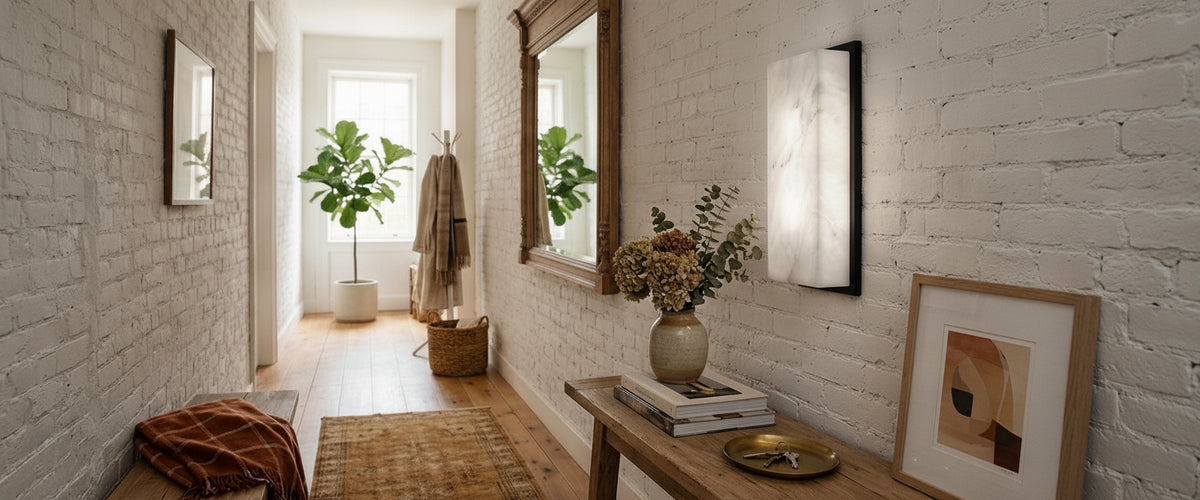
The problem starts at eye level. A clear bulb beside a sofa or a bed is a point of glare, and no styling fixes that. This is where we often depart from strict industrial purism. A slab or bowl of alabaster in place of clear glass keeps the iron or brass arm, the bolts and the backplate, but turns the bulb into an even, honey-toned glow. In the studio we regularly pair heavy dark metal with stone diffusers, and the contrast between the rough frame and the softly lit stone tends to read as more considered than a bare bulb. The alabaster lighting collection takes that approach further, from wall lights to pendants.
If you prefer a cage or a bulkhead guard, a frosted or prismatic inner lens does a similar job at lower cost to the eye. Opal glass diffuses evenly, while ribbed glass throws a more decorative pattern on the wall.
Wall Plate Depth and Projection: The Throw Decision Most Buyers Miss
Projection is how far the fitting sticks out from the wall, and it is the measurement most often skipped when ordering vintage industrial wall lights. Swan-neck and gooseneck arms can reach 30 cm (12 inches) or more. In a converted warehouse flat in Leeds, a client fitted four of these along a corridor about a metre (3 feet 3 inches) wide, and the first visitor walked straight into one. They were moved to the stairwell, where the same fittings now look deliberate.
As a working rule, keep projection under about 15 cm (6 inches) in passageways and use deeper arms only where there is clear space in front of the wall. Projection also changes the light. A long arm throws light down and away, which is useful for washing a painting or lighting a front step. A flat bulkhead sends light sideways along the wall and grazes brick texture, which is often exactly what an industrial interior needs. Where you want that grazing effect in two directions, an up-and-down design such as the Rond Up & Down Wall Light, Black washes the brick above and below the fitting without the reach of a swan-neck arm.
Check backplate depth too. A slim plate may not cover an existing box or conduit, and on old brickwork an electrician may need a deeper pattress. Ask about this before you order rather than on installation day.
IP Ratings and the Industrial Outside Wall Light
The IP code (Ingress Protection) has two digits. The first covers solids and the second covers water. IP44 resists splashing from any direction, and suits a sheltered porch or covered terrace. IP54 adds better dust protection and is a sensible choice for an exposed rear wall. IP65 is jet-resistant and worth specifying near a hosed-down courtyard or a coastal façade.
Converting an indoor design into an industrial outside wall light changes more than the label. A true outdoor version has gaskets around the glass and the backplate, a sealed cable gland, stainless or coated fixings that will not streak rust down render, and usually a sealed lamp holder. For an exposed rear wall, a plain sealed fitting such as the Duli 5W Square LED Bulkhead Wall Light IP54, Anthracite is closer to the right brief than a converted indoor lantern, while on a sheltered porch an IP44 bulkhead like the Milo 7040T/P E27 IP44 Bulkhead Wall Light, Grey keeps the familiar E27 lamp format. Both are typical of the genre: plain, sealed and built to sit on a wall for years with little attention.
Natural stone needs care here. Alabaster is soft and slightly porous, so we recommend it for covered or interior positions only, never for direct rain. For exposed walls, use metal and glass, and save stone for inside the door. Outdoor circuits in England and Wales fall under building regulations, and Approved Document P sets out when notifiable work applies. Use a qualified, registered electrician.
Where Vintage Industrial Wall Lights Earn Their Place, and Where They Argue With the Architecture
Kitchens with brick, concrete or timber. A pair of articulated arms above open shelving gives both task light and character.
Hallways and stairwells. Low-projection bulkheads in a repeated run give rhythm, and the variation in a good aged finish keeps them from looking mass-produced.
Bathrooms. Caged bulkheads with the correct IP rating for their zone suit Victorian tiles particularly well.
Bars, cafés and hotel corridors. These are the hospitality spaces where exposed filaments belong, mounted high and dimmed low.
The look argues with the room in a Georgian drawing room with fine cornicing, where heavy iron fights the proportions, and in a minimal new-build with flat white walls and no texture for the light to catch. In bedrooms, bare bulbs at pillow height are rarely a good idea. If you want industrial bones in those rooms, soften them with a stone or opal diffuser, or move to a calmer fitting from the wider lighting range.
Buyer's Checklist
- Confirm the material and how it has been coated, especially for outdoor use.
- Measure projection against the clear width of the space.
- Check that backplate depth covers the existing box or conduit.
- Match the IP rating to exposure: IP44 for sheltered spots, IP54 or higher for open walls.
- Decide whether the bulb will be seen at eye level, and choose a shade or diffuser to suit.
- Specify warm, dimmable LED lamps and a compatible dimmer.
- Confirm the wall can carry the weight, particularly for cast iron.
- Book a qualified electrician before delivery, not after.
Budget for vintage industrial wall lights depends on material, scale, finishing and installation complexity. For anything bespoke, such as a stone diffuser on a custom arm, ask Niori for a tailored quote rather than guessing.