
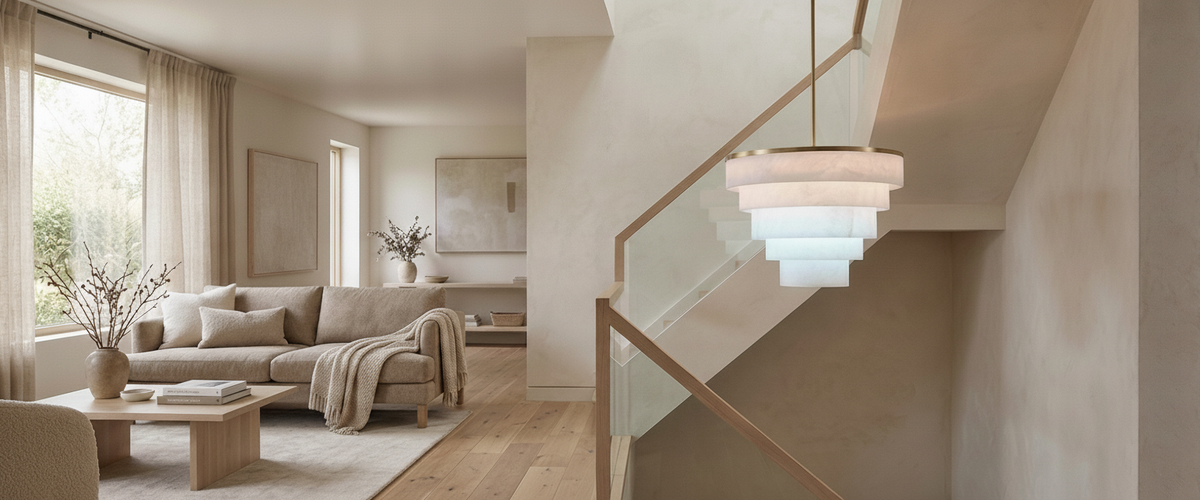

Most traditional chandeliers go wrong for one of two reasons: they hang too low, or they are one size too small for the room they are supposed to anchor. Everything else, the arm count, the finish, the crystal or stone, is a matter of taste. Scale and height are matters of fact. Get those right and even a fairly ornate fixture reads calm and deliberate in a contemporary home; get them wrong and the most beautiful piece in the catalog looks like an afterthought bolted to the ceiling. Scale first, then style: that order is what makes traditional chandeliers work in a modern room.

Quick Answer: What to Get Right Before You Buy
- Diameter: add the room's length and width in feet; that total in inches is a solid starting diameter. A 14 x 16 ft room suggests roughly a 30 in (76 cm) fixture.
- Over a dining table: aim for about half to two thirds the table width, and hang the lowest point 30 to 36 in (76 to 91 cm) above the tabletop.
- In a hallway or open room: keep at least 7 ft (2.1 m) of clearance under the fixture.
- Light quality: 2400K to 2700K bulbs, fully dimmable, with the driver or dimmer matched to the lamps.
- Material matters more than arm count: alabaster, marble, and onyx diffuse light through the stone itself; crystal and clear glass bounce it around the room.
- Weight and fixing: confirm the ceiling box and bracing with a qualified electrician before anything is ordered.

What Traditional Chandeliers Suit and Who They Are For
Traditional chandeliers earn their keep in rooms with a defined center: a dining table, a stair void, a formal entry, a principal bedroom with a bed that sits square to the wall. The form descends from candle-lit fixtures where the arms existed to hold flame at a safe distance from each other, which is why the silhouette still reads as ceremonial. Museum collections of European decorative arts, including the holdings at The Metropolitan Museum of Art, show how consistent that arm-and-branch language has been across three centuries of rock crystal, gilt bronze, and cut glass.
Buyers of traditional chandeliers are rarely furnishing a period house top to bottom. More often it is a homeowner or designer working in a transitional interior: flat-front cabinetry, plaster walls, a linen sofa, and one piece overhead that supplies the ornament the rest of the room deliberately withholds. We ship a lot of these into Texas and California new builds where the architecture is clean-lined and the client wants warmth without adding pattern. A single fixture with real presence does that job better than a room full of decorative objects.
Venue owners think differently again. Restaurants and boutique hotels want fixtures that photograph well, sit above sightlines, and can be dimmed low enough for dinner service without the light going gray. Traditional chandeliers with stone or opal diffusers hold their color at low output far better than bare candle lamps, which is worth knowing before you commit a whole dining room to one look.
Sizing, Height, and Placement for Traditional Chandeliers
The diameter rule above is a starting point, not a verdict. Adjust it in two situations. If the ceiling is above 10 ft (3 m), go up a size; height eats visual weight. If the chandelier sits over a table rather than in open floor space, ignore the room formula and size to the table instead, because the table is the thing the eye compares it against.
Arm count follows the same logic, and most traditional chandeliers are sold by it. In a breakfast area, a modest dining room, or a bedroom where the formula lands under about 24 in, a three-arm frame such as the Kristy 3 Light Chandelier in distressed gold holds the center of the room without crowding it, whereas the same silhouette in five or more lights is what a formal dining room or a wide entry needs to register at all.
Hanging height is where the most expensive mistakes happen. Over a dining table, 30 to 36 in (76 to 91 cm) of clearance from the tabletop to the lowest point of the fixture is the working range. Lower and guests across the table lose eye contact; higher and the pool of light spreads too thin. For every additional foot of ceiling above 8 ft, add roughly 3 in of chain or rod. In stairwells and double-height entries, traditional chandeliers should sit so the lowest point is level with, or slightly above, the second-floor landing rail, with nothing intruding into the stair path.
Placement details people forget: center the chandelier on the table, not the room, if the two do not align. Check the swing of the ceiling fan or door before you finalize the drop. And in bedrooms, resist hanging directly over the bed unless the fixing has been engineered for it and the clearance is generous. A pair of stone wall lights flanking the bed with a smaller ceiling fixture centered in the room usually reads better anyway.
Materials, Finishes, and Light Quality
Crystal and cut glass throw light. Stone holds it. That single difference should drive your choice of traditional chandeliers more than any style label.
Alabaster, a fine-grained gypsum stone, is translucent enough to glow from within when lit, and its natural veining shows as soft cloud and shadow rather than sparkle. The material has been carved for lighting and sculpture since antiquity, and conservation notes from institutions such as the Victoria and Albert Museum explain why it was so favored by carvers: it is soft, workable, and takes fine detail. Marble is denser and reads more solid, often used for the body or base with glass or alabaster carrying the light. Onyx brings stronger banding and amber tones, which can be beautiful over a dining table and overwhelming in a small hallway.
Metal finish sets the temperature of the whole piece. Aged and antique brass sits warmly against alabaster and suits walnut, oak, and unlacquered hardware elsewhere in the room; on a wide frame with many arms, as on the Marvele 10 Light Chandelier in aged brass, that softer metal keeps the piece from turning brassy and hard under dimmed light. Distressed gold leans decorative and works well in traditional dining rooms and bedrooms. Blackened or bronze frames pull traditional chandeliers toward something more restrained, which is the usual choice for open-plan spaces where the fixture has to coexist with modern joinery; where a room needs the shape without the shine, something like the Brianna 9 Light Chandelier in black is closer to the right design language. Our alabaster lighting collection is a useful place to compare how the same warm stone behaves against brass, bronze, and paler metals.
Bulbs and Dimming
Specify 2400K to 2700K. Anything cooler makes alabaster look chalky and makes brass look gray. Choose lamps with a high color rendering index (CRI 90 or above) so wood, textiles, and skin tones stay true. Candle-style LED lamps with a visible filament suit exposed-socket traditional chandeliers; frosted lamps are better where the stone shade does the diffusing.
Dimming is not optional on a fixture of this kind. Match the dimmer to the lamps or driver, and buy all the lamps from the same batch so they dim in step. Warm-dim LEDs, which drop in color temperature as they lower, mimic candlelight convincingly and are worth the premium in dining rooms. Any hardwired installation should be signed off by a qualified electrician, including confirmation that the ceiling box is rated for the fixture's weight and supported by adequate bracing.
Common Mistakes and How to Avoid Them
- Buying small to be safe. Undersized traditional chandeliers are the most common error in the category by a wide margin. If you are torn between two sizes in a room over 12 ft wide, take the larger.
- Ignoring the chain and canopy. Chain, rod, and cable are part of the composition on a high ceiling. Check that the supplied drop covers your height before ordering, and that the canopy finish matches the frame.
- Mixing five metal finishes. Two is a scheme. Five is an accident. Let the chandelier's metal echo one other element in the room, whether that is cabinet hardware, a faucet, or a mirror frame.
- Forgetting maintenance access. If the fixture sits over a stairwell or above a fixed table, plan how lamps will be changed. We had a Hamptons client discover, after installation, that changing a lamp meant hiring a scaffold tower. A winch or a slightly lower drop would have solved it at design stage.
- Cleaning stone like glass. Alabaster is soft and reacts badly to water and acidic or ammonia-based cleaners. Dust dry.
- Skipping the mock-up. Tape a paper circle of the proposed diameter to the ceiling and hang a weighted string to the intended lowest point. Ten minutes of cardboard prevents a return.
Installation and Care Checklist
- Confirm fixture weight against the ceiling structure and box rating with your electrician before ordering.
- Check the total drop available, including chain, rod, cable, and canopy.
- Dry-fit the mock-up and view it from the seated position, not standing.
- Install the dimming circuit and test with the actual lamps before the fixture is finally dressed.
- Handle stone components with clean, dry hands or soft cotton gloves; oils mark porous surfaces.
- Dust with a soft dry brush or microfiber every few weeks; never spray liquid onto alabaster or onyx.
- Wipe brass with a dry cloth only, unless the finish is lacquered and the maker states otherwise.
- Check suspension hardware and electrical terminations once a year, or after any building work that shakes the ceiling.
How Niori Can Help With Lighting Projects
Niori works in alabaster and natural stone across pendants, chandeliers, wall lights, table lamps, and floor lamps, and ships worldwide. Traditional chandeliers sit inside a wider scheme, so the questions we get most often are about coordination: how a stone chandelier over the dining table relates to the wall lights in the hall, whether a marble table lamp will read too heavy on a slim console, how many lumens a double-height entry actually needs. Browsing the full lighting range alongside the chandeliers usually answers those faster than looking at one fixture in isolation.
For project work, send through a plan or elevation with ceiling heights, table dimensions, and any structural constraints, and we will advise on scale, drop, and lamp specification. Budget depends on material, scale, complexity of the frame, engineering for the fixing, installation, and finishing, so we quote traditional chandeliers per project rather than publishing a single figure. If you are early in a build and want to compare directions, the Niori homepage is the quickest overview of how the stone reads across different fixture types.