
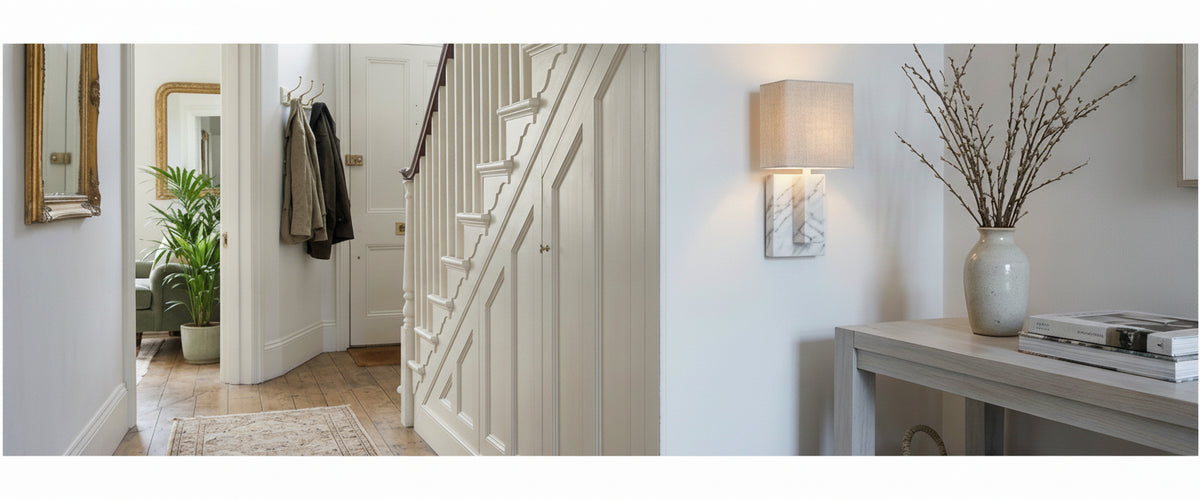

Most people buy a rechargeable marble wall lights because they cannot face chasing a cable through a freshly plastered wall. That is a sound reason, but it is only half the decision. Natural stone changes character as the light behind it dims, and battery-powered fittings are often run at lower output to stretch the charge, or step down as the cell empties. Know how the marble responds before you choose one and it will look considered at 11pm as well as at 7pm.
At a glance
- A rechargeable fitting removes the need for new wiring, which matters most in listed, rented and freshly decorated rooms.
- Thinner, more lightly veined marble glows more evenly. Dense veining looks striking at full output and goes darker as output drops.
- Look for a warm colour temperature (around 2700K) and dimming that holds its warmth at low output.
- White marble gives the softest glow, light grey reads cooler, and green marble works best as a surface accent, not a light source.
- Lithium-ion batteries last longer if you avoid full drains and keep them away from heat.

The Wiring Problem That Made Rechargeable Stone Lights Practical
Wall lights have always been the awkward member of the lighting family. A pendant can usually reuse an existing ceiling rose, and a table lamp plugs into a socket. A wired sconce needs a cable run to a precise point on the wall, which means cutting into plaster, making good and redecorating. In a period property it can mean far more. If the building is listed, altering historic fabric may need consent, and Historic England's guidance on listed building consent is worth reading before anyone picks up a chisel.
Picture a typical case: a Georgian hallway with original panelling, a conservation officer who is understandably protective, and a homeowner who wants soft stone light at eye level on the stairs. A rechargeable marble wall light is often the only route that touches nothing but a couple of fixing points. Stone suits the job because it carries its own visual weight. A cordless plastic sconce looks like a temporary fix. A slab of marble looks like it was always meant to be there.

How Marble Thickness and Vein Density Shape the Glow
Marble is far less translucent than alabaster. Alabaster is a soft, fine-grained stone that lets light pass with an almost milky softness. Marble is crystalline calcite or dolomite, denser and more resistant to light. To glow at all, marble has to be cut thin, and in a rechargeable marble wall light the thickness decides almost everything about the result.
Thin stone lets more light through and shows a gentle, even halo. Thicker stone gives a more muted, less even glow, which some people love and others find heavy. Veining complicates the picture. Dense veins block light unevenly, so at full output you get a dramatic map of the stone's geology. At lower output, the darker veins swallow what little light passes through and the panel can read patchy.
When we review samples in the studio, we look at each piece twice: once at full brightness, once dimmed right down. The panels that photograph best at full output are not always the ones that live best on a wall. If you want consistency through the evening, choose lighter veining. If you want drama for a dinner party and accept a quieter glow later, bolder veining earns its place.
Battery Runtime Reality: What Low Output Does to Warm Stone
Every rechargeable marble wall light trades brightness against runtime. Run it at full output and you get a shorter evening; dim it and the battery stretches. That trade has a visual cost specific to stone.
As output drops, less light passes through the marble and more of what you see is light reflecting off its face from the room around it. The stone stops behaving like a lantern and starts behaving like a surface. In a room lit by warm lamps, that is fine. In a room lit by cool overhead downlights, a dimmed marble panel can turn grey and flat surprisingly quickly.
Two specifications help. First, a warm colour temperature, ideally around 2700K, because warm light flatters the creams and honey tones in most marbles. Second, a good colour rendering figure (CRI 90 or above is a sensible target), which keeps the stone's natural colour honest even at low levels. Ask, too, whether the fitting dims in steps or smoothly, and whether it holds its colour temperature when dimmed. Some cheaper LED modules drift in colour at low output, and marble shows that drift more than glass does.
Where a Rechargeable Marble Wall Light Beats a Wired Sconce
There are rooms where a wired fitting is still the better choice, and we would say so. A main living room wall light used for four hours every night is a good candidate for proper wiring, installed by a qualified electrician. On a long wall where the light needs real presence, a wired linear fitting such as the Albatre Alabaster LED Wall Light 800mm, Brass delivers the scale and steady, even glow that a battery module would struggle to sustain night after night. But there are placements where a rechargeable marble wall light does something a wired sconce simply cannot.
- Listed and period interiors. Panelling, lime plaster and decorative cornicing stay untouched.
- Rented homes. Two screw holes are easier to make good than a chased channel, and the light leaves with you.
- Beside a bed that might move. Rearrange the room and the reading light follows the headboard.
- Alcoves, bookcases and stair landings. Points where a cable run would be long, disruptive or simply impossible.
- Restaurants, bars and event spaces. Table-side walls and banquettes where operators want stone warmth without rewiring a leased unit.
For covered outdoor spaces such as a loggia or a sheltered terrace, check the ingress protection rating carefully and remember that marble is porous. Rain, frost and acidic run-off all affect polished stone over time. Where the wall is genuinely exposed rather than sheltered, a sealed, purpose-built fitting such as the Garto 8W Up Down Outdoor Wall Light, Anthracite is the more sensible choice, leaving marble for the protected corners where it can age gracefully. In bathrooms, only use a fitting rated for the relevant zone, and ask an electrician if you are unsure. If you are weighing marble against softer, more translucent stone for an interior wall, browse our alabaster lighting collection to compare how each material carries light.
Light Grey, White and Green Marble Compared
Colour decides how a rechargeable marble wall light reads once it is switched on and fixed to the wall. Here is how each tends to behave.
White Marble
The most forgiving choice. White marble transmits the most light of the three and shifts towards a soft ivory under warm LEDs. It suits bedrooms, hallways and anywhere you want the light to feel calm. Its weakness is that it can look plain when switched off, so choose a piece with some movement in the veining.
Light Grey Marble
Grey stone reads cooler and more architectural. Lit, it gives a pewter-toned glow that sits well against limewash, charcoal walls and blackened metal. Pair it with warmer light than you think you need, because grey marble under neutral white can look institutional.
Green Marble
Deep green marbles are among the least translucent stones used in lighting. Treat them as a jewel-like surface framing a light source (a shade, a backplate or a canopy) instead of a panel you expect to glow through. Against brass detailing in a dining room or library, the effect is rich and very grown-up. If you want green that glows, onyx is usually the better material.
How to Choose: A Buyer's Checklist
- Decide on the job first. Accent glow, reading light or wayfinding on a stair. Reading light needs more output, which means shorter runtime.
- Check the stone thickness and ask for a lit photograph, ideally at both full and low brightness.
- Confirm colour temperature and CRI. Warm and high-rendering is the baseline for natural stone.
- Ask about charging. Is it a detachable battery, a USB-C cable to the fitting, or a magnetic dock? A detachable unit means the stone never comes off the wall.
- Ask whether the battery is replaceable. The marble will outlast any cell by decades.
- Check the weight against your wall. Stone is heavy; plasterboard needs the right fixings and, in some cases, a timber noggin behind it.
- Budget realistically. Cost depends on the stone, its scale, the engineering of the battery module, finishing and installation. Request a tailored quote for project quantities.
If you are planning a whole scheme and want rechargeable wall lights to work alongside wired pendants and table lamps, the wider niori lighting range is the place to match finishes and colour temperatures across the room.
Charging Cycles, Battery Ageing and Habits Worth Building Early
Lithium-ion cells lose capacity gradually with each charge cycle and with age. You will not notice it in the first months, but a rechargeable marble wall light that gave you a full evening when new may give you noticeably less a few years on. A few habits slow that decline considerably.
- Avoid running it flat. Recharge when it drops to roughly a fifth of capacity, not when it dies.
- Do not leave it on charge for days. Unplug once full.
- Charge away from heat. Not on a radiator shelf, not in direct sun, not under bedding.
- Use the supplied or a correctly rated charger. The London Fire Brigade's lithium battery advice is clear and sensible on this.
- Dust the marble with a soft dry cloth. Avoid acidic cleaners, vinegar and citrus sprays, which etch calcite.
- Keep the charging port clean and dry, especially in kitchens and covered outdoor spaces.
One habit we recommend to every client: charge on a weekly rhythm, the same evening each week. It stops the light dying mid-dinner, and it keeps the battery in a comfortable middle band most of the time.
A well-chosen rechargeable marble wall light puts stone warmth exactly where a cable could never go. Choose the right thickness and colour, treat the battery kindly, and the fitting will feel as permanent as the wall it hangs on. You can explore more of Niori's natural-stone pieces from the homepage.