
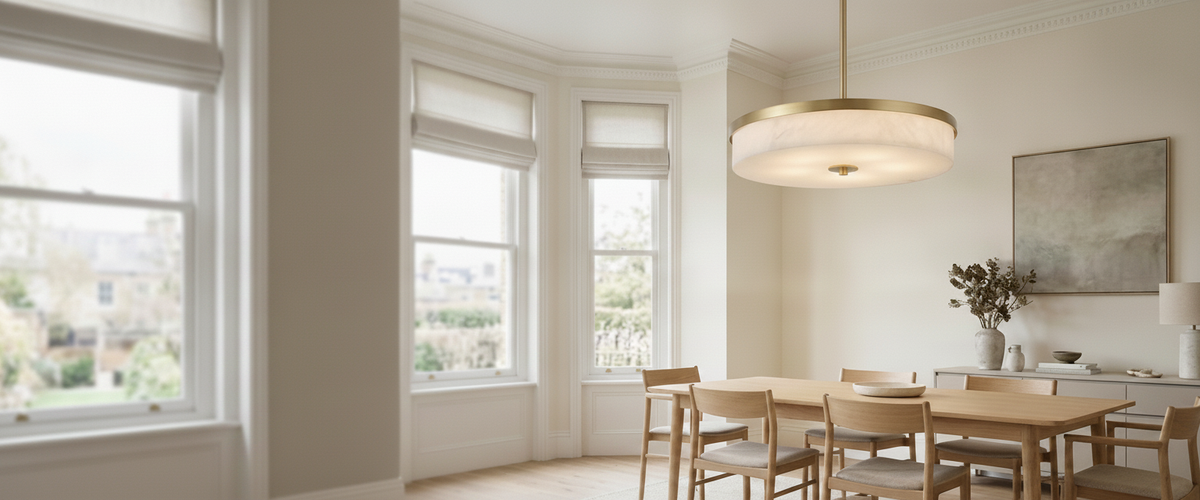

Most rooms that stall in the design phase have the same problem overhead: a Victorian cornice that wants ornament and a client who wants nothing fussy. The alabaster transitional ceiling lights are the answer that keeps both sides honest. This kind of fitting carries enough weight and material presence to sit under moulded plaster without looking apologetic, yet its lines stay quiet enough for a room stripped back to white walls and oak boards. Stone does the reconciling. The glow it gives is warm and even, and the form can lean old or new depending on the mount you choose.
Carved stone bridges ornate plasterwork and a quiet, modern scheme.
We ship these fittings into a lot of homes caught between two eras, and the pattern is consistent: buyers know what they don't want long before they can name what they do. So let's make the alabaster transitional ceiling light nameable.

Key Takeaways Before You Buy
Transitional means the fitting borrows restraint from modern design and softness from period detail, without committing fully to either.
An alabaster transitional ceiling light diffuses light from within, so the fixture reads as a glowing object rather than a bright source pointed at your eyes.
Even, fine veining glows uniformly; heavy dark banding can blotch and shadow once a bulb sits behind it.
Ceiling height and room footprint decide whether you want a flush mount, a semi-flush, or a low-drop fitting.
A dimmable warm LED and a light dusting routine keep the warmth honest for years.

What 'Transitional' Actually Signals in an Alabaster Ceiling Fitting
Transitional is not a hedge word. In furniture and lighting it describes a deliberate middle register: the ornament of traditional design pulled back, the coldness of pure modernism warmed up. For an alabaster transitional ceiling light, that usually shows in the metalwork and the silhouette. A traditional piece might carry ornate brass scrollwork and a bell-shaped shade. A strictly modern one would be a flat disc with hidden fixings. The transitional version sits between: a clean brushed-brass or blackened frame, a stone form with a soft profile rather than a sharp one, and detailing that suggests craft without shouting about it.
The point of this middle register is that it does not fight the room it lands in. Put it under egg-and-dart cornicing and the stone answers the plaster. Put it in a new-build with square-set ceilings and it adds the warmth that flat drywall usually lacks. That flexibility is why designers reach for an alabaster transitional ceiling light when a project has mixed architecture, which most renovated homes do.
How Carved Stone Reconciles Period Cornicing With a Pared-Back Room
Alabaster is a soft, translucent form of gypsum that has been carved for lamps and vessels since antiquity; the Metropolitan Museum of Art holds carved pieces from the ancient Mediterranean that still show how the stone catches and holds light. That translucency is the whole trick. Where glass throws light through cleanly, alabaster lets it soak in and re-emerge softened, which is why an alabaster transitional ceiling light reads as gentle even at full output.
Fine, even veining glows uniformly once a bulb sits behind the stone.
In a room with heavy period detail, that softness matters. Ornate cornicing casts its own small shadows and rewards diffuse, ambient light rather than a hard downlight that flattens everything. A carved shade spreads a low, honeyed glow across the ceiling plane and lets the plasterwork keep its texture. In a pared-back room the effect flips usefully: the stone becomes the one warm, tactile object in an otherwise cool scheme, so the space feels considered rather than bare. You can see the range of stone forms across our alabaster lighting collection, which helps when you're trying to picture how much the material carries a plain ceiling.
Antique, Contemporary and Transitional Mounts, and How Each Reads Overhead
The mount changes the whole character of an alabaster transitional ceiling light, so it's worth separating the three registers before you commit.
Antique Alabaster Ceiling Light
An antique alabaster ceiling lights leans into ornament: aged brass, chain suspension, a shaped bowl or lantern form, sometimes with visible casting detail. Overhead it reads as a period statement, and it suits high-ceilinged reception rooms, panelled dining rooms, and hallways where a plain fitting would look mean. The risk is scale; these forms need height and airspace or they crowd the room.
Alabaster Contemporary Ceiling Light
An alabaster contemporary ceiling light strips ornament out entirely. Think a single carved disc, a cylinder, or a clean geometric block with concealed fixings and a minimal metal collar. It reads as architecture rather than decoration, which is why it works so well flush against a low modern ceiling. Where a room wants that quiet architectural read but still needs a warmer metal to soften it, a piece such as the Gemini Flush Ceiling Light 42.5cm in Brushed Brass sits closer to the transitional line than a stark white disc. Some buyers find pure contemporary a touch austere on its own, which is precisely the gap the alabaster transitional ceiling light fills.
Alabaster Modern Ceiling Light
An alabaster modern ceiling light and its transitional cousin often overlap. The distinction is small: a modern piece prioritises form and finish; a transitional one keeps a modern silhouette but adds a warmer metal, a softer edge, or a hint of traditional proportion. If your room mixes old bones with new furniture, an alabaster transitional ceiling light almost always ages better than a strictly modern one.
Veining That Glows Evenly Versus Veining That Blotches Under a Bulb
This is the part most buyers underestimate. Unlit, a dramatically veined slab looks gorgeous in a showroom. Lit from behind, the same stone can turn patchy: pale zones bloom bright while dense mineral bands read as dark smudges. Because an alabaster transitional ceiling light is lit from within and viewed from below, veining behaviour is the single biggest predictor of whether you'll love the piece at night.
What to look for:
Fine, even veining that runs in soft ripples tends to glow uniformly, with gentle movement rather than hard contrast.
Consistent translucency across the panel matters more than a headline pattern; hold a torch behind a sample if you can.
Heavy dark banding or dense mineral inclusions can block light and create shadow blotches once a bulb sits behind the stone.
Book-matched panels on larger fittings should mirror cleanly; a mismatch shows badly when backlit.
Because it is a natural material, no two pieces are identical, and honest suppliers say so. The Natural Stone Institute is a reasonable primer on how natural stone varies block to block. We photograph an alabaster transitional ceiling light lit as well as unlit for exactly this reason, and we'd always rather a buyer knows the stone will move under light than be surprised on install day.
Ceiling Height and Room Scale a Transitional Fitting Can Carry
Alabaster is heavier than glass, so mounting an alabaster transitional ceiling light is a structural question as much as an aesthetic one. Have a qualified electrician confirm the ceiling and fixing can carry the load, and never treat wiring a stone fitting as a casual DIY job.
For proportion, use these rough guides:
Standard ceilings around 8 feet (2.4 m): a flush or semi-flush transitional fitting keeps headroom clear while still giving you the stone glow. In a compact room at this height, a fitting on the scale of the Gemini Flush Ceiling Light 42.5cm in White tucks close to the ceiling without dominating.
Rooms of 9 to 10 feet (2.7 to 3 m) or higher: you can afford a low-drop or a deeper carved form; period rooms with tall ceilings can carry an antique-leaning piece comfortably. Where a larger footprint needs a broader spread of light, stepping up to the Gemini Flush Ceiling Light 61cm in Brushed Brass keeps the proportions balanced.
Diameter: a common starting point is to add the room's length and width in feet and treat that number in inches as a sensible fitting diameter. In a 12 by 14 foot room, roughly a 26 inch (66 cm) fitting reads as balanced. Adjust for furniture below it and for how many other light sources share the space.
Kitchens, dining rooms, principal bedrooms, and entrance halls are the natural homes for an alabaster transitional ceiling light. In a bedroom, the diffuse quality is a genuine asset; soft, low-glare light in the evening supports the wind-down that sleep specialists like the Sleep Foundation associate with better rest. Browse the broader lighting collection if you want to see how ceiling fittings pair with matching wall lights or table lamps for a layered scheme.
Dimming and Cleaning That Keep the Warmth Honest Over the Years
Two habits protect the investment.
Dimming. An alabaster transitional ceiling light rewards a warm colour temperature, generally in the 2700K to 3000K range, on a dimmable circuit. Match a trailing-edge dimmer to a compatible dimmable LED and confirm the pairing with your electrician; the wrong combination flickers or buzzes and undoes the calm the stone is there to create. A dimmable warm LED lets the fitting move from soft evening ambience to a brighter working level without ever turning harsh.
Cleaning. Alabaster is porous and softer than marble, so treat it gently. Dust with a dry, soft cloth or a clean, dry brush. Avoid water, sprays, and any acidic or abrasive cleaner, all of which can etch or stain the surface over time. Never soak the stone. If an alabaster transitional ceiling light picks up a stubborn mark, ask the maker before you experiment. Handled properly, the material keeps its warmth for decades rather than dulling.
Making the Decision
Start with the room's architecture, not a wishlist of features. A period room with strong cornicing can carry an antique or transitional form with a low drop. A clean-lined modern space usually wants a flush or semi-flush contemporary or transitional fitting. Then judge the stone lit, not unlit; check the veining glows evenly and the panels match. Confirm the fixing and the load with a professional, size the diameter to the room, and pair a warm dimmable LED with the right dimmer. Get those right and an alabaster transitional ceiling light stops being a compromise between old and new and becomes the reason the two finally sit together.
Niori designs and supplies alabaster and natural-stone lighting for homes, hospitality, and design projects, and we're glad to talk through stone selection and placement before you commit to an alabaster transitional ceiling light.