
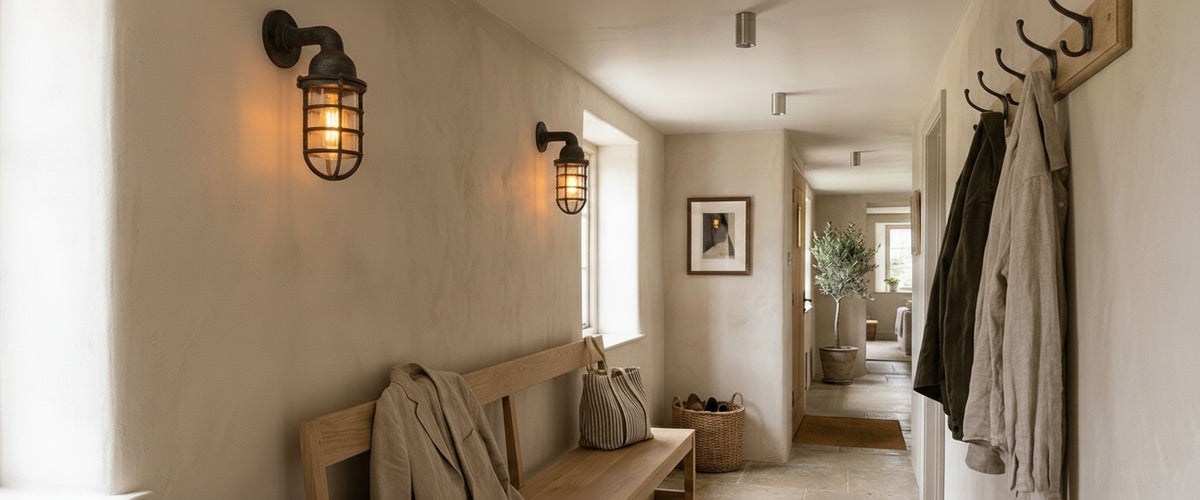

Hang a bare filament at eye level and it stops being a design decision and starts being a headache. That is the honest problem with industrial wall lights: strip away the diffuser and every choice you make afterwards, from bulb to mounting height to the angle of the shade, becomes visible. Get it right and a cast iron sconce anchors a hallway with real conviction. Get it wrong and guests spend the evening squinting past a naked coil of tungsten.
We sell alabaster and natural-stone fittings at Niori, so we spend most of our time thinking about diffusion. That is exactly why industrial fittings interest us. They are the opposite discipline. Nothing softens the source, so the geometry has to do the work.

At a Glance: What Decides Whether Industrial Wall Lights Work
- The bulb is the design. With no diffuser, filament shape, glass tint and lumen output are as important as the metalwork.
- Mounting height controls glare. Above roughly 1.8 m (6 ft) a bare bulb sits out of a standing sightline; below 1.6 m (5 ft 3 in) it rarely does.
- Finish ages differently. Cast iron dulls, powder-coated steel chips, unlacquered brass patinates. Choose for how it will look in five years.
- Outdoors, the gasket matters more than the style. Check IP rating, drainage and fixings before you fall for the shade shape.
- Salvage needs rewiring and earthing. Assume a qualified electrician, always.
- Bare bulb is a room-by-room decision. Utility spaces reward it. Bedrooms and dining rooms usually do not.

Why the Bulb Is the Whole Design in Industrial Wall Lights
An alabaster wall light forgives a mediocre lamp. The stone takes a hard LED source and turns it into a low, honeyed wash, hiding the hotspot inside 15 mm of translucent mineral. Exposed industrial lighting on a wall forgives nothing. You are looking straight at the emitter, which is why two identical industrial wall lights can feel completely different depending on which bulb went in.
With most industrial wall lights, look for bulbs with a long, vertical filament rather than a tight cluster, and lower output than you would instinctively choose. In an exposed fitting, 250 to 400 lumens per point is often plenty; the eye reads the visible source as brighter than the meter says. Amber or lightly smoked glass drops perceived glare considerably. Clear glass at 2200K to 2400K gives that soft candle-adjacent tone people actually want when they say vintage.
One more point that catches buyers out: filament LEDs vary wildly in dimming quality. Cheap drivers flicker below 20 per cent, and flicker is far more obvious in a bare bulb because there is no diffuser to average it out. Test one on your dimmer circuit before you buy six.
Glare Maths: Height, Angle and Where the Filament Sits
Most industrial wall lights are hung by habit rather than by sightline, so treat this as geometry rather than taste. Sit or stand where people actually will, then ask whether the filament falls inside a 60-degree cone from your eye line. In a corridor where everyone is walking, a mounting centre of 1.9 to 2.0 m (roughly 6 ft 3 in to 6 ft 6 in) keeps the source above the sightline of most adults. Beside a bath or a console table where people are seated, the same fitting at 1.5 m becomes a flare in your peripheral vision.
Shade angle is the other lever. A deep cone or a shallow dish that tilts down shields the source from anyone approaching; a wide, flat disc broadcasts it sideways along the whole wall. Cage guards look the part but do almost nothing for glare, and they cast a busy shadow web that reads as clutter on a smooth plastered wall. If you want that mesh detail, put it where the shadow lands on brick or board, not on fresh paint.
Designers specifying industrial wall lights in stairwells should also check the beam at foot level. A downward-throwing sconce that lights treads is genuinely useful; an omnidirectional bare bulb on a landing tends to light the ceiling and leave the steps in shadow. The Chartered Institution of Building Services Engineers publishes sensible guidance on lighting levels for circulation routes if you need numbers to back a specification.
Indoor Industrial Wall Lights: Cast Iron, Aged Brass or Powder-Coated Steel
Material choice is the difference between a fitting that improves and one that just wears out.
Cast Iron
Heavy, matte, slightly gritty in texture, and superb against lime plaster or exposed brick. It swallows light rather than reflecting it, so an iron sconce on a dark wall reads almost as a silhouette. The drawback is weight: you need proper fixings into masonry or a noggin, not plasterboard anchors alone.
Aged and Antique Brass
Brass is the bridge material. It sits comfortably with industrial forms and equally comfortably with stone, which is why so many of our alabaster wall lights use brass backplates and stems. Unlacquered brass will darken unevenly wherever hands touch it, and that is the point. If you want it to stay bright, buy lacquered and accept it will look uniform rather than lived-in. The Canadian Conservation Institute's notes on the care of metals are a useful reality check on aggressive polishing, which strips patina you cannot put back.
Powder-Coated Steel
The most practical indoor option and the least romantic. It holds colour well, comes in graphite, off-black and greys that behave predictably against paint, and it chips at the edges when knocked. In a boot room or utility corridor that chipping becomes character. In a formal hallway it just looks tired. Matt black powder coat against a warm white wall creates a hard visual break; against a mid-grey or deep green it settles far more quietly.
Industrial Outdoor Wall Light: Gaskets, Drainage and Winter Finishes
Outdoor industrial wall lights fail from the inside. Water gets past a hardened gasket, sits in the base because there is no drainage path, and quietly corrodes the terminal block long before the finish looks bad. When you are comparing an industrial outside wall light, ask three specific questions: what is the IP rating, is the gasket replaceable, and where does condensation drain?
For an exposed wall on a coastal or exposed site, IP65 is the sensible minimum, and marine-grade stainless or a high-quality polyester powder coat will outlast raw steel by years. Salt air is brutal on cheap plating. Where the finish has to survive that kind of weather without annual attention, a sealed powder-coated unit such as the Flareon Grey LED Outdoor Wall Light 25W 3000K, 20cm is a more realistic proposition than reclaimed metalwork. Reclaimed bulkhead fittings, popular as industrial outdoor wall light options for garden rooms and barn conversions, were often designed for ships and workshops where someone maintained them annually; used on a house wall with no maintenance, their gaskets perish within a few seasons.
Also think about what the light does to the building at night. A downward-shielded fitting grazes brick or stone and gives a rhythm along a facade. An unshielded bare bulb over a doorway throws light into your neighbour's window and into the sky. It also destroys the effect of any softer lighting elsewhere in the garden, because the eye locks onto the brightest point. Where you want that graze without a visible source, a shielded 20 cm body like the Flareon Black LED Outdoor 25W 3000K Wall Light is closer to the right design language, and on a narrow pier or beside a back door the smaller Flareon Brown 12W at 10 cm keeps the scale proportionate to the wall it sits on.
Buying Vintage and Antique Industrial Wall Lights
Salvaged metalwork can be the best value in the room and the biggest liability. Vintage industrial wall lights bought from a reclamation yard almost always need full rewiring, and any metal-bodied fitting needs a proper earth connection to the metalwork. In the UK that means work to BS 7671; the IET's electrical resources are the reference point, and installation should be signed off by a qualified electrician rather than attempted as a weekend project.
What you cannot see in a listing photo is the inside. Look for corrosion inside the backplate, seized threads on the shade collar, cracked porcelain lampholders, and old rubber-insulated flex that crumbles when flexed. Ask whether the fitting has been converted for a modern lampholder, and whether the conversion respects the original geometry, because a taller holder pushes the bulb out of a shade that was designed to conceal it. That single change is why some antique industrial wall lights glare when the originals did not.
Practical tip from the studio: measure the backplate against the socket box you already have. Reclaimed plates are often smaller than modern ones, and an exposed patch of old paint or a filled chase looks worse than any bulb ever will.
Where Bare Bulb Reads Intentional, and Where It Reads Unfinished
Retro industrial wall lights belong in spaces with a working character: boot rooms, pantries, garages, workshops, stairwells with painted brick, bars, and any room where the floor and joinery are already robust in texture. In those rooms the visible filament is consistent with everything else.
Industrial wall lights struggle where people rest their eyes for long periods. Bedside, at a dining table, beside a reading chair, or flanking a bathroom mirror, exposed sources fight the room. We had a client converting a mill building in West Yorkshire who had specified caged sconces throughout, including both sides of the principal bedroom bed. They kept the iron fittings on the landing and the stair, and swapped the bedside pair for alabaster wall lights with brass arms. Same visual family, completely different comfort. The stone gave them a warm 2700K glow they could read by without a hotspot in the corner of their eye.
That is the useful rule. Use metal and exposed filament where the light is scenic, and use diffused stone where the light is functional and close to the face. If you want to see how the softer end of that pairing looks, our alabaster lighting collection shows how translucent stone handles a source that would be uncomfortable left bare.
Buyer's Checklist Before You Order Industrial Wall Lights
- Confirm mounting centre against real sightlines, seated and standing, before the electrician chases the wall.
- Check the wall build-up. Cast iron and solid brass need masonry fixings or timber behind the board.
- Choose the bulb at the same time as the fitting. Filament shape, tint, lumens and dimming performance, tested on your circuit.
- Specify the switching. Trailing-edge dimmers for LED filaments; keep sconces on a separate circuit from downlights so you can drop the ceiling out entirely at night.
- For exterior use, verify IP rating, gasket replaceability, drainage and fixing material for your exposure.
- For salvage, budget for rewiring, earthing and a lampholder that keeps the bulb inside the shade line.
- Balance the scheme. Pair hard exposed sources with at least one diffused layer, whether that is stone, fabric or an uplit surface.
- Ask for a quote rather than assuming a figure. Cost depends on material, scale, engineering, finishing and installation complexity, and reclaimed pieces carry restoration time on top.
Mixing Industrial Metalwork With Stone
The best schemes we ship rarely commit to one language: graphite steel industrial wall lights in a utility corridor, alabaster sconces in the bedroom, an onyx pendant over the island, brass details tying them together. The metal handles the graphic, hard-edged moments; the stone handles anywhere you need light on skin, food or a page. Browse the wider lighting range if you are building a whole-house scheme and need the diffused pieces to sit alongside industrial fittings you already own.
One last observation from the workshop. Alabaster and industrial metal share something that glass does not: both show their history. Iron dulls, brass darkens, and every block of alabaster carries veining that no two fittings repeat. If you like materials that change, you will like both. Just be deliberate about which one you point at people's eyes.