
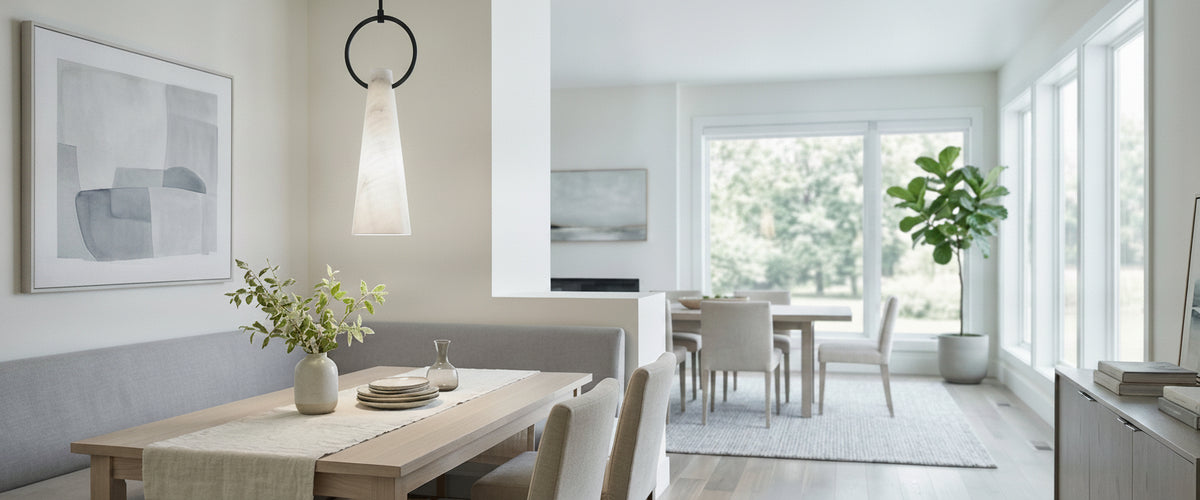

Two designer pendant lights can photograph almost identically and still be separated by a factor of ten in price. One is hand-blown or hand-carved, hung on properly engineered suspension, and shielded so the lamp never stares back at you. The other is pressed, cast or moulded, hung on a cable that twists out of plumb within a fortnight, and glares like a torch at eye level. Most shoppers comparing designer pendant lighting are looking at the wrong differences: shape, colour, the name on the box. The differences that actually separate designer pendant lights from decorative lookalikes are usually invisible in a styled photograph, which is exactly why they are worth learning.

At a Glance: Where the Money Goes in Designer Pendant Lights
Material and how it was formed. Hand-blown glass and hand-carved stone carry real labour and real waste. Pressed glass and cast resin do not.
Optical control. Diffusers, shielding and socket placement are the difference between soft light and a hotspot.
Suspension engineering. Canopy, ceiling plate, cable grip and load rating decide whether the piece hangs straight for a decade.
Finishing. Solid brass that has been lacquered or aged by hand behaves differently from plated steel over five years.
What does not justify a premium on designer pendant lights: a designer's signature on a shape anyone can mould, packaging theatre, and a colourway that will date faster than the room.

The Four Things That Genuinely Cost Money, and the Three That Just Cost Marketing
Start with labour, because the honest premium on designer pendant lights is mostly an hour count. A blown glass shade takes a team, a furnace running continuously, and a rejection rate that gets absorbed into the price of the pieces that survive. A carved alabaster shade takes a block that may fracture halfway through, a carver who reads the veining as they cut, and a wall thickness thin enough to glow but thick enough to survive a courier. That waste is real, and it is priced in.
Second, optical design. Any competent factory can make a shade. Fewer bother to work out where the lamp sits inside it, how far the diffuser sits from the source, and what happens to the light at a 45 degree viewing angle when you are seated at a dining table. Third, suspension hardware: the canopy, cable grip and load rating are engineered components rather than accessories, and they are what separate engineered designer pendant lights from assembled ones when a heavy shade has been hanging for five years. Fourth, finishing quality on metalwork, which is the component most likely to betray a cheap fitting after a few years in a humid kitchen.
What you can usually discount: limited-edition framing on a piece that is clearly in continuous production, extravagant boxes, and the assumption that a well-known catalogue brand's designer pendant lights are engineered better than a specialist's simply because they are heavily advertised. Some of those catalogue pieces are genuinely well made. Many are the same pressed shade sold by three other retailers under different names, which you can often confirm by reverse-searching the product image.
Hand-Blown Glass or Machine-Pressed: The Seam, the Bubble and the Light They Throw
Good design in glass pendant lights starts with how the glass was formed, because that determines how it scatters light. Hand-blown glass has slight variation in wall thickness, which means the light coming through it varies subtly across the surface. That variation is what makes a blown shade look alive when it is lit. Machine-pressed glass is uniform, and uniform glass tends to read flat.
Three checks before you buy any of the glass designer pendant lights on your shortlist. Look for a mould seam running vertically down the shade; pressed and moulded pieces usually have one, sometimes polished but rarely invisible under raking light. Look at the rim, which on hand-blown work is fire-polished and slightly irregular rather than perfectly cut. And look at the bubbles: a scattering of tiny, randomly placed seeds suggests hand production, while evenly spaced bubbles in a repeating pattern are moulded decoration pretending to be a happy accident.
Neither is wrong. A crisp glass globe in matt black or opal white can be the correct choice for a utility area or a run of three over a breakfast bar, and something like the DUOline Globe Pendant, Matt Black is the right design language for that job: simple geometry, a dark metal collar that disappears against a ceiling, and no pretence of being a sculptural centrepiece. Just do not pay hand-blown money for it. Listings for genuine designer pendant lights will tell you how the glass was made, and if a listing stays quiet on that point, the silence is itself an answer.
Carved Alabaster and Cast Resin at the Same Price Point
This is the trap that catches designers as often as homeowners. Plenty of designer pendant lights described as stone are neither carved nor quarried. Cast resin and composite stone can be made to look convincingly like alabaster in photography, and the marketing language around them is deliberately slippery: "stone effect", "stone composite", "alabaster-look". Real alabaster is a gypsum stone, soft enough to carve by hand and translucent in a way that resin simulates but never quite matches. The British Museum's collection of medieval Nottingham alabaster carvings shows why the material became a carver's favourite in the first place: it takes fine detail and holds a warm internal glow.
How to tell them apart from a photograph alone:
Veining logic. Real stone veining runs through the body of the material and continues across a curve in a way that makes geological sense. Printed or cast veining tends to repeat, sit on the surface, or stop abruptly at an edge.
Lit versus unlit shots. Ask for both. Alabaster changes character completely when lit, with veining that darkens and brightens unevenly. Resin lights up more evenly and often takes on a slightly milky, plastic cast.
Piece-to-piece variation. If every unit in the listing looks identical, it is not carved stone.
Weight and fixing notes. Genuine stone pendants are heavy, and a serious brand will say so and specify the ceiling fixing required.
At Niori we work with alabaster, marble and onyx precisely because that internal glow cannot be faked, and every shade we ship carries its own vein pattern. Carved alabaster hides the lamp entirely while still transmitting a warm, uneven glow that resin cannot copy. If you want to compare stone against glass side by side before committing, the alabaster lighting collection is the fastest way to see how differently the two materials handle the same lamp, and most people who audition both stop treating designer pendant lights as one flat category.
Suspension, Canopy and Cable: The Unglamorous Hardware
We once replaced a run of three pendants over an island in a converted Somerset farmhouse where the client's complaint had nothing to do with the shades. The shades were fine. The cables had been supplied uncut, coiled at the ceiling inside a shallow canopy, and the stored twist slowly rotated each pendant a few degrees out of alignment. From the doorway, the three of them looked drunk.
Good pendant lights design solves this at the ceiling, and the ceiling is where designer pendant lights either earn their price or quietly fail. Look for a canopy deep enough to house connections without compressing the cable, a proper cable grip that takes the mechanical load rather than the electrical terminals, and a stated drop range with adjustment that locks. On heavier stone pieces, ask whether the fixing is rated for the weight and whether a joist or backing plate is required; a plasterboard ceiling on its own will not do for anything substantial.
Drop height then decides whether designer pendant lights read as considered or accidental. Over a dining table, aim for roughly 75 to 90cm (30 to 35in) from tabletop to the bottom of the shade. Over an island, similar, but check sightlines across the kitchen from the seating area. In a stairwell or double-height hall, hang so the lowest point clears any door swing and sits comfortably within the window line when seen from outside at night.
Diffusers, Sockets and Shielding: Why a Cheap Pendant Glares
Glare is the clearest technical tell separating real designer pendant lights from decorative copies. An inexpensive fitting typically puts a bare lamp close to a thin, clear or lightly frosted shade, with no secondary diffuser and no shielding at the aperture. Sit down at the table and the source is straight in your eye line.
Well-resolved designer pendant lights control this in layers: the lamp sits deeper in the body, there is a diffuser plate or an opal inner, and the aperture is cut so the source is hidden at normal seated angles. Where a fitting hangs low and close to eye level, an opal shade such as the Staring 1 Light Mini Pendant Light, Distressed Gold with Opal Glass is a safer specification than a clear equivalent, because the diffusion is doing the shielding for you. Reserve clear or faceted glass for positions where the source sits well above the sightline, where a piece like the Windsor 1 Light Pendant Light, Black with Clear Faceted Glass can throw pattern across a stairwell wall without putting the lamp in anyone's eye. Stone does a lot of this work by itself. Alabaster is thick enough to hide the lamp entirely while still transmitting light, which is why stone pendants tend to be comfortable at low ceiling heights where glass would need careful specification.
Designer pendant lights are also only as good as the lamp you put inside them. 2700K is the sweet spot for alabaster and warm brass, because it lets the natural cream and honey tones in the stone read properly. Push to 3000K only if the room is cool-toned throughout. Choose a lamp with a colour rendering index of 90 or above, keep the physical lamp small enough that no hot spot forms against the shade wall, and match the dimmer to the driver rather than hoping. Trailing-edge dimming suits most LED retrofit lamps; leading-edge often flickers. The Lighting Industry Association publishes guidance on compatibility, and any hard-wired installation should be signed off by a qualified electrician.
When a Plain Fitting Is the Smarter Spend
Not every position needs designer pendant lights. Budget is finite, and the sharpest specifications concentrate spend where the eye lands and go deliberately quiet elsewhere.
Spend on the piece hung over the dining table, the single sculptural pendant in a stairwell, and the pair flanking a bed or a bathroom mirror where you see them at close range every day. Save on utility rooms, boot rooms, deep corridors and anywhere a downlight would do the actual work. One restaurant client put the bulk of their lighting budget into six carved stone pendants over the banquette run and specified plain recessed fittings everywhere else; nobody photographs the corridor.
The same logic applies within a single room. One alabaster pendant plus two well-chosen wall lights will read more considered than five mid-quality designer pendant lights competing for attention. Browse the full lighting range with that hierarchy in mind rather than trying to match every fitting to every other.
The Designer Pendant Lighting Buying Checklist
Run this list against any designer pendant lights you are shortlisting, before the shade or the price tag persuades you.
Ask how the shade was formed: blown, pressed, carved or cast. Vague answers are answers.
Request a lit and an unlit photograph of the exact piece, not a render.
Confirm the material by name. "Stone effect" is not stone.
Check the weight and the required ceiling fixing before you commit to a position.
Confirm the drop range, whether cable can be shortened, and how the canopy conceals connections.
Sit at the height you will actually use the room and check the source is shielded.
Specify lamp colour temperature and CRI at the point of order, not afterwards.
Match dimmer type to driver, and book a qualified electrician for installation.
Ask what happens if a stone shade is damaged in transit and whether replacements can be matched.
Decide which positions get the designer piece and which get a plain fitting, before you shop.
Living With Stone Pendants
Alabaster and marble are porous, so care is simple but specific. Dust with a dry, soft cloth. Avoid anything acidic, and never use a proprietary glass cleaner on stone, since the solvents can leave a dulled patch that will not buff out. If a shade needs more than dusting, a barely damp cloth and immediate drying is enough. Brass detailing that has been left unlacquered will darken over time, which most people come to prefer; if you want it bright, a light polish once or twice a year holds it. Details on materials and finishes for individual pieces sit on the Niori product pages, and the studio will confirm specifics before you order.
Good designer pendant lights are a long purchase. The shade you choose for a kitchen island today should still be hanging straight, glowing evenly and free of glare when the room gets its next repaint. That outcome is decided by material, optics and hardware, not by the name on the label.