
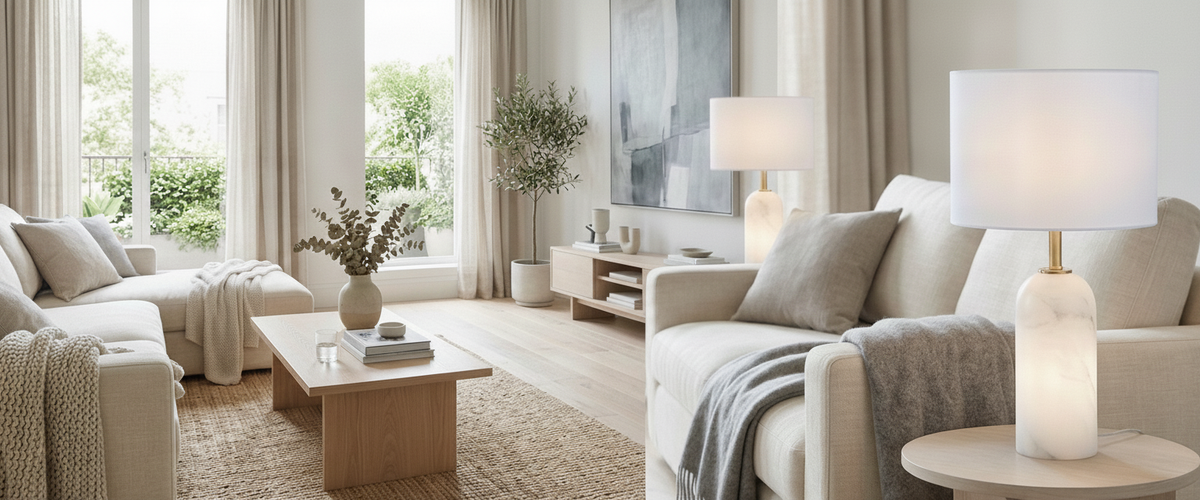

Most contemporary table lamps age badly because they were designed to look new, not to look good in three years. There is a difference. A lamp that reads as modern this season often does so through a trick of color or a fashionable base shape, and those tricks curdle fast. The contemporary table lamps that hold their line are quieter about it. They rely on proportion, honest materials and a base that does real work when the light is off. That is the standard worth buying to, and it is where alabaster and natural stone earn their place.
At Niori we sell alabaster and natural-stone lighting to homeowners, interior designers and hospitality clients, and the same question comes up whether the room is in Notting Hill or a boutique hotel lobby: how do you pick contemporary table lamps that still feel considered once the trend that inspired them has passed? Below is the way we answer it.
A pair of alabaster lamps giving a living room symmetry and a warm evening glow.

Key Takeaways Before You Buy
Base material matters more than styling. Alabaster and stone give a lamp weight, texture and a glow that painted metal cannot fake.
Proportion is the fastest way to date a lamp. Get the base-to-shade ratio right and half the work is done.
Shade choice controls the mood. A translucent alabaster base wants a shade that lets it glow; an opaque shade throws all the light down.
For a living room end table, aim for a lamp around 26 to 32 inches tall (66 to 81 cm) overall, with the shade bottom near eye level when you are seated.
Build quality hides in the details a catalogue shot flatters: base weight, socket quality, cord finish and switch feel.

The Line Between Contemporary and Merely Stripped of Character
There is a lazy version of modern that mistakes bareness for design. Strip a lamp of ornament, paint it matte black, and you have something that looks current without being good. It photographs well and disappoints in the room. The best contemporary table lamps keep restraint but add interest through material and form, so the eye has somewhere to rest.
This is why we keep coming back to stone. An alabaster base carries natural veining that no two pieces share, so a minimal silhouette still holds attention. The form can be plain because the material is not. That balance, calm shape and rich surface, is what separates a lamp that feels intentional from one that feels merely blank. You can see the principle across our alabaster lighting range, where the shapes stay simple precisely so the stone can speak.
How Stone and Alabaster Bases Hold Their Own in a Modern Scheme
Alabaster is a form of gypsum, soft enough to carve into flowing shapes yet dense enough to feel substantial in the hand. Its defining quality is translucency: light passes partway through the stone and warms as it goes, so a lit alabaster base glows from within rather than simply reflecting off its surface. The Metropolitan Museum of Art notes that carvers have prized alabaster for exactly this luminous quality for centuries, long before electric light gave it a new job. That glow is what sets alabaster contemporary table lamps apart from anything made in resin.
Marble and other natural stones read differently. They are denser and mostly opaque, so they behave as a solid, grounding base with veining that catches the eye rather than transmitting light. In a modern scheme, that opacity can be an asset: a marble base anchors a lamp visually against pale walls and glass. If you want the base itself to glow, alabaster or backlit onyx is the answer. If you want a heavy, quiet foundation with graphic veining, marble does the job. Where a ceramic base is the middle ground you want, a piece such as the Job 1 Light Table Lamp in bronze metallic ceramic reads as solid and grounding without the coolness of stone.
Either way, stone brings a tactile honesty that painted resin and thin metal cannot. Run a hand over an alabaster base and it feels cool and slightly waxy; there is mass behind it. Clients tell us the weight is the first thing they notice when a lamp is unboxed, and it is usually the thing they did not know they were missing from cheaper pieces.
Silhouette and Proportion: The Shapes That Date a Lamp Within a Season
Fashions in lamp shape move quickly. The exaggerated bulb-on-a-stick, the over-styled asymmetric base, the novelty geometry that looked clever in a launch photo; these are the first things to feel stale. The contemporary table lamps that last tend toward columns, gentle tapers, soft domes and clean cylinders. They read as modern without shouting a specific year.
Column and tapered forms with the shade set at roughly two-thirds the base height.
Proportion is where most people go wrong. A good rule: the shade should be roughly two-thirds the height of the base, and its width should be close to or slightly greater than the base is tall. Overall, a lamp destined for a living room usually wants to land somewhere around 26 to 32 inches (66 to 81 cm) tall, though the surface it sits on changes that. Too tall and it looms; too short and it looks apologetic. When in doubt, measure the space the lamp will occupy before you fall for the photograph.
Shade Choice and the Light a Base Is Allowed to Throw
The shade decides how the lamp behaves at night, and with an alabaster base it also decides whether the stone gets to glow at all. A tall, opaque drum shade sends light firmly up and down and keeps the base in shadow, which suits task-heavy corners. A shorter or more translucent shade lets ambient light spill sideways and lets the base contribute its own warm glow. This is where alabaster contemporary table lamps really pull ahead.
For alabaster in particular, we usually steer buyers toward shades that do not swallow the base. Off-white linen and smoke glass both let some light escape at the sides while the stone glows below, so the whole fixture reads as one soft source rather than a bright shade sitting on a dead lump. Where you want that diffused sideways spill rather than a hard downlight, the Lena Smoke Glass Table Lamp pairs a translucent base with an off-white shade in exactly that spirit. Warm-white LED bulbs around 2700K keep that glow honest; cooler bulbs make stone look gray and clinical. A dimmer is close to essential. Alabaster is at its best at low output, where the veining lights up like frosted glass, and a dimmable warm bulb gives you that range across an evening.
Reading Real Construction Quality Past a Flattering Catalogue Shot
Photography hides more than it shows, so learn to question the details that a stylist cannot fake. Good contemporary table lamps survive that scrutiny.
Weight and base felt. A quality stone lamp is heavy and sits on a proper felted or recessed base so it never scratches a console.
Socket and switch. Look for a solid brass or metal lamp holder and an inline or base switch that feels positive, not flimsy.
Cord and finish. Braided or well-sheathed flex reads better than thin PVC, and it lasts longer where it flexes near the base.
Stone finish. Alabaster should feel smoothly honed with veining that runs through the piece, not printed on a coating.
Fittings. Brass detailing should be machined and consistent, with clean threads where the shade fitting meets the harp.
If a listing shows only lit, glamour-lit angles and never a plain daylight shot of the base, ask for one. Electrical safety is not negotiable either: buy from sellers whose lamps meet UK wiring standards, and follow the guidance from Electrical Safety First on lamps and lighting. If any hard-wiring is involved, use a qualified electrician.
Where a Contemporary Lamp Settles Across Living, Bedroom and Hall
The same lamp behaves differently depending on the room, so match the fixture to the job. Well-chosen contemporary table lamps can move with you as a scheme evolves.
Living Room
On a living room end table beside a sofa, you want the bottom of the shade near eye level when you are seated, so the bulb is hidden and light falls onto your lap for reading, not into your eyes. That usually means an overall height around 26 to 30 inches (66 to 76 cm), adjusted for how tall the table is. A matched pair of contemporary table lamps on matching end tables gives a room symmetry and balance that a single lamp cannot. An alabaster base here does double duty: reading light when you want it, low warm glow when it is dimmed for the evening. Browse the wider lighting range if you are building a layered scheme rather than buying a single piece.
Bedroom
Bedside contemporary table lamps want a softer output and an easy-reach switch, ideally a dimmer so you can drop the light right down before sleep. A translucent alabaster base is a quiet win here because the glow at low levels is gentle on the eyes. Keep the shade bottom around the height of your shoulder when sitting up in bed so it lights the page without glare.
Hall and Console
A hallway console is where a lamp earns its keep as sculpture. It is often seen unlit during the day and glowing at night, so the base has to look good both ways. This is the classic home for a heavier marble base or a boldly veined alabaster column; the form greets people as they arrive. Where the console leans graphic rather than soft, a lamp such as the Artisan Table Lamp with its black metal scroll base gives that sculptural presence during the day and a warm point of light at night. One well-chosen lamp usually beats two here, unless the console is long enough to carry a symmetrical pair.
A Quick Decision Checklist
Confirm the surface height and available width before choosing a lamp.
Aim for a base-to-shade ratio near two-thirds, with the shade width close to the base height.
Decide whether you want the base to glow (alabaster, backlit onyx) or to anchor (marble, opaque stone).
Pick a shade that suits the job: opaque for task light, translucent for ambient glow.
Specify a warm 2700K LED bulb and a dimmer wherever you can.
Check base weight, socket quality, cord finish and safety compliance before you buy.
Get those six right and contemporary table lamps stop being a seasonal purchase. They become fixtures you keep moving from room to room as your home changes, which is the real test of good design.