
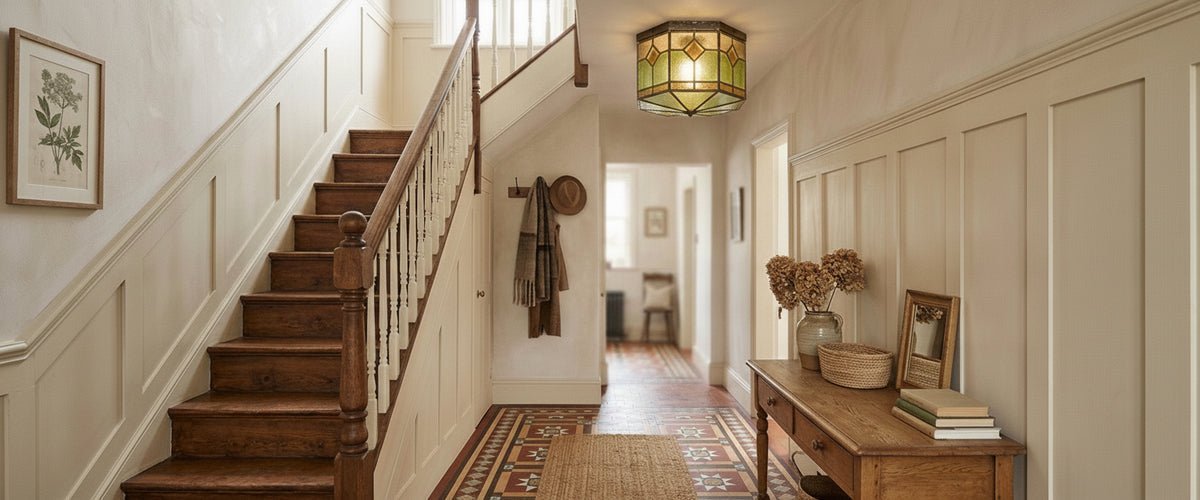

Hang a stained glass ceiling lights in the wrong room with the wrong bulb and it looks like a themed pub refit. Get it right and the ceiling takes on a slow wash of amber, bottle green and ruby that no frosted shade can fake. The fitting is rarely the problem. The trouble usually comes from how much space you give it, the colour temperature of the bulb and the room you put it in.
At a glance
- Colour behaves differently from diffusion. Stained glass tints the whole room. It does not simply soften the light.
- Period or contemporary? Originals suit rooms with their own architecture. Contemporary designs suit restraint.
- Allow more drop and more ceiling space than you think you need, so the colour has somewhere to land.
- Use a warm white bulb around 2700K with a high CRI. Very warm or cool bulbs flatten the palette.
- Hallways, landings and dining rooms are where it shines. Working kitchens are where it struggles.

Why Coloured and Leaded Glass Rewrites the Room
A frosted or opal shade scatters light evenly. It takes a hard point source and turns it into a soft, neutral glow. Stained glass does something else entirely: it filters. Each pane absorbs part of the spectrum and passes the rest, so a ruby panel throws red onto the ceiling while a pale amber panel warms the walls. Lead came, the H-section strips that hold the panes together, adds a fine dark graphic to the pattern of light. That is why a leaded fitting reads as drawing as much as illumination.
This is also why a stained glass ceiling light should never be your only light source. It sets the mood, not the reading level. Alabaster is a useful comparison: it diffuses rather than colours, and its warmth comes from the stone's natural veining and translucency, not from any dye. Stained glass is more theatrical, and it needs more careful handling in a scheme.
The quieter cousin is the milk glass ceiling lights. Opal or milk glass diffuses like frosted glass but with a creamier, denser glow, a little closer to thin-cut alabaster. If you love the idea of a glass fitting but worry that colour will take over the room, milk glass is the honest middle ground. A simple opal flush fitting such as the Albers Opal Glass Flush Ceiling Light in Champagne Bronze keeps the period warmth of the frame while letting the glass stay neutral.

Period Originals Versus Contemporary Takes
An original Victorian or Arts and Crafts fitting belongs in a house with the bones to carry it: cornicing, a tiled hall floor, panelled doors, perhaps an original fanlight. In a Victorian terrace or an Edwardian semi in south London, a period lantern looks as though it has always been there. The Stained Glass Museum in Ely is worth an afternoon if you want to train your eye on how leading, colour and painted detail changed from one period to the next. It makes a convincing piece much easier to spot.
The same fitting in a new-build flat with a plasterboard ceiling and recessed downlights tips into costume. There is nothing for it to talk to. In those rooms, a contemporary stained glass ceiling light works better: geometric panels, limited palettes of two or three colours, and slim brass or blackened frames. It keeps the chromatic effect without asking the room to pretend it is 1905.
Buying antique? Check the came for bowing, look for cracked panes that have been patched with the wrong glass, and assume any original wiring needs replacing. A qualified electrician should rewire and test a vintage fitting before it goes anywhere near your ceiling rose.
The Clearance Problem Most Buyers Miss
Stained glass needs breathing room for two reasons. The first is practical. Leaded panels are heavy for their size and are rarely designed to be knocked, so a pendant hanging at head height in a narrow hall is a breakage waiting to happen. Allow comfortable headroom (around 2.1 metres, or 7 feet, from floor to the underside of the fitting is a sensible working minimum in walkways). Over a dining table, the table itself keeps people out of the way, so you can hang it lower.
The second reason is optical, and it is the one people miss. The colour needs somewhere to fall. Mount a flush stained glass ceiling light on a low ceiling and the projected colour bunches into a tight, muddy halo right around the base. Give it drop on a pendant or chain, or a higher ceiling, and the colour spreads into soft, readable pools. Stairwells show this most clearly. In a stairwell rising through three floors, a flush fitting at the top leaves a smudge of colour on the top landing. A long pendant hung at mid-height turns that smudge into a wash that travels down the walls.
Heat matters too. Old incandescent lamps in enclosed leaded shades ran hot enough to soften putty and stress the glass over the years. LED lamps largely remove that worry, but still respect the fitting's maximum wattage and ventilation.
Bulb Temperature Is Not Neutral Here
With alabaster, bulb choice changes the warmth of the glow. With a stained glass ceiling light, it changes the colours themselves. A bulb of 2200K or lower is very orange. It makes ambers and reds feel rich, but blues and greens go murky and grey. Cool white at 4000K does the opposite: blues sing, but amber turns thin and lemony and the whole piece looks clinical.
For most mixed palettes, 2700K is the reliable middle ground. Pair it with a CRI of 90 or above, because low-CRI LEDs have gaps in their spectrum that make certain panes look dead however warm the bulb claims to be. If you can, try two lamps side by side in the same fitting: the gap between a cheap filament-style LED and a good high-CRI lamp is obvious within seconds.
Bulb shape matters as well. A clear filament lamp can show a visible hot spot through pale glass, while a frosted or opal lamp evens out the panel. Put the fitting on a dimmer if you can (use a dimmer compatible with your LED lamps). At low levels the colour deepens and becomes the main event of the evening.
Where a Stained Glass Ceiling Light Makes the Scheme (and Where It Fights)
Hallways and Landings
This is its natural home. You pass through rather than work, so the colour can be as generous as you like. Pair it with a period front door or fanlight and the whole entrance holds together.
Dining Rooms
Hung low over the table with a dimmer, a stained glass ceiling light turns dinner into an occasion. Keep the rest of the room calm with plain walls and soft wall lights so the ceiling carries the colour.
Bedrooms and Snugs
These work well in small doses. Choose a restrained palette and add bedside or table lamps for reading. Alabaster table lamps sit beautifully beneath coloured glass because their neutral warmth balances the tint.
Bathrooms
They can work, but check the IP rating for the zone you are fitting into and let an electrician confirm it. Coloured light over a mirror is unkind to skin, so keep stained glass to the centre of the room and use neutral light for the vanity.
The One Where It Fights: The Working Kitchen
Kitchens need true colour. You are judging whether chicken is cooked and whether a sauce has caught, and a green or red cast makes that harder. It also distorts marble and quartz worktops, which read best under clean, even light. If you must have one, hang it over a breakfast table away from the prep zone and light the worktops separately. Over the working areas, a clear glass semi-flush such as the Jude Clear Glass Dome Semi-Flush Ceiling Light in Matte Black gives honest, uncoloured light while its dark frame still echoes the graphic line of leaded glass elsewhere in the room.
Choosing Your Fitting: Decision Criteria
- Ceiling height: low ceilings favour semi-flush fittings or pale palettes. Rooms of 2.7 metres (about 9 feet) and above can take pendants and lanterns.
- Room architecture: period detail supports originals and reproductions. Plain modern rooms suit geometric, limited-palette designs.
- Palette: two or three colours live with a scheme more easily than a full rainbow.
- Frame finish: aged brass warms amber glass, while blackened metal sharpens graphic designs.
- Construction: check the soldering, rigidity and fixing weight, and confirm your ceiling can take the load.
- Serviceability: can you reach the lamp without dismantling panels? This matters more than people expect.
- Supporting light: plan wall lights, table lamps or floor lamps so the ceiling fitting never has to do all the work.
If the ceiling is simply too low for coloured light to spread, pattern can do some of the work that colour would. A textured flush fitting such as the Elle Chevron Glass Flush Ceiling Light in Heritage Brass brings a geometric, brass-framed character to the ceiling without the muddy halo a flush stained panel would cast.
Budget for a stained glass ceiling light depends on the glass, how much hand-leading is involved, the scale of the fitting, the engineering of the frame and the installation. For bespoke or project work, a tailored quote is the only honest answer.
Caring for Glass Ceiling Light Covers
Leaded panels and glass ceiling light covers reward gentle, infrequent care. Always switch off at the consumer unit before touching a fitting, not just at the wall. Electrical Safety First has clear guidance on working safely around household electrics. Dust with a soft, dry brush. For deeper cleaning, use a barely damp microfibre cloth and mild, pH-neutral soap. Never use ammonia or vinegar on leaded work, because they can attack the came and the putty. Dry the panels fully before switching back on. Anything involving rewiring or re-fixing belongs with a qualified electrician.
Where Alabaster Fits In
Stained glass is a statement. Many of the schemes we help with use one stained glass ceiling light as the focal point and then build the supporting layers in natural stone. Alabaster wall lights and lamps give soft, neutral warmth that lets the colour lead without competing with it. Our alabaster lighting collection includes pieces that sit comfortably beside coloured glass. At Niori, that combination of one theatrical piece and several quiet ones is the arrangement we come back to most often.