

Plenty of the vintage floor lamps listed online were made within the last few years. That isn't always a problem, since a well-made reproduction can light a room beautifully, but it matters when you are paying for age, provenance or a particular era's craftsmanship. The good news is that real vintage floor lamps give themselves away through weight, proportion and wear, and once you know where to look you rarely get fooled twice.

At a Glance
- Pick an era first. A 1930s Deco uplighter and a 1960s Italian arc share almost nothing, so "vintage" alone tells you very little.
- Trust weight over finish. A solid stone base is heavy for its size. Painted resin and hollow metal are not.
- Decide anchor or theme. One period lamp can steady a modern room. Three turn it into a set.
- Budget for rewiring. Assume any genuinely old lamp needs inspection by a qualified electrician before it goes near a socket.

Vintage Floor Lamps Span a Century, and the Eras Do Not Mix
Sellers use "vintage" to cover anything from an Edwardian brass standard lamp to a 1980s halogen uplighter. Those are different design languages built around different light sources. Early electric lamps were scaled for dim carbon-filament bulbs, so shades sit low and close. Art Deco torchieres threw light at the ceiling because bounced light flattered plaster and made rooms feel taller. Mid-century Italian designers, freed by brighter bulbs, stretched stems into long arcs and pared bases down to a single slab of marble.
Why should a buyer care? Because the era dictates how the lamp lights the room, and that is the part you live with every evening. A low Edwardian shade gives a reading pool at chair height. A Deco uplighter washes a wall. Choose the era for the light you need, then for the look.
Torchiere, Arc, Tripod and Pharmacy: Period or Costume?
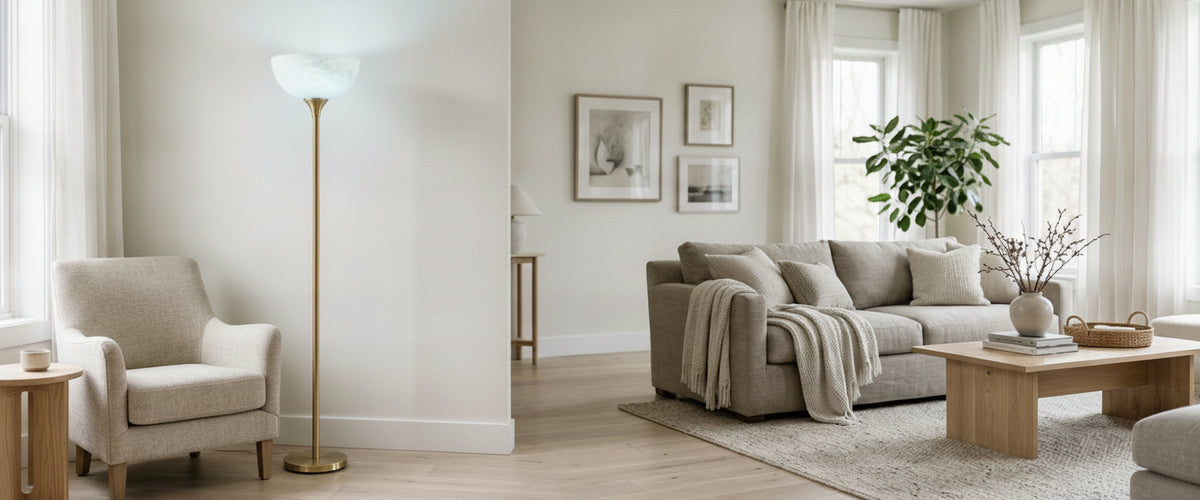
Torchiere. The original Deco uplighter reads authentically period when the bowl is glass, alabaster or spun metal and the stem is slim. Oversized bowls on chunky plastic stems are a 1990s idea wearing older clothes. If you love the upward glow but do not need genuine age, an openly new piece with a period-style glass shade and a darkened metal finish, such as the Kami Tiffany Torchiere Floor Lamp in Vintage Bronze, is a more honest choice than a reproduction pretending to be eighty years old.
Arc. The arc is the most copied silhouette in lighting. A genuine mid-century arc relies on a heavy stone counterweight, often well over 20 kg, so the reach looks effortless. Reproductions with thin bases tend to tip, or they compensate with a stubby arm that spoils the proportion.
Tripod. Tripods came from photographic and theatrical equipment, so authentic examples have honest mechanical joints and visible hardware. A tripod with ornate turned legs is a costume: it mixes industrial origins with parlour decoration.
Pharmacy. The adjustable pharmacy lamp is a reading lamp first. Period examples have a small, directional shade and a smooth height mechanism. If the shade is huge and fixed, the lamp has lost the point of its own design.
Material Signals: Bases, Stems and Shades
The base tells you more than anything else. A real vintage marble floor lamps has a base cut from a single block, with veining that runs continuously around edges and under the foot. Composite marble shows repeating patterns, and painted finishes reveal a uniform colour where the stone should vary. Lift one corner: a true marble base floor lamp feels dense and slightly cold to the touch even in a warm room.
An antique marble floor lamp will also show honest wear. Expect softened edges, faint etching where a glass once stood, and a patina rather than a high factory polish. Turn every stone base over before anything else, because felt pads glued underneath often hide chips or old repairs. If a seller refuses to let you lift the pad, ask why. For valuable or damaged stone, a conservator accredited through the Institute of Conservation can advise on cleaning and repair without stripping the surface.
Stems and shades confirm the story. Solid brass darkens unevenly and is heavy. Brass-plated steel attracts a magnet and shows rust where plating has worn through. Shades are frequently replaced, which is fine, but a period glass or alabaster shade should show slight irregularities in thickness. A perfectly uniform glow usually means modern moulded glass or resin.
Anchor or Theme: Placing a Vintage Floor Lamp Room by Room
In a living room, one vintage piece works best as an anchor. Put an arc behind the sofa so its shade lands roughly 40 to 50 cm above seated head height, and let the rest of the room stay contemporary. The lamp becomes a fixed point that the eye returns to.
In a study or library, period character can become the theme. Dark joinery, leather and a pharmacy lamp beside the reading chair belong together, and the low directional light suits the room's purpose. Where an original is hard to find, an adjustable brass stem with a dark base, like the Funk Adjustable Floor Lamp in Brass with Black Base, keeps the same reading-lamp logic and sits more comfortably against dark wood than a broad-shaded standard lamp.
Bedrooms need restraint. A torchiere in a corner gives soft ambient light for getting dressed without glare, but avoid tall arcs over the bed, where a heavy head becomes something you notice from the pillow.
Hospitality spaces are different again. In hotel lounges and restaurant bars, vintage floor lamps tend to take a beating from cleaners and guests, so specify stable bases and confirm the wiring before opening night, not after.
Pairing Vintage Forms With Modern Furniture
Pastiche happens when everything in the room points to the same decade. The fix is contrast in one or two places, chosen on purpose.
- Match scale, not style. A slender arc suits low-slung modern sofas. A heavy Deco torchiere needs a solid piece beside it, such as a stone side table or a deep armchair.
- Repeat one finish. If the lamp has a brass stem, echo brass once elsewhere (a picture light, a cabinet handle) and stop there.
- Let stone talk to stone. A marble lamp base pairs well with a travertine coffee table or an onyx tray. Different stones in similar tones look collected; identical stones look ordered from one catalogue.
- Keep the shade quiet. A plain linen or alabaster shade lets the period base carry the character without turning the whole lamp into a statement.
Condition and Rewiring: What UK Buyers Should Ask
A familiar auction story: a 1970s Italian marble arc with an immaculate base, original fabric-covered flex that crumbles when bent, and a lampholder with no earth connection. It is a lovely object and a genuine hazard until rewired. Treat these questions as non-negotiable before any vintage piece leaves the seller:
- Has the lamp been rewired, and by whom? Ask for the electrician's details or a test record.
- Is it fitted with a UK plug? Lamps sold for use in the UK should meet the Plugs and Sockets etc. (Safety) Regulations, and continental two-pin plugs on travel adaptors are not a long-term solution.
- Are metal parts earthed? Brass and steel stems should be, unless the lamp is properly double insulated.
- What bulb fitting does it take? Older E27 and B22 holders accept modern LED bulbs, which run far cooler than the incandescents these lamps were built for.
- Does it dim? If you plan to add a dimmer, choose LED bulbs marked as dimmable and a compatible switch. Warm white around 2700K keeps the period glow without the heat.
- How will it ship? Ask how the stone base and any glass or alabaster shade will be packed separately.
Whatever the answers, have a qualified electrician inspect the lamp before first use. Rewiring a period floor lamp is not a DIY weekend job, however simple the cable route looks.
Vintage or New Stone: How to Decide
Buy genuine vintage when provenance matters to you, when a specific era's proportions are the point, or when you enjoy the hunt. Expect variation in condition and accept that restoration is part of the cost.
Choose a newly made stone lamp when you want period character with modern wiring, consistent stock and the option to match pieces across a project. This is where alabaster earns its place: a hand-carved alabaster shade gives the same warm, diffused glow that made early uplighters so flattering, without the uncertainty of eighty-year-old components. Browsing the alabaster lighting collection is a useful way to compare how different stone thicknesses and veining change the colour of the light before you commit to a vintage hunt.
For designers specifying several rooms, mixing works well. One true vintage floor lamp as the anchor in the main living space, with new alabaster table and floor lamps elsewhere, keeps a scheme coherent and buildable. At Niori we see this approach most often in residential renovations and boutique hotels, where clients want character in the public rooms and reliability everywhere else. Budget depends on material, scale, finishing and installation, so request a tailored quote for larger schemes.
The best vintage floor lamps earn their keep through the light they cast, not the label on the listing. Start with the era, test the stone, question the wiring, and the lamp you bring home will still be lighting the room in another fifty years.