

Drive through any new development after dark and you will see the same mistake repeated down the whole street: bright white boxes bolted at random heights, throwing hard scallops up neutral render and leaving the actual doorstep in shadow. Outdoor wall lights are the exterior fitting most people reach for first, and the one most often misused. Get the beam shape, the height and the colour temperature right and a plain brick elevation looks considered at midnight. Get them wrong and you have floodlit the gutter.

Outdoor Wall Lights at a Glance
- Beam shape first, style second. Downward, up-and-down, and lantern fittings do completely different jobs on the same wall.
- IP44 is a minimum for sheltered positions; exposed elevations and coastal sites want IP65 and a marine-grade finish.
- Height is not decorative. Front door fittings usually sit around 1.8 to 2m (roughly 6ft to 6ft 6in) to the centre of the lamp; patio and step lighting sits far lower.
- Warm is kinder outdoors. 2700K to 3000K flatters brick, stone and timber; anything above reads clinical against a dark sky.
- Solar outdoor wall lights suit path markers and boundary walls, not front doors. British winter daylight is too short and too flat to rely on.
- Alabaster and marble belong under cover. Porches, loggias and garden rooms, never open weather.

Light Where You Need It, Darkness Where You Don't
Write the brief before you shortlist a single fitting. Walk the property at night with a torch and note the three or four places where you genuinely need light: the front door lock, the step change on the side return, the bin store, the point where the path turns. Everything else can stay dark. The best exterior schemes use fewer fittings at lower output than most homeowners expect, because light only reads as generous when there is darkness around it for contrast.
This matters commercially too. A hotel entrance or restaurant terrace does not need every square metre lit to the same level; it needs a bright welcome point, a legible route, and pools of calm in between. Outdoor lights for wall surfaces should describe the building, not erase it.
Downward, Up-Down or Lantern: What Each Throws onto Brick, Render and Stone
Downlight-only fittings throw a single cone at the ground. They are the safest choice near neighbouring windows and the best option for glossy render, which shows every imperfection when raked from below. Use them on low walls, beside steps, and along a side return where you want the path lit and nothing else. Where the wall needs a controlled cone rather than a decorative glow, a small quiet body such as the Atom Black Outdoor Wall Light 10cm does more than a lantern: at that size the fitting disappears and only the light on the paving reads.
Up-and-down fittings are the workhorses of contemporary outdoor wall lights. Two opposing beams graze the wall face, which is flattering on textured surfaces: handmade brick, flint, dry-laid stone, rough render. On smooth modern render the same grazing effect can look harsh, so pull the fitting slightly away from the surface or choose a wider beam angle. Check the upward beam does not simply light the underside of a soffit from 30cm away.
Lanterns and diffused box forms emit in all directions and read as a light source rather than an effect. They suit period properties, porches and courtyard walls, and they are the friendliest option where guests need to see faces rather than paving. The trade-off is glare, so insist on a frosted or opal diffuser and a modest lumen output.
IP44 Versus IP65, and the Coastal Salt Test That Finishes Both
The IP rating tells you what the fitting can survive. IP44 handles splashing water from any direction and is fine under a deep porch or a covered walkway. IP65 adds protection against low-pressure jets, which in practice means driving rain on an exposed gable, and it is the sensible default for anything on an open elevation or within reach of a hose or pressure washer.
The rating says nothing about corrosion. We shipped a set of brass exterior fittings to a house on the Suffolk coast a few winters ago; the client had chosen them for the patina, then rang in spring surprised at how fast the salt air had etched the lacquer. Salt-laden wind will pit ordinary aluminium and blister cheap powder coating within a couple of seasons, whatever the IP figure. Within about a mile of open coast, ask for marine-grade 316 stainless steel, solid brass or copper left to weather honestly, or a certified marine powder-coat specification. Ask specifically about the fixings too, because stainless screws in an aluminium body will happily corrode the body around them.
Mounting Height by Door, Path, Patio and Side Return
Height is where most self-specified schemes come apart. Some working rules:
- Front door: centre the fitting roughly 1.8 to 2m (about 6ft to 6ft 6in) above threshold level, slightly above eye height so the source sits out of direct view. A single fitting goes on the lock side, not the hinge side. A pair flanks the door symmetrically.
- Garage and driveway: a little higher, around 2 to 2.2m, and spaced so the beams overlap at ground level rather than leaving dark gaps between bright discs.
- Paths and side returns: 1.5 to 1.8m works well, spaced roughly 3 to 4m apart depending on beam angle. Alternate sides on a narrow route to avoid a runway effect.
- Patios and seating walls: drop right down to 0.4 to 0.6m. Low, warm, downward light around a terrace is far more comfortable than anything at head height.
Driveways and garage walls are the one place where output has to rise with the mounting height, since a fitting at 2.2m has further to throw before the beams overlap. A 25W fitting such as the Flareon Black LED Outdoor Wall Light 20cm covers that span at 3000K without tipping into the cold, over-bright look that ruins most driveway schemes.
On size, scale the fitting to the opening. As a rough guide, an exterior fitting flanking a standard door reads well at around a quarter to a third of the door height, and a single fitting above the door can go slightly larger. In practice that puts a 24cm body such as the Eclipseax Grey Outdoor LED Wall Light 24cm in the right bracket beside a standard 2m door, with the grey finish reading as part of the render or stone rather than as an object stuck onto it. Cardboard mock-ups taped to the wall are unglamorous and never wrong; check them from the gate as well as from arm's length.
Warm Output, Low Glare and Why Cooler Light Reads Cold Outside
Colour temperature behaves differently against a night sky than it does indoors. 3000K is a perfectly sensible baseline for outdoor wall lights and works on grey stone, slate and modern render. Push warmer, to 2700K, and red brick, terracotta, oak and Bath stone come alive. Go above 3000K and the light flattens masonry into something that looks like a car park, and it clashes visibly with the 2700K light glowing through your windows.
Check the CRI figure too. Above 90 keeps planting green rather than grey and stops brickwork turning muddy. Glare control is the other half of the job: recessed light sources, deep shrouds, honeycomb louvres and frosted diffusers all keep the beam on the surface and out of your neighbour's bedroom. If you can see the LED chip from the pavement, the fitting is doing it wrong.
Solar, Mains or Low Voltage: Honest Performance Through a British Winter
Solar outdoor wall lights have improved, and for path markers, shed walls, boundary fences and places where trenching a cable is unrealistic, they earn their place. Be realistic about December in the UK, though. Short days, low sun angles and weeks of flat cloud mean a panel that charges well in July can manage only a brief, dim showing at Christmas, exactly when you want it most. If you buy solar, buy fittings with a replaceable lithium cell and a separately mountable panel you can aim south at a decent tilt.
Mains fittings give consistent, dimmable output and are the only credible choice for a front door. All exterior circuits should be installed by a qualified electrician working to the current wiring regulations, and a new outdoor circuit is notifiable under Part P of the Building Regulations in England and Wales, so this is not a weekend project. Low-voltage 12V or 24V systems sit neatly in between, with a transformer indoors or in a weatherproof enclosure, and are excellent for garden walls, planting beds and terraces where you may want to move things later.
Where Alabaster and Natural Stone Belong Outdoors
Here is the honest specialist answer: alabaster does not go outside. It is a gypsum stone, soft and slightly soluble, and sustained rain will dull and eventually erode a carved surface. The same caution applies to most polished marble and onyx in exposed positions. That is why our exterior recommendations lean on metal bodies and technical glass, while the alabaster pieces stay under cover.
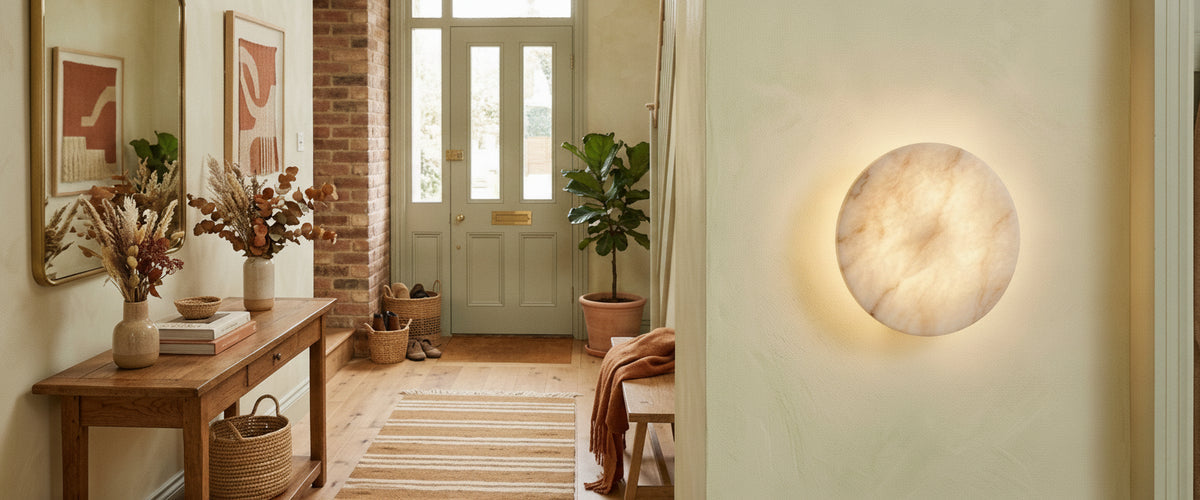
Covered space is another matter. A deep porch, a loggia, a glazed garden room or a sheltered courtyard with a solid roof over it will happily take an alabaster wall light, and the effect is worth planning for: the stone glows from within, veining reads like watermarked paper, and arriving guests get warm diffused light instead of a hard beam. We regularly specify a pair of alabaster wall lights inside a porch with a technical downlight over the door outside it, so the practical light and the atmospheric light do separate jobs. You can see how those stone forms behave across the alabaster lighting collection, and the broader lighting range shows how wall fittings, pendants and floor lamps can be kept in one visual family from the porch through to the hallway.
Dark-Sky Manners, Sensors and Timers
Good exterior lighting is a neighbourly act. Full-cut-off fittings that emit no light above the horizontal, warm colour temperatures and modest output all reduce skyglow and light trespass; the Dark Sky International lighting principles are a short, sane read before you finalise a scheme, and the Institution of Lighting Professionals publishes detailed guidance on obtrusive light for anyone specifying at commercial scale.
Controls do the rest. Put security lighting on a PIR sensor with a short timeout and a sensitivity setting that ignores foxes and passing cars. Put welcome and amenity lighting on an astronomical timer or a smart relay so it comes on at dusk and switches to a lower scene, or off entirely, at a set hour. Dimming exterior LEDs to around 30 per cent after midnight keeps the house legible without lighting the whole street.
The Outdoor Wall Lights Buying Checklist
- List the tasks that need light, then delete the ones that do not.
- Match beam shape to surface: downward for smooth render, up-and-down for texture, lanterns for faces and period frontages.
- Confirm IP44 minimum under cover, IP65 for exposed positions.
- Within a mile of the coast, specify 316 stainless, solid brass or a marine-grade coating, and check the fixings.
- Choose 2700K to 3000K with CRI 90 or above.
- Mock up positions in cardboard and check heights from the gate, the door and the pavement.
- Decide mains, low voltage or solar based on run length, winter performance and how often you may want to change the layout.
- Book a qualified electrician early; back boxes and cable routes are far easier before rendering or repointing.
- Add sensors and timers at design stage, not as an afterthought.
- Plan an annual clean: soft cloth, mild soapy water, no solvents, and a check on gaskets and seals.
Budget for exterior schemes varies enormously with material, scale, engineering and installation complexity, so treat any single figure you see quoted online with suspicion and ask for a price against your actual elevation drawings. If you are pairing a technical exterior scheme with softer stone fittings inside the threshold, our team at Niori can help you match finishes and colour temperature across both, so the move from garden to hallway feels like one continuous idea rather than two separate shopping trips.