
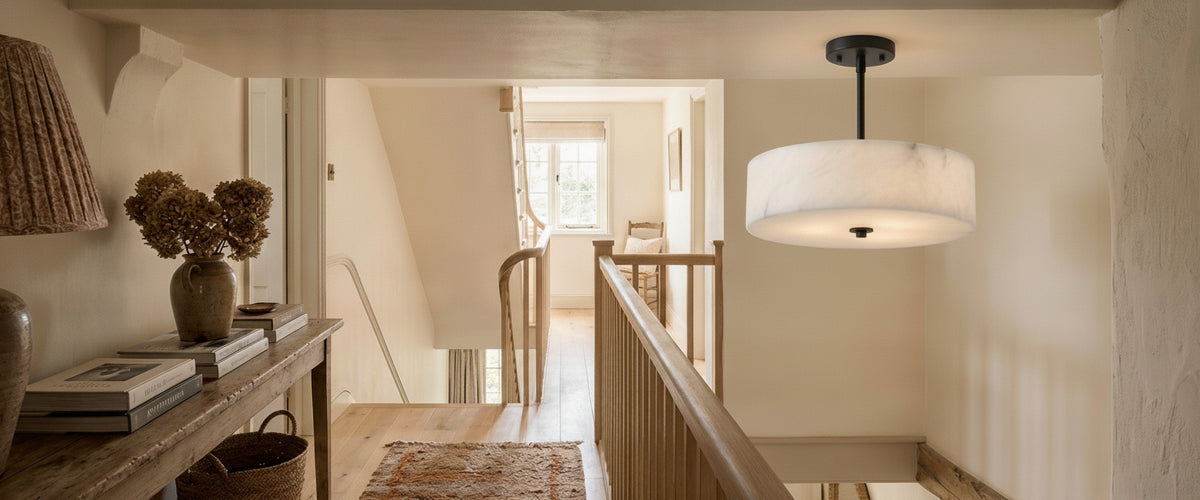

Hang a 900mm pendant in a room with a 2.4 metre (roughly 8ft) ceiling and you will spend the next few years walking around it. That is the everyday problem an industrial semi flush fitting was built to solve: it sits close to the ceiling, keeps the visual weight of a proper metal fixture, and still throws light sideways rather than straight down into a puddle. Get the numbers right and it looks intentional. Get them wrong and it looks like a pendant that lost an argument with the plasterboard.

At a Glance: When an Industrial Semi Flush Is the Right Call
- Ceiling under about 2.4m (8ft): an industrial semi flush almost always outperforms a hanging pendant, especially over walkways and seating.
- You want presence, not a disc: unlike a fully flush mount, a semi flush holds a cage, louvre or shade with real form.
- Multi-light versions scale up: three and four light fittings cover more floor area than a single lamp without needing extra drop.
- Finish carries the room: aged iron and blackened brass hold shadow; brushed steel needs warmth nearby to avoid looking clinical.
- Diffusion matters more than wattage: seeded glass, opal or alabaster softens the glare that bare industrial cages create.
- Lamp choice finishes the job: a wide beam angle at 2700K does more for a cage fitting than any amount of extra wattage.

The Ceiling Height Argument: When a Pendant Overwhelms
Designers tend to work from a rule of thumb that the underside of a fitting should sit around 2.1m (about 7ft) above the floor in circulation space. In a 1930s semi with 2.35m ceilings, that leaves you roughly 250mm of usable drop once you account for the canopy and rod. A pendant designed for a double-height hallway simply cannot live there.
An industrial semi flush works within that constraint instead of fighting it. The body sits 150mm to 300mm below the ceiling plane, so the fitting still casts a shadow line and reads as an object, yet nobody clips it carrying a laundry basket upstairs. We shipped a four light black oxide fitting like the Collier 4 Light Semi-Flush Ceiling Light to a converted mill flat in Manchester where the client had already sent back two pendants; the ceiling was 2.3m and both had hovered awkwardly at eye level. The semi flush read as architecture rather than an obstacle.
There is a second argument that has nothing to do with headroom. Low ceilings bounce light. A fitting held close to the plaster uses that surface as a reflector, spreading a broader wash than a pendant that concentrates output downward. In a snug or a landing, that is exactly what you want.
Drop Distance and Canopy Width: The Two Numbers Buyers Underestimate
Almost every industrial semi flush return we handle comes down to one of two measurements being guessed rather than checked.
Drop. Buyers read "semi flush" and assume it means "barely there". Some sit tight to the ceiling; others drop enough to need a full rod and count as a mini pendant in all but name. Measure from your ceiling to the top of any door frame, wall unit or bed head in the same sightline. If the fitting extends below that line, it will look heavy, no matter how good the metalwork.
Canopy width. The ceiling plate is the part nobody photographs and everybody notices afterwards. A wide canopy hides an old rose or a patched-over hole; a narrow one exposes it. If you are replacing a fitting rather than wiring from scratch, measure the existing ceiling rose footprint before you order. A 100mm canopy over a 140mm scar is a weekend of filler and touch-up paint you did not plan for.
Scale the visible diameter to the room, too. A rough working method: add the room's length and width in feet, treat that total as inches, and use it as the diameter of your fitting. A 12ft by 14ft room suggests something around 26in (roughly 66cm) across, which usually means a three or four light fitting rather than a single lamp.
Aged Iron, Blackened Brass or Brushed Steel: Finishes for an Industrial Semi Flush
Industrial lighting borrowed its language from factory and workshop fittings, where form answered the demands of the machine rather than the drawing room. You can trace that shift through the design collections at the V&A, and it explains why the best examples still look purposeful rather than decorative.
In practice, the finish decides whether the fitting holds the room or falls flat:
- Aged iron and black oxide: the safest choice in a room with warm timber, exposed brick or dark cabinetry. It absorbs light, so the fitting reads as a silhouette. Watch it against very dark ceilings, where it can disappear entirely.
- Blackened or antique brass: more depth than plain black, with a warm edge that flatters plaster, lime wash and natural stone. This is the finish that rescues an industrial fitting from feeling austere in a family kitchen.
- Graphite and brushed steel: crisp and architectural, excellent in a utility room or boot room. In a living space it needs company. Pair it with leather, wool or stone, or it turns cold under LED light.
- Polished chrome: reads contemporary rather than industrial and shows fingerprints. Usually a bathroom decision, where an IP-rated fitting is required anyway.
If a fully metal fitting feels too hard for the room, a stone or alabaster diffuser changes the temperature of the whole scheme. Our alabaster lighting collection shows how a translucent shade paired with darkened metal keeps the industrial frame while taking the glare out of it. Alabaster carries faint internal veining that throws a soft amber cast when lit, which sits far more comfortably over a dining table than a bare cage.
Kitchens, Landings, Snugs and Corridors: Same Fitting, Different Demands
Kitchens need working light with reasonable colour accuracy. Two or three smaller industrial semi flush fittings spaced along a run of worktop beat one central fitting fighting your own shadow. Keep 800mm to 1m between centres on an island, and never place a single fitting directly behind where you stand to chop.
Landings and stairwells are about headroom and glare angle. Anyone climbing stairs looks upward, straight into the light source. A louvred or partially shielded shade is worth the extra spend here; a shielded industrial semi flush such as the Louvre 4 Light Semi-Flush Ceiling Light in graphite keeps the lamp out of the direct upward sightline while still spreading light across the stair. A naked filament bulb at eye level is uncomfortable and, on a stair, genuinely unhelpful.
Snugs and bedrooms want the fitting doing atmospheric work, not task work. Choose diffusion over output, dim it hard, and let table lamps carry the reading. Marble and onyx table lamps do this job well alongside a darker ceiling fitting; browse the wider lighting range if you are building the layers rather than buying one piece.
Corridors reward repetition. Two or three identical fittings at even spacing read as a considered scheme; one lonely fitting in the middle reads as a builder's decision. Allow roughly 1.8m to 2.4m between centres depending on corridor length. Where the run is narrow and a multi-arm fitting would crowd it, a single-lamp piece like the Winslow 1 Light Semi-Flush in natural brass with seeded glass repeats well, and the textured glass takes the hard edge off the filament at close quarters.
Beam Angle Inside a Cage Matters More Than the Wattage Label
Wattage tells you almost nothing useful about an LED retrofit. Beam angle tells you what the fitting will actually do. Drop a 25 degree spot lamp into an open cage and you get a hard pool on the floor plus visible scallops on the ceiling. Use a 200 degree or fully omnidirectional lamp and the same fitting washes light in every direction, which is what an industrial semi flush is geometrically designed to do.
Three practical notes on lamps:
- Stay at 2400K to 2700K for living spaces. Above 3000K, aged metal finishes start to look grey and alabaster loses its honey tone.
- Choose lamps rated CRI 90 or above where food, skin tone or natural stone is involved. Low-CRI lamps flatten marble veining badly.
- Check dimmer compatibility before you buy. Mismatched trailing-edge dimmers and cheap drivers cause the flicker and buzz people blame on the fitting. The Energy Saving Trust has clear guidance on dimmable LED specification.
Any hard wiring, dimmer replacement or ceiling-box work should be done by a qualified electrician. It is also the moment to confirm the ceiling box can carry the weight of a multi-arm metal fitting, which can be considerably heavier than the plastic pendant it replaces.
Two Mistakes That Ruin an Otherwise Good Installation
Undersized fittings. This is the most common error by a wide margin. People compensate for a low ceiling by buying something small, which makes the ceiling look lower still. Go wider rather than longer. A broad, shallow four light industrial semi flush anchors a room; a dainty single light floats in it.
Clashing canopy trims. Mixing metal temperatures across one ceiling plane is where schemes come undone. A blackened brass canopy next to chrome downlight bezels will read as a mistake even if nobody can articulate why. Decide on your ceiling metal first, then let wall lights and table lamps introduce contrast lower down, where the eye reads them as a deliberate layer.
Buyer's Checklist Before You Order an Industrial Semi Flush
- Measure floor-to-ceiling height at the exact fixing point, not the room average. Old houses slope.
- Note the total drop of the fitting and compare it to your door head height.
- Measure the existing ceiling rose or patch, then check the canopy diameter will cover it.
- Add room length plus width in feet, use that number in inches as your target diameter.
- Decide the ceiling metal finish and match every other ceiling-level trim to it.
- Confirm lamp base, beam angle, colour temperature and CRI, not just wattage.
- Check IP rating if the fitting is going into a bathroom zone or a covered porch.
- Ask whether the fitting is dimmable as supplied and which dimmer type is recommended.
- Book a qualified electrician and confirm the ceiling box weight rating with them.
Living With the Fitting: Care Notes
Aged and blackened finishes are patinated, not plated, so aggressive metal polish will strip them. Dust cages with a dry soft brush, then wipe with a barely damp microfibre cloth and dry immediately. An industrial semi flush over a hob collects an airborne film of cooking oil within months; a diluted neutral soap solution lifts it before it hardens.
Stone and alabaster components need gentler handling still. Natural stone is porous and reacts to acids, so keep vinegar and citrus cleaners away from it entirely. A dry cloth, then a damp one with plain water, and never let water sit in a carved seam. Cool the fitting fully before touching any glass or stone shade. Handled this way, an alabaster diffuser will outlast several generations of bulb technology, which is a large part of why we build around it at Niori.
An industrial semi flush is one of the few fittings that genuinely improves a compromised ceiling rather than apologising for it. Measure twice, size up rather than down, keep your metals consistent, and let a diffused shade do the work your bare bulb cannot.