
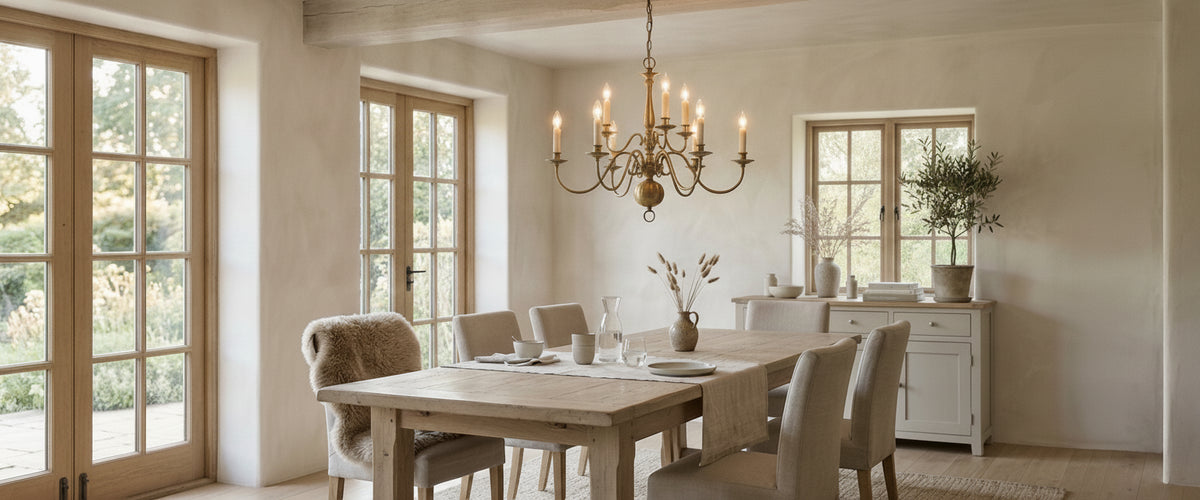

The most common complaint about an antique brass chandeliers is not about a fault. It is about disappointment: the piece that looked honeyed and mellow in the photographs now looks muddy, greenish or oddly dull above the dining table. Nothing is wrong with the metal. Antique brass is a finish that reacts to everything around it, including the bulb, the wall colour, the ceiling height and the air in the room. Once you understand how it is made, buying one becomes far less of a gamble.

Quick Answer
- Antique brass is a finish, not an alloy. It is brass that has been chemically darkened and then hand-relieved to suggest age.
- Lacquered pieces hold their colour for years. Unlacquered pieces keep deepening and will look noticeably richer by year five.
- Bulbs at 2200K to 2700K with a high colour rendering index keep the warmth. Cooler light turns it grey-green.
- Warm backdrops soften it; cool or dark backdrops make it glow.
- Scale to the ceiling first, then the room. A many-armed piece in a low room reads busy at eye level.

What Antique Brass Actually Is
Start with the base metal. Brass is a copper and zinc alloy, and fresh from polishing it is bright, almost yellow-gold. The antique look is built on top of that in layers. The metal is cleaned and degreased, then treated with an oxidising solution that darkens the surface to a brown or near-black. A finisher then works back over the piece by hand with fine abrasives, rubbing the high points and edges so brighter metal shows through where years of handling would naturally have worn it. The result is then waxed, oiled or sealed with lacquer. The Copper Development Association's guidance on architectural copper-alloy finishes is a useful read if you want the chemistry behind chemically induced patinas.
That hand-relief stage is where quality shows. On a well-finished antique brass chandelier the contrast follows the form: lighter on the curve of an arm, darker in the recesses of a cast cup. On a cheaper piece the colour sits like a flat brown paint, because sometimes that is roughly what it is. Ask whether the body is solid brass or brass-plated steel or zinc. Plated finishes can look convincing on day one, but they cannot be refinished in the same way and they tend to fail at scratches.
Lacquered or Unlacquered: How Patina Changes Over Five Years
This is the decision that shapes how an antique brass chandelier looks long after delivery, and it deserves more thought than it usually gets.
Lacquered
A clear lacquer locks the finish at the moment it left the workshop. Five years on, a lacquered antique brass chandelier in a sitting room will look much as it did the day it was hung. That predictability suits designers matching a scheme, or anyone who wants the chandelier to agree with antique brass switch plates and wall lights bought at the same time. Even a small plate such as the 10AX 1 Gang DP Switch, Antique Brass plays a part: chosen in the same finish as the fitting, it keeps the tone consistent around the room rather than leaving one element a shade lighter or darker. The trade-off is that lacquer is a skin. If it chips during installation or cleaning, air reaches the metal at that spot and a small dark patch forms, which can look worse than an evenly aged surface.
Unlacquered
An unlacquered finish keeps moving. In the first months you will see fingerprints from installation, which alarm people. It is common for owners to assume a new antique brass chandelier is faulty within a fortnight of hanging it; by the following winter the prints have usually blended into a deeper, even brown and the piece starts to look as though it has always been there. By year five, expect a darker, softer, more chocolate tone, with the highlights mellowing too. Kitchens and rooms near the coast age faster because of steam and salt, and a faint green can appear in crevices. If that sounds appealing, go unlacquered. If it sounds like a problem, do not.
Wall Colour, Flooring and the Way Antique Brass Reads
The same antique brass chandelier can look like two different objects depending on what sits behind it. Antique brass is mid-toned and warm, so it either blends with its backdrop or stands out from it.
- Warm backdrops such as plaster pink, ochre, terracotta, honey oak floors and creamy limewash let the brass recede. The effect is quiet and enveloping, good in a bedroom or snug.
- Cool backdrops such as soft greys, white marble with blue veining and pale stone floors push the brass forward, so it reads more golden by contrast.
- Dark backdrops such as deep green, inky blue or aubergine are where antique brass looks its best. The metal catches every bit of light and the dark wall absorbs the rest.
- Brilliant white walls under cool light are the combination that causes most complaints. The brass loses its warmth and can tip towards khaki.
Flooring matters more than people expect, because light bounces upward. A pale oak floor throws warmth back into the underside of the arms. Polished dark stone reflects the chandelier itself, which doubles the sparkle in a hall.
Bulb Temperature and Shade Choice for an Antique Brass Chandelier
Hang a piece of antique brass under two lamps side by side, one at 2700K and one at 4000K, and the difference is immediate. At 4000K antique brass looks grey and slightly dirty; at 2700K it looks like brass. For an antique brass chandelier, stay between 2200K and 2700K, and choose LEDs with a colour rendering index of 90 or above so the reds and ambers in the metal are actually rendered.
Dim-to-warm LEDs are worth the extra thought: as you dim, the colour drops towards candlelight, which is when this finish looks richest. Check that bulbs and dimmer are compatible (trailing-edge dimmers generally suit LED loads better) and have a qualified electrician fit the switch and fixture.
Shades change the character as much as the bulb does:
- Clear glass or exposed filament lamps give sparkle and throw small highlights onto the metal. They can glare at eye level in a low room.
- Seeded glass scatters light into soft points, a natural partner for a three-light natural or antique brass piece over a kitchen table. A compact design such as the Winslow 3 Light Chandelier Seeded Glass, Natural Brass is close to the right scale for that job; its natural brass will read brighter than an antique finish, but the seeded shades give the same softened sparkle.
- Ivory or linen fabric shades calm everything down and suit traditional drawing rooms.
- Alabaster is the pairing we return to most. A stone bowl or shade turns the bulb into a creamy amber glow that matches the warmth of aged brass almost exactly, with the natural veining adding movement when lit. Our alabaster lighting collection is a good place to see how brass fittings and stone diffusers sit together.
Scale, Arm Count and Ceiling Height
A chandelier designed for a double-height hall has a lot going on: tiers, many arms, drops, decorative stems. Hung high, that detail resolves into a single shape. Bring the same piece into a sitting room with a 2.4m (about 8ft) ceiling and it sits close to eye level, where every joint and arm competes for attention. That is why it reads fussy.
A typical example: a twelve-arm piece hung in the front room of a Victorian semi, with a ceiling of around 2.5m (8ft 2in). It looks crowded and the lowest arms come close to head height. Moved to the stairwell, the same chandelier looks exactly right, and a compact five-light suits the front room far better.
Some working rules:
- Diameter: add the room's length and width in feet; that number in inches is a sensible starting diameter. In metric, the sum in metres multiplied by roughly eight gives centimetres.
- Over a table: allow roughly 75 to 90cm (30 to 36in) between the tabletop and the lowest point, and keep the diameter to around half to two-thirds of the table width.
- Walkways: keep at least 2.1m (7ft) of clear head height.
- Low ceilings: choose three to five arms, a single tier and a short drop, or a semi-flush design.
- High ceilings: eight or more arms and multiple tiers earn their place, especially in halls and stairwells.
Before You Buy: A Checklist
- Confirm solid brass or plated, and whether the finish is lacquered, waxed or raw.
- Decide whether you want a fixed colour or a living patina, and be honest about it.
- Look at your wall colour and floor under the light you will actually use at night.
- Measure ceiling height and the drop you can allow before choosing arm count.
- Check the bulb type, cap and maximum wattage, and plan for warm, high-CRI LEDs.
- Ask for the fixture weight and confirm with your electrician that the ceiling point can carry it.
- Think about matching finishes on wall lights and switch plates so the room hangs together.
Budget depends on material, scale, complexity, engineering, installation and finishing, so we recommend requesting a tailored quote rather than working from a ballpark. You can compare brass, stone and glass options across our full lighting range.
Care and Installation
Dust a lacquered antique brass chandelier with a soft, dry microfibre cloth and nothing else; metal polish strips lacquer. For unlacquered brass, a dry cloth keeps it even, and a light coat of microcrystalline wax slows the patina if you want to hold a colour. If your chandelier carries alabaster shades, clean the stone separately with a dry cloth only, since alabaster is soft and water marks it. Switch off at the mains and let bulbs cool before any cleaning. Installation of any ceiling fixture, especially a heavy multi-arm piece, should always be handled by a qualified electrician who can check the ceiling support as well as the wiring.
Handled with a little forethought, an antique brass chandelier is one of the few fittings that can genuinely improve with the years, whether you lock its colour in or let it deepen. At Niori we pair brass with alabaster, marble and onyx because the materials work so well together: the stone softens the light, the metal holds or deepens its tone, and the room feels warmer the longer you live with it.