
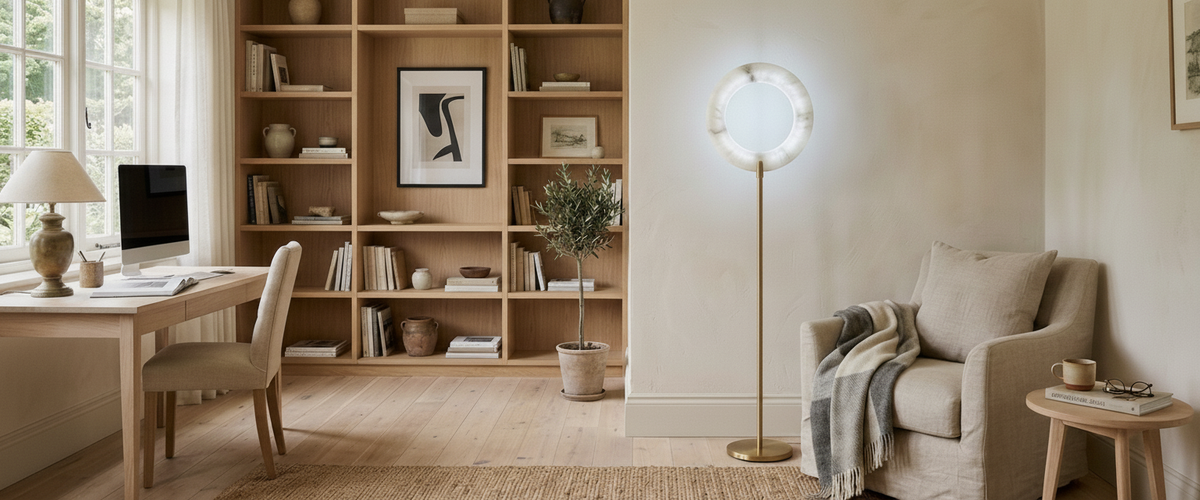

A good alabaster floor lamps does something no downlight or ceiling fitting can manage: it stands at eye level and glows from inside, throwing a warm column of light into the corner of a room while the stone itself softens the edges of everything around it. Get the placement right and it anchors a whole seating area. Get it wrong and even a beautiful piece reads as furniture that nobody quite knows what to do with. Placement is where most of these lamps succeed or fail, so that is where we will spend our time.
We ship these regularly to buyers who have already fallen for the material and now need to know exactly where it goes. The material is the easy part. The corner, the bulb, and the neighbouring furniture do the real work.

Key Takeaways
- An alabaster floor lamp works best in a corner or beside seating where its glow has darker surfaces to play against.
- Uplight torchiere shapes wash the ceiling; shade-diffused shapes give a lower, reading-height pool. They suit different rooms.
- Warm-white bulbs around 2700K and a good dimmer keep the stone looking honey-toned rather than grey.
- White stone gives a clean, even glow; veined stone adds pattern and warmth but a slightly less uniform spread.
- The most common mistake is stranding the lamp in open floor space where it lights nothing in particular.

The Corners That Welcome a Stone Floor Lamp, and the Ones It Overwhelms
Alabaster is happiest with something to react against. Set the lamp in a corner where two walls meet and the stone bounces light onto both surfaces, filling a dead zone that overhead lighting always misses. That corner behind a sofa, the gap beside a bookcase, the turn of an L-shaped seating plan: these are where an alabaster floor lamp earns its place.
The rooms it overwhelms are the small and the already-bright. Drop a tall stone column into a narrow hallway and it dominates rather than lights. Put it in a room flooded with south-facing daylight and pale walls, and by day it barely registers; the glow that makes it special only shows against some contrast. If your walls are already high-gloss white and the space is compact, a table lamp in natural stone often serves better than a floor model. Scale matters more with stone than with metal or fabric because the material asks to be noticed.
Uplight Versus Shade-Diffused: Two Very Different Glows
One silhouette, two completely different jobs. An alabaster torchiere floor lamp pushes light upward, the carved bowl catching the beam and washing it across the ceiling. That reflected light fills a room gently and flatters plaster and beams. Where you want that upward wash in a metal fitting rather than stone, a piece like the Opera Torchiere Floor Lamp shows the same indirect logic at work. Because it is indirect, it rarely gives you enough to read by, but it sets a mood beautifully and lifts a low-ceilinged room by drawing the eye up.
A shade-diffused lamp, where the alabaster forms a drum or the fitting carries an alabaster floor lamp shades, throws a lower, more usable pool of light at seating height. This is the one you want next to a reading chair. Some pieces combine the two, with an uplight bowl and a lit stem, and those work hardest in a large room because they light the ceiling and the floor in one gesture. Decide what the lamp is actually for before you fall for a shape. A gorgeous torchiere beside a reading chair will frustrate anyone trying to finish a chapter after dark.
Footprint Next to Sofas, Reading Chairs and Consoles
The practical questions are about where the light lands and where the base sits. A few placements that consistently work:
- Beside a reading chair: position the lamp slightly behind and to the side of the shoulder, so light falls onto the page rather than into the eyes. Shade-diffused or downlight-capable models suit this best. For that job in a warmer metal register, a linen-shaded form such as the Penny Tripod Floor Lamp in Burnished Brass gives the same low, readable pool the diffused stone shapes aim for.
- At the end of a sofa: a taller design reads as a natural bookend to the arm. Keep the base clear of foot traffic and out of the walkway between sofa and coffee table.
- Flanking a console or media unit: a slim column or an alabaster totem floor lamp with a monolithic form balances a low horizontal piece of furniture and lights the wall behind it.
- Filling a dead corner: the classic move. The corner gives the glow two surfaces to work against and hides the flex neatly.
Give the base breathing room. Stone bases are weighty by design, which is what keeps a tall lamp stable, but crowding one against a chair leg or wedging it behind a curtain kills the effect. You are choosing a piece of furniture with a footprint, so measure the clearance the way you would for a side table. If you want to see how floor and table pieces sit together across a scheme, the wider lighting collection is a useful place to compare proportions.
Warm-White Bulbs and Dimming That Keep the Stone Glowing
Alabaster lives or dies by the bulb inside it. The material is translucent and slightly warm in tone, so a cool or blue-leaning LED drains it to a flat grey and throws away everything you paid for. Fit a warm-white bulb, ideally around 2700K, and the stone reads honey and cream the way it should. Push cooler than 3000K and you lose the glow.
Two more things matter as much as colour temperature. First, colour rendering: a bulb with a high CRI, around 90 or above, shows the veining and warmth of the stone honestly. Second, dimming. An alabaster floor lamp at full output can feel too eager; on a dimmer it settles into the low, candle-like light the material was made for. Use a bulb rated as dimmable and a compatible dimmer, and always have a qualified electrician confirm any hard-wired dimming or fixed installation. The Chartered Institution of Building Services Engineers publishes lighting guidance worth a look if you are planning levels across a whole room rather than a single lamp.
White Stone or Veined: What Each Does to the Ambient Light
A white alabaster floor lamp gives the cleanest, most even glow. Fewer heavy veins mean light spreads uniformly through the stone, which suits pared-back interiors and rooms where you want the lamp to feel quiet. It is the safe, elegant choice for a modern scheme.
Veined and figured stone does something different. The mineral lines catch and hold the light, so the lamp glows unevenly in a way that adds character and warmth. Against a dark-panelled study or a richly coloured wall, that pattern comes alive. The trade-off is a slightly less uniform pool of light, so it favours mood over task. An alabaster traditional floor lamp with heavier veining and brass detailing leans period and formal; a smooth white column reads contemporary. For a period scheme where the stone itself is unavailable, a traditional fitting such as the Lincolndale Traditional Floor Lamp in Astral Bronze carries the same formal, warm-toned language. Neither is better. They light a room differently, and the room should decide.
Every block of alabaster is unique, which is part of the appeal and worth understanding before you buy. Museums that conserve the stone note how its translucency and mineral banding vary piece to piece; the Getty holds carved works that show just how differently it can read under light. Expect variation in your own lamp and welcome it.
Placement Mistakes That Leave a Fine Lamp Looking Like an Afterthought
The errors are consistent, and all of them are avoidable:
- Stranding it in open floor. A lamp adrift in the middle of a room lights nothing in particular and looks lost. Anchor it to seating, a corner, or a piece of furniture.
- Fighting the daylight. Placing it where strong daylight overpowers the glow for most of the day wastes the material. Reserve corners and darker walls for it.
- Wrong bulb, grey stone. Cool bulbs are the single most common reason a lovely lamp underwhelms. Warm and dimmable, always.
- Ignoring scale. A slender design lost against a large sofa, or a heavy totem crammed into a tight nook, both jar. Match the mass of the lamp to the mass of the furniture near it.
- Trailing flex on show. Route the cable behind furniture or along the skirting. Nothing undercuts a stone lamp faster than a loop of visible cable across a walkway.
One last note from the studio. We once sent an antique alabaster floor lamp with heavy veining to a client who set it in a north-facing sitting room in a period house, on a dimmer, tucked into the corner beside a dark green wall. It looked ordinary in the photos and quietly extraordinary in the room. That is the whole lesson: the lamp is only as good as the corner and the light you give it. If you are weighing shapes and finishes, browsing the alabaster lighting range with your room in mind will tell you more than any spec sheet.