
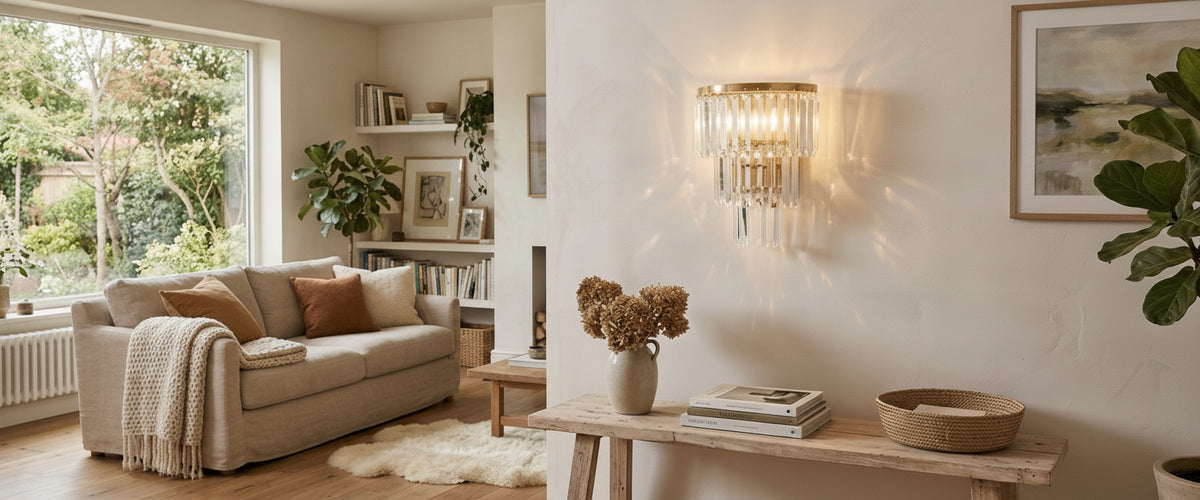

Most crystal wall sconces fail in the same quiet way. They get mounted flat against a matt-painted wall, fitted with a frosted lamp, then dimmed to a whisper so the room feels calm. Every one of those decisions strips the refraction out of the crystal, and what should have been a wall of moving light becomes a slightly shiny bracket. A crystal wall sconce is an optical instrument before it is an ornament, and it only performs when the cut, the light source, the mounting depth and the surface behind it are working together.

Key Takeaways
- Crystal needs a point source. A clear filament or small-envelope LED produces defined refraction; a frosted lamp turns the whole fitting into a dull glow.
- Cut depth matters more than crystal count. Deep, sharply angled facets throw shards of light; shallow pressed facets give a soft, low-contrast shimmer.
- Arm and bracket depth control the show. A crystal wall sconce sitting under about 80mm (3in) off the wall has nowhere to cast its pattern.
- Your wall finish is half the fitting. Chalky matt paint absorbs refraction; eggshell, lacquer, polished plaster and antique mirror multiply it.
- Dimming exposes everything, from a poorly matched driver to a mediocre cut. Specify the dimmer and the lamp together, not as an afterthought.

K9, Lead Crystal and Faceted Glass: Three Scatter Patterns from One Bulb
Put three crystal wall sconces side by side with identical lamps and you get three completely different light patterns, because the glass itself bends light at different rates. K9 optical crystal is a clear, lead-free optical glass, machine-cut to consistent angles. It is bright, clean and slightly cool in character, and it is what most modern crystal wall lights use. Traditional lead crystal contains lead oxide, which raises the refractive index and produces heavier, warmer, more prismatic flashes, along with that distinctive weight in the hand. The Corning Museum of Glass has a useful explanation of how glass composition changes optical behaviour, and it is worth five minutes if you are specifying for a project where the sparkle has to read from across a room.
Faceted pressed glass is the third category, and it deserves less snobbery than it gets. Pressed facets are moulded rather than cut, so the angles are softer and the edges rounder. The result is glitter rather than refraction: a lot of small highlights, very little projected pattern. On a landing where you want texture without theatre, that can be exactly right. On a bedhead where the crystal sits within arm's reach and gets inspected daily, it will not hold up.
One caution from the studio: crystal count is a terrible proxy for quality. We have seen a crystal wall sconce hung with sixty small pressed drops throw less light onto a wall than one with a dozen properly cut prisms. Ask what the crystal is, how it is cut, and how it is fixed, before anyone tells you how much of it there is.
Cut Depth and Drop Shape Decide Shards or Shimmer
The single biggest visual variable is the depth of the cut. A deep V-cut with sharp arrises acts like a series of small prisms, splitting the beam into distinct rays that land on the wall and ceiling as defined lines. Shallow cuts scatter at low angles and produce an even, diffuse sparkle with almost no projection.
Drop shape changes the direction of the show. Long, slim baguette or icicle drops send light downward in vertical streaks, which flatters tall narrow walls and panelled hallways. Faceted spheres and octagons scatter in every direction, so they suit a room where the crystal wall sconce is seen from multiple angles. Flat, chandelier-style pendeloques catch light on their broad face and flash when you move, which is why they read so well in circulation spaces where people are always walking past.
If you want a crystal light wall effect down a corridor, choose deeper cuts and accept that you will see pattern on the plaster. If you want quiet glamour behind a dining table, shallower cuts and rounded drops keep the sparkle contained.
Arm Length and Bracket Depth: How Far Off the Wall a Crystal Wall Sconce Should Sit
Refraction needs somewhere to go. A crystal element pressed tight to the backplate loses much of its throw to the wall behind it, and the little pattern it does cast lands within a few centimetres of the fitting. Give the same fitting an arm that holds the crystal 100 to 150mm (4 to 6in) off the wall and the projection opens into a proper fan.
That extra depth carries consequences. In a hallway narrower than about 1.1m (3ft 6in), a deep-projection crystal wall sconce is a shoulder hazard, and building control conversations about protrusion into escape routes are not worth having on a whim. Measure the clear width, then choose depth accordingly. Slim wall lights with crystals mounted close to the backplate exist precisely for tight corridors, and they are the honest answer there, even if they sparkle less. Where the wall can only give up a few centimetres, a compact glass fitting such as the Astro 1 Light Glass Wall Light, 25cm keeps the light close to the plaster rather than out at shoulder height.
Mounting height also shifts the effect. At the usual 1.5 to 1.65m (roughly 60 to 65in) to centre, a crystal wall sconce throws pattern up onto the ceiling and down the wall. Drop it to bedhead height, around 400 to 600mm above the mattress, and most of the refraction lands where people can actually see it while lying down. Which may or may not be what you want at midnight.
Matt Paint Absorbs the Pattern, Gloss and Mirror Multiply It
We shipped a pair of crystal wall sconces to a Bath townhouse where the designer had specified deep chalky limewash on the stairwell. The fittings were beautiful. The refraction disappeared entirely, because a matt mineral surface scatters incoming light and returns almost none of it as a defined pattern. She repainted a single test panel in an eggshell finish of the same colour and the sconces came back to life.
The hierarchy is straightforward. Chalk and flat emulsion absorb. Eggshell and satin hold a soft version of the pattern. Lacquered or polished plaster keeps the edges crisp. Antique mirror and dark polished stone double the fitting, because you get the crystal and its reflection at once. Silk wallcovering sits in the middle and adds its own sheen, which is why crystal modern wall light schemes in hotel corridors so often pair with a subtle textured paper rather than flat paint.
Dimming a Crystal Wall Sconce Reveals Every Flaw in the Cut and the Driver
Crystal is unforgiving at low output. Dim the lamp and the source loses brightness without losing its hard edges, so any inconsistency in the facet angles shows up as uneven flashing. Cheap drivers add flicker, which crystal amplifies into visible shimmer because you are seeing dozens of reflected copies of the same unstable source.
Practical guidance for a crystal wall sconce on a dimmer:
- Use a clear lamp with a compact filament, not a frosted or opal envelope. Frosting destroys the point source and with it the refraction.
- Choose 2700K and CRI 90 or above. Higher colour temperatures make cut crystal look glassy and blue.
- Match the dimmer type to the driver, usually trailing edge for retrofit LED. Ask your electrician to confirm minimum and maximum load for the circuit.
- Consider warm-dim lamps that shift towards 2200K as they lower. Crystal reads far better warm at 20 per cent than it does cold.
- Test one fitting before committing a run of six. Flicker is easiest to spot on a phone camera at low output.
Chrome, Brass and Antique Silver: How the Frame Tints the Refraction
The metal frame of a crystal wall sconce is a mirror sitting inside the optical path, so it colours everything the crystal throws. Polished chrome and nickel keep the light neutral and slightly cool, which suits K9 crystal and modern crystal wall light schemes in bathrooms and pale interiors. Unlacquered or antique brass warms the refraction noticeably, pushing the flashes towards amber and softening the contrast; it flatters lead crystal and works beautifully alongside walnut, oxblood and deep greens. A brass-bodied fitting such as the Essence Brass Round Wall Light, 75cm is a fair gauge of how much warmth the metal alone brings to a wall before any crystal is introduced. Antique silver and pewter absorb more than they reflect, so the sparkle reads quieter and older, which is often the point in a period hallway.
Mixing metals across a scheme is fine. Mixing them within one fitting rarely is, because the crystal will pick up both tints and the result looks unresolved rather than deliberate. If you are pairing crystal sconces with stone or alabaster pieces elsewhere, match the metal detailing across the range; you can browse how brass and blackened finishes sit against natural materials across our full lighting collection.
Hallways, Bathrooms and Bedheads: Where the Drama Lands and Where It Overplays
Hallways and stairwells are where a crystal wall sconce earns its keep. People move through them, and moving past a faceted fitting is what triggers the flash. Pairs flanking a mirror or spaced evenly up a staircase give rhythm without needing a chandelier. Where the wall is wide enough to take a horizontal fitting instead, a two-lamp piece such as the Astro 2 Light Glass Wall Light, 40cm spans a mirror more comfortably than two separate sconces crowded either side of it.
Bathrooms are the technical case. Any fitting near a bath or shower must carry the right IP rating for its zone and be installed by a qualified electrician working to Part P; the NICEIC is a sensible place to check registered contractors. Crystal at a vanity is genuinely useful, because the scatter fills in the shadows that downlights carve under the eyes.
Bedheads are where crystal wall lights most often overplay. At close range the flash becomes glare, and a fitting designed to project pattern will project it straight into someone's face. If you want light with presence beside a bed, this is where alabaster wins outright. A carved stone shade glows from within, holds no hard highlight, and gives the warm, even reading light that faceted glass cannot. Our alabaster lighting range exists for exactly that trade-off, and plenty of clients specify crystal in the hallway and alabaster in the bedroom without any sense of contradiction.
The Buyer's Checklist for a Crystal Wall Sconce
- Confirm the crystal type: cut lead crystal, K9 optical crystal or pressed faceted glass.
- Ask about cut depth and whether the facets are hand-cut or moulded.
- Measure clear corridor width before choosing projection depth.
- Check the wall finish and, if it is flat matt, budget for a sheen change or accept a softer effect.
- Specify a clear, compact, high-CRI lamp at 2700K.
- Match the dimmer to the driver and mock up one fitting first.
- Choose the frame metal for the tint you want in the refraction, not only for the fixed hardware in the room.
- Confirm IP rating and zone compliance for any bathroom position, with a qualified electrician.
- Plan for cleaning access; crystal shows dust far faster than stone.
- Ask for a tailored quote. Cost depends on crystal grade, cut method, metalwork, scale and installation, so a like-for-like comparison is the only useful one.
Care, and the Long View
Crystal wants a light hand. Dust with a dry microfibre cloth, isolate the circuit before touching anything, and where the drops are removable, take them off and wash them separately. Avoid ammonia-based sprays on plated or unlacquered metal, and never let liquid run into the lampholder. Natural stone asks for the opposite routine: no water, no chemicals, just a soft dry brush.
Specified well, a crystal wall sconce does something no other wall fitting manages. It puts light in motion. Specified carelessly, it just hangs there. The difference is rarely the price of the fitting; it is the depth of the cut, the size of the source and the sheen of the plaster behind it. Get those right and the room does the rest. If you would like help pairing crystal with stone across a whole scheme, the team at Niori works on this daily.