
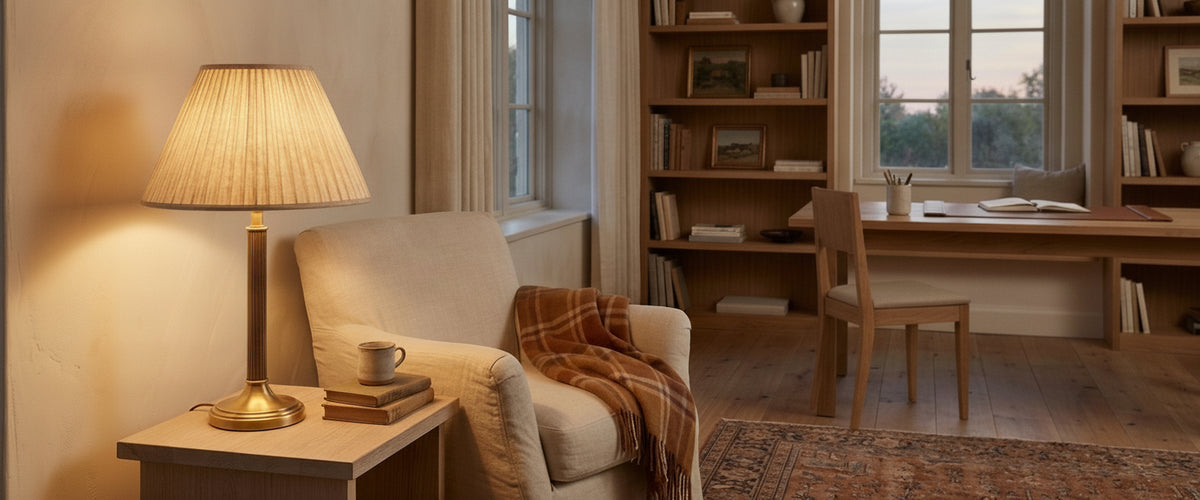

An antique brass table lamp is easy to judge in daylight and hard to judge at night. By day it reads as a calm, slightly smoky gold. At 9pm, with the bulb on and the curtains drawn, that same base can glow like old toffee or sink into a brown smudge. Which one you get depends on the shade, the bulb and what sits around it. We see the gap between those two outcomes every week at Niori, where most of our lamps pair brass detailing with alabaster, marble or onyx. So this guide is about what the lamp does once it is lit.

Quick Answer: At a Glance
An antique brass table lamp absorbs more light than polished or satin brass. It needs a luminous shade to carry the room.
Pair it with warm, translucent shades. Alabaster, ivory linen and parchment flatter it. Bright white cotton and black opaque drums tend to deaden it.
Use 2200K to 2700K bulbs. Filament styles at 2200K bring out the bronze undertones in a way chrome never shows.
Size to the surface. When you are seated, the bottom of the shade should sit roughly at eye level.
Repeat the finish once elsewhere in the room so a mixed-metal scheme looks planned.

How an Antique Brass Table Lamp Differs Once the Bulb Is On
Brass is a copper and zinc alloy, and the Copper Development Association has good material notes if you want the metallurgy. What matters when buying an antique brass table lamp is the surface. Polished brass is a mirror: it throws bright highlights and picks up every point source in the room. Satin brass is brushed, so it spreads reflections into a soft sheen. Antique brass has been chemically darkened, then usually relieved by hand and lacquered. The recesses stay dark and the raised edges catch the light.
That relief is the whole point. With an antique brass table lamp switched on, the light from the shade falls down the stem and lands on those raised edges. You get a broken, candlelit shimmer rather than a single hot reflection. On a turned or fluted base it looks rich. On a plain, smooth cylinder in a dark finish, much of the effect disappears, because there is no texture for the light to catch. If you like the antique look, choose a form with some carving, reeding or a stepped profile.
The darker finish also gives back less light. A polished brass base acts almost like a secondary reflector. Antique brass table lamps soak some of that light up, so the shade has to do more of the work.
Shade Color and Material: Where the Glow Is Won or Lost
An antique brass table lamp fails on the shade more often than on any other choice. The finish has warm red and olive undertones, and the shade either supports those or fights them.
Shades that flatter: natural alabaster, ivory or oatmeal linen, parchment, pleated silk in warm cream. Each one passes light through with a slightly honeyed cast that matches the aged metal below. Alabaster is the strongest match for an antique brass table lamp, in our view. The stone's veining turns into a soft amber pattern when lit, and the diffused glow falls evenly onto the base without glare. You can see how stone shades and brass fittings sit together across our alabaster lighting collection.
Shades that deaden: optic white cotton, which turns cool and makes the brass look grubby next to it. Opaque black or navy drums push all the light up and down, leaving the base in shadow so it reads as a dark lump. Pale gray shades are the subtle offender, because they cancel the warmth that makes antique brass worth buying.
One lesson from the studio: a client in a Georgian terrace in Bath sent back photos of an antique brass table lamp she described as "muddy." The base was fine. She had fitted a bright white drum from another lamp. We suggested an alabaster shade instead, and the same base went from flat brown to deep gold in her follow-up photos. Same room, same bulb.
Rooms Where Antique Brass Earns Authority (and Where It Competes)
Antique brass suits rooms that already have some depth: timber, leather, wool, stone, books, paintings in gilt or dark frames. In a paneled study, a library corner or a drawing room with a marble fireplace, an antique brass table lamp looks as if it has always been there. Bedrooms work well too, because the softer reflection is easier on the eyes at night than polished metal on a bedside table.
It struggles in two settings. The first is the all-white, high-gloss kitchen or bathroom, where it can look like an object left behind from another house. The second is a room already crowded with pattern and gilt. Put an antique brass table lamp next to a gilded mirror, a brass coffee table and a heavily patterned rug, and nothing stands out. Each warm metal cancels the others. In those rooms, a single stone lamp with minimal brass trim does more.
For hospitality, antique brass table lamps are reliable in hotel bars, members' lounges and restaurant banquettes. They hide fingerprints and wear far better than polished finishes, which matters when staff are not polishing every hour.
Base Proportion, Surface Height and the Objects That Flank It
Proportion decides whether an antique brass table lamp looks deliberate. A few working rules:
Shade height to eye level. On a side table next to a sofa, the bottom edge of the shade should land at roughly seated eye height, so you see glow rather than bulb. On most sofas that means the total of table plus lamp comes out around 38 to 42 inches (about 97 to 107 cm) from the floor.
Base width to table. The shade's widest point should not overhang the surface edge. If it does, the lamp looks top-heavy and gets knocked.
Visual weight. A dark antique finish looks heavier than polished brass of the same size. On a slim console, go slightly smaller than you think.
What sits beside the lamp matters as much as the lamp itself. An antique brass lamp looks best with one or two objects of a contrasting material: a stack of cloth-bound books, a small stone bowl, a ceramic vase in a matte glaze. Skip a second metallic object on the same surface. A pair of lamps on a console with a mirror between them is the classic arrangement for a reason. The mirror doubles the glow and the matching bases give a calm symmetry.
Bulb Choice: Why a 2200K Filament Behaves Differently Here Than in a Chrome Fitting
Color temperature changes how metal reads. Chrome and nickel are near neutral, so a 2200K filament simply makes them look warmer, like a chrome tap under candlelight. Antique brass already carries warm pigment in its patina. Light at 2200K pushes into that, deepening the bronze and amber tones and making the relieved edges glow orange-gold. The effect is noticeably richer than on any cool metal.
There is a limit. At 2200K in a room with no other light, an antique brass table lamp under a dark shade can go too brown. If the shade is alabaster or ivory linen, 2200K is lovely for evenings. If the shade is denser, step up to 2700K so the color stays gold rather than tobacco. The Energy Saving Trust has a clear explainer on choosing LED color temperature and brightness if you want to compare options.
Choose LEDs with a high color rendering index (CRI 90 or above). Cheap low-CRI bulbs flatten the red end of the spectrum, which is exactly where brass and alabaster get their warmth. Dimmable bulbs are worth the small effort, but check that the bulb and dimmer are compatible, and use a qualified electrician for any wall dimmer installation.
Mixing Antique Brass With Other Metals Without It Looking Accidental
Mixed metals look planned when there is a clear lead and a clear supporting role. Let antique brass lead in the warm pieces (lamps, picture lights, cabinet hardware) and keep a second metal for the functional or cooler elements, such as blackened steel curtain poles or aged nickel taps.
Three habits help. Repeat the antique brass at least once more at a similar height, so your antique brass table lamp is not an orphan. If the lamp sits on a console beneath a painting, a slim fitting such as the Chawton Medium Picture Light in Aged Brass carries the same muted warmth onto the wall without adding another object to a surface that is already full. Keep the competing metal in a different finish family, so brushed or matte against your aged warmth, rather than polished brass sitting next to antique brass, which reads as a mismatch. And use stone or glass as a buffer. An alabaster pendant or marble lamp base between two metals gives the eye somewhere to rest.
The smallest fixtures count too. A bright white or chrome plate by the door can undercut a carefully chosen antique brass table lamp, whereas a 1 gang antique brass switch quietly ties the finish into the architecture of the room. If you are planning a whole room, browsing across our full lighting range makes it easier to see which finishes sit together.
Buyer Checklist Before You Commit
Does the base of your antique brass table lamp have carving, fluting or steps that will catch light? Smooth forms lose the antique effect.
Is the finish lacquered? Unlacquered brass will keep changing color; lacquered will hold its look.
Is the shade translucent and warm-toned, or will you swap it?
Have you measured table height and seated eye level?
Does the bulb fitting suit warm filament LEDs at 2200K to 2700K, and is it dimmable?
Where else in the room will the antique brass repeat?
Is it a brass table lamp antique dealers or auction houses have sold on? If so, has it been checked and rewired by a qualified electrician before use?
Living With It: Brass and Stone Care
Lacquered antique brass needs a dry, soft cloth and nothing more. Metal polish strips the lacquer and the patina with it, leaving bright patches that cannot be blended back. Unlacquered pieces will darken further over time, which many owners enjoy; if you want to slow it, a light coat of microcrystalline wax helps.
Alabaster shades are softer than marble and sensitive to water, so dust them with a dry brush and keep them out of steamy rooms. Clean the bulb only when the lamp is switched off and cool. Small habits like these keep an antique brass table lamp looking settled for decades.