
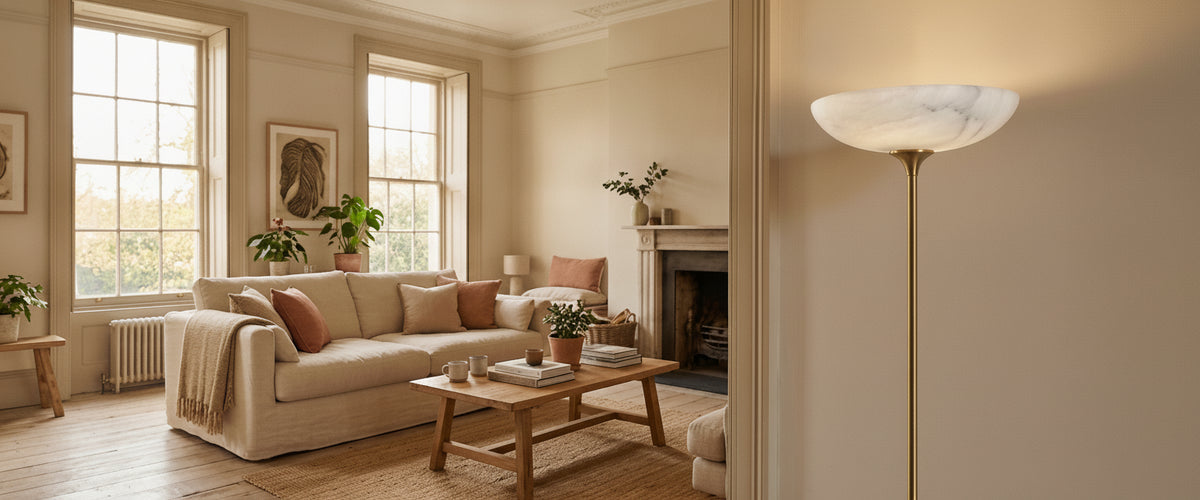

Most floor lamps work against the room they stand in. They drop a pool of light onto the rug, leave the ceiling in shadow and make a 3-metre (10 ft) drawing room feel lower than it is. An alabaster torchiere floor lamps reverses that. It sends light upwards, through and over a bowl of translucent stone, and lets the ceiling return it as a soft, even wash. That single change of direction is why the fixture behaves so differently from anything with a fabric drum on top.
At Niori we spend much of our working week holding stone up to light, and the torchiere is the form where material and direction matter most. Here is what we would want any buyer to understand before choosing one.

At a Glance
- An alabaster torchiere floor lamp is an ambient light first. It lights the room through the ceiling, not the page you are reading.
- Stone thickness and veining set the colour before the light leaves the bowl. Thin, pale stone reads cool and white; thicker, veined stone glows honey and amber.
- Ceiling height and finish matter. A pale, matt ceiling of roughly 2.6 metres (8.5 ft) or more gives the cleanest wash.
- Run it at around 2700K and dim to about 70% for the most even glow through the stone.
- Ask about stone origin, wall thickness and base stability before you buy.

Uplight Versus Downlight: Why a Ceiling Wash Feels Different
Downlight is directional. It tells you where to look: the armchair, the side table, the book. Uplight from a torchiere does something less obvious. Once it hits the ceiling it spreads, softens and falls back into the room from a broad, low-contrast source, which our eyes read as daylight-like rather than lamplight. Shadows under the eyes and beneath furniture fade. Corners stop going dark.
Alabaster adds a second layer. A metal or glass torchiere sends all its light straight up. A stone bowl lets part of the light pass through the material, so the fixture glows from within while the ceiling glows above it. You get two gentle sources from one lamp, and neither throws glare. This is why an alabaster torchiere floor lamp so often replaces a harsh central pendant in period sitting rooms; it carries the ambient load without anyone in the room being able to see a bulb.
Be honest about what it won't do. A torchiere is poor reading light. Pair it with a table lamp or a directed wall light by the chair, and let the stone do the background work. Where there is no wall to fix to beside the seat, an adjustable spot floor lamp such as the Evalo FL 3x10W GU10 Floor Lamp in white handles the task light, leaving the torchiere free to fill the ceiling.
How Stone Thickness and Veining Set the Warmth
Alabaster is a fine-grained form of gypsum, soft enough to be turned and carved thin. The British Geological Survey covers gypsum in its UK minerals resources, and that softness is the reason the stone can be worked into a shade that lets light through at all.
Thickness is the first control. A thin-walled bowl passes more light and looks whiter and brighter; the same stone cut thicker absorbs more of the blue end of the spectrum and glows warmer, particularly at the rim, where the light travels through the most material. Veining is the second. Dense, honey-coloured veins block and tint light, painting the glow with darker drifts. A near-veinless white alabaster floor lamps gives a calmer, more uniform glow that suits pale, minimal rooms.
One thing we learnt early in the studio: two bowls cut from the same block can glow quite differently. We now sort shades on a light table before pairing them, because a matched pair in daylight can look mismatched once lit. If you are ordering two lamps for either side of a fireplace, ask whether the alabaster floor lamp shade on each has been compared lit, not just by eye.
Alabaster Torchiere Floor Lamp or Totem: Opposite Silhouettes
The same stone can produce two very different floor lamps. The torchiere is slim below and open above: a stem carrying a shallow bowl at around head height or higher. It disappears visually and sends its effect upwards. An alabaster totem floor lamp does the reverse. It is a solid column of stacked or carved stone, glowing along its whole length, and it reads as sculpture standing on the floor.
That difference shapes room presence. A torchiere suits rooms where you want the light felt rather than seen: drawing rooms, bedrooms, hotel suites with good ceilings. A totem suits corners that need an object, such as an entrance hall, the end of a long gallery wall or a restaurant banquette where you want a glowing vertical marker. Totems do little for the ceiling; torchieres do little as objects in daylight. Choose based on which job the corner needs doing. You can compare both silhouettes across the alabaster lighting collection to see how differently the stone sits in each.
Where to Stand an Alabaster Torchiere Floor Lamp
A ceiling wash looks intentional when it has a clear shape and a reason to be there. It looks accidental when it is lopsided, clipped by a beam or scorching one patch of wall.
Distance From the Wall
Stand the lamp roughly 30 to 45 cm (12 to 18 in) from the wall. Closer than that and the bowl throws a bright, hard scallop up the plaster. Further out and the wash floats in the middle of the ceiling with no anchor. Textured lime plaster deserves extra caution, because grazing light picks out every trowel mark.
Ceiling Height and Finish
Leave a generous gap between the top of the bowl and the ceiling; under about 2.4 metres (8 ft), the wash tends to collapse into a bright disc. A matt, warm-white ceiling returns the softest light. Gloss paint reflects a visible hotspot, and dark ceilings swallow the effect almost entirely.
Room by Room
- Drawing room: in a corner diagonal to the main seating, so the wash spreads across the longest ceiling run.
- Bedroom: away from the bed, so the glow fills the room without sitting in your eyeline when lying down.
- Hospitality: flanking a doorway or at the ends of a lounge, where pairs read as deliberate architecture.
A client in a Georgian townhouse in Bath with 3.4-metre (11 ft) ceilings first stood her torchiere tight into an alcove. The light climbed the chimney breast in a hard stripe. Moved 40 cm forward and turned so the thickest vein faced the wall, it lit the cornice evenly and the room finally looked finished in the evening.
Why 2700K at 70% Is the Native Setting
Alabaster is warm by nature, so colour temperature acts as a multiplier. At around 2700K, the stone reads as it should: creamy, with veins showing honey rather than brown. Push to 3000K or above and the glow turns chalky and slightly grey, and the stone loses its depth. Drop below about 2400K and it tips into orange, which flatters a bar but can feel heavy in a bedroom.
Output matters as much. At full brightness, a bulb sitting close to a thin bowl shows as a visible hotspot through the stone, and the ceiling wash can glare. At around 70%, the light evens out across the bowl and the ceiling glow softens at the edges. That is where we set most torchieres in the studio when judging a piece. Below about 30%, a warm-dim LED that shifts towards amber as it dims keeps the stone looking natural rather than murky.
Check that the lamp and its LED source are dimmable and compatible with your control. Inline or foot dimmers on a plug-in lamp are simple. If you want the torchiere on a wall dimmer or a switched socket circuit, have a qualified electrician fit it.
Questions to Ask Before You Order
An alabaster torchiere floor lamp carries a heavy stone bowl at the top of a slim stem, which makes buying one a little more technical than choosing a fabric-shaded lamp. Run through these before committing:
- Where is the stone from? Spain's Aragon region and the area around Volterra in Tuscany are long-established alabaster sources. A good supplier will tell you.
- Is the bowl turned from a single piece? Bonded sections can show seams when lit.
- How consistent is the wall thickness? Uneven walls produce patchy glow.
- What is the base made of, and how heavy is it? Weight low down matters with children, pets or busy venues.
- How is the bulb accessed? You should be able to change it without lifting the stone off.
- Is it dimmable, and with what? Confirm the LED type and compatible dimmers.
- Where will it live? Gypsum is slightly water-soluble, so keep alabaster out of steamy bathrooms and damp garden rooms.
Budget depends on stone grade, bowl size and carving, metalwork, engineering and finishing, so a tailored quote is the honest route. If you are planning a scheme rather than a single lamp, the wider lighting collection helps you pair a torchiere with wall lights and table lamps that share its warmth. Where the walls need to carry the same stone glow at eye level, a double alabaster sconce such as the Velaris 2 Light Double Alabaster Wall Light in brushed brass keeps the material consistent between floor and wall rather than introducing a second, cooler light source.
Living With an Alabaster Torchiere Floor Lamp
Care is light but specific. Dust the bowl with a soft, dry brush or microfibre cloth; never use water, sprays or household cleaners, which can etch and cloud the surface. Lift the bowl with two hands and clean hands, since skin oils can leave marks on pale stone. Over years, alabaster can mellow slightly in tone, which most owners find suits it. Treated this way, an alabaster torchiere floor lamp is a piece that stays in a room for decades, quietly doing the work a ceiling fitting never quite manages.