

Most bedside lighting fails at one specific moment: you are lying down, the room is dark, and the bulb sits square in your eye. A wall light fixture bedroom plan lives or dies on where you mount it, not on how good the fitting looks in a product photo. This guide covers the numbers and the judgment calls behind that decision: mounting height measured from your mattress rather than the floor, beam direction for reading versus winding down, the three placements that cover most rooms (beside the headboard, above a dresser, either side of a mirror), how wall color shifts the warmth of the same bulb, and the switching and cable choices people leave until the plaster is already up. Get those right and your wall light fixture bedroom setup stops being a nightly irritation.
Get the height wrong by an inch or two and a calm, diffused fitting turns into a small spotlight aimed at your retina. Get it right and you rarely think about it again. That is why a bedroom wall light rewards planning more than almost any other light in the house. Every wall light fixture bedroom decision is made for a fitting you use at your most relaxed and your most tired, from a fixed position, night after night.
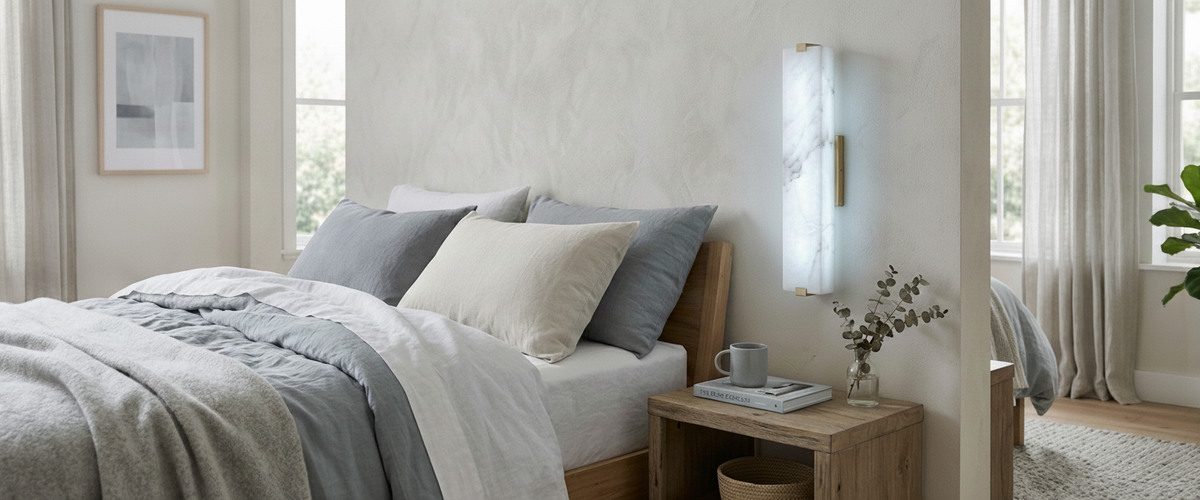
An alabaster bedside fitting mounted just above seated eyeline.

Key Takeaways
Mount a wall light fixture bedroom pair so the base of the shade sits above your seated eyeline, roughly 5 to 5.6 feet (1.5 to 1.7 m) from the floor for most beds.
Alabaster and natural stone shades diffuse the bulb rather than expose it, which is the single easiest way to kill bedside glare.
Plan switching before you plan the fixture. A light you cannot turn off without getting up is a light you will resent.
Placement beside the headboard, over a dresser, and flanking a mirror each ask something different of a wall light fixture bedroom scheme in terms of height and beam behavior.
Paint color changes how warm and how bright the same fitting appears, so test it against your actual wall.

The Jobs a Bedroom Wall Fitting Is Quietly Asked to Do
Think of the bedside light as three lights sharing one fitting. There is the task light, bright and focused enough to read without straining. There is the mood light, dropped low so the room feels settled before sleep. And there is the object itself, the thing on the wall you see in the morning with nothing switched on. A good bedroom wall light handles all three without compromise, which is why any wall light fixture bedroom decision starts with the material of the shade rather than the arm or the switch.
This is where alabaster earns its place. A carved alabaster shade glows from within rather than pushing a hard beam at you, so the same bulb that would dazzle behind clear glass reads as a soft, even light. The stone's natural veining catches the warmth and spreads it. At Niori we work almost entirely in alabaster and natural stone for exactly this reason: the material does the diffusing for you, which is precisely what a wall light fixture bedroom scheme needs.
Sightlines From the Bed: Mounting Height That Avoids Glare
The mistake we correct most often is height set from a standing measurement. You do not use a bedside light standing up. You use it sitting against the headboard and lying down, so those two positions decide the right wall light fixture bedroom height.
As a working rule, the bottom of the shade should sit just above your eyeline when you are sitting up in bed. For a standard divan with a headboard, that usually lands the fitting center somewhere between 5 and 5.6 feet (1.5 to 1.7 m) from the floor, though a low platform bed or a tall upholstered headboard will shift that. Measure from your actual mattress height, not the floor, then check the number by sitting in place and holding a tape where the shade will be.
Measure from mattress height and check the sightline before drilling.
Beam direction matters as much as height in any wall light fixture bedroom layout. A shade that is open at the bottom sends light down onto a book, which is what you want for reading. Where the space beside a compact bed calls for a scaled-down fitting that still glows evenly rather than glaring, a small piece such as Georgette Small Wall Light keeps the ambient light soft while staying clear of your eyeline. A fully enclosed shade gives an all-round glow that is kinder for winding down but less directional for a late-night page-turner. Many bedrooms want one of each behavior on a dimmer, and a translucent stone shade already softens the transition between the two.
Beside the Headboard, Over a Dresser, Flanking a Mirror
Three placements cover most bedrooms, and each one changes the rules for a wall light fixture bedroom arrangement.
Beside the headboard. This is the classic wall light fixture bedroom pair, swing-arm or fixed, one each side. Keep the pair symmetrical and matched in height even if your bedside tables are not the same. If you read in bed, choose a fitting with an adjustable arm or a downward-throwing shade so light lands on the page rather than across the room. Space the two so their inner edges clear the headboard and do not crowd the pillows.
Over a dresser. A wall light fixture bedroom position above a chest of drawers or a low dresser is doing display lighting, not reading lighting. Here you can mount higher and let the light wash down the wall and across whatever sits on top. Where you want an opal-glass diffuser that spreads a soft even wash rather than a hard spot, a fitting such as Marant 1 Light Wall Light gives that quiet gallery feel without the glare risk you get near a bed.
Flanking a mirror. If your bedroom doubles as a dressing area, a wall light fixture bedroom pair either side of a mirror beats a single light above it every time. Side lighting fills in the shadows under your brow and chin instead of casting them, which is why theater dressing rooms are lit this way. Mount the pair at roughly face height when standing, and keep the shades diffused so you are not staring into a bright bulb. Our full range of alabaster wall lights works well here because the stone softens the light before it reaches your face.
Backdrop and Contrast: How Paint Color Changes the Fitting
The same wall light fixture bedroom setup looks different on different walls, and light blue bedrooms are a good example of why. Cool wall colors pull the perceived warmth out of a light, so a bulb that looks cozy against warm plaster can read slightly clinical against pale blue. To decorate a bedroom with light blue walls and keep it restful, lean into warmer light: alabaster shades and a warm-white bulb around 2700K bring back the comfort the cool wall takes away.
Dark and moody walls do the opposite. Deep greens, charcoals and inky blues absorb light, so a wall light fixture bedroom scheme becomes a glowing point of interest rather than a room-filler, and you may want a second layer of light elsewhere. Pale, warm neutrals are the most forgiving backdrop of all and let a natural-stone piece show its veining clearly. Whatever the color, hold the actual fitting against the wall before you commit; the veining and glow of alabaster shift noticeably depending on what sits behind them.
Switching, Reach and the Cable Problem Nobody Plans For
Here is the practical trap. People choose a beautiful fitting, mount it perfectly, and then discover the only switch is by the door, so the last job before sleep is a walk across a dark room. Plan switching first. A wall light fixture bedroom placement within arm's reach of the pillow wants a local switch, either a pull cord, a switch on the fixture body, or a wall switch on a plate beside the bed. Two-way switching, one at the door and one at the bedside, is worth asking your electrician about at first-fix stage.
Then there is the cable. A hard-wired fitting with the cable buried in the wall looks cleanest and is the right answer for a permanent bedroom scheme, but it means chasing the wall and involving a qualified electrician. A plug-in wall light fixture bedroom solution with a visible flex is genuinely useful in rentals or where you cannot cut into plaster; just route the flex deliberately, clip it, and let it fall behind the headboard rather than snaking across bare wall. All fixed electrical work should go to a qualified electrician, and the guidance from Electrical Safety First is a sensible starting point if you are unsure what your project involves.
Placement Mistakes We See Most in Real Bedrooms
Height set standing, used lying down. The most common cause of glare in any wall light fixture bedroom setup. Always measure from the mattress and check the sightline in position.
Mismatched pairs. Two different heights either side of the bed unsettle the whole wall. Match them even when the tables do not match.
Exposed bulbs at eye level. A bare filament looks charming until you are lying beside it. Diffused stone or opal shades solve this at source.
No local switch. If you have to leave the bed to turn the light off, you chose the wrong switching, not the wrong light.
Cold bulbs in a cool room. A high-Kelvin bulb on a pale blue or gray wall drains the warmth out of the space. Stay around 2700K for bedrooms.
Forgetting the daytime view. The fitting spends most of its life switched off. If it does not earn its place unlit, keep looking.
A Quick Word on Temporary Lighting
Plenty of bedrooms mix a permanent wall fitting with seasonal or decorative string lighting, and there is a right way to handle the temporary layer too. To hang Christmas lights, fairy lights or string lights on a bedroom wall without damaging paint, use removable adhesive hooks rated for the weight rather than pins or nails, run the lead back to a single accessible socket, and keep the flex away from bedding and curtains. Battery or low-voltage sets are the safest choice near a bed. Treat these as decoration, not as your main light; the wall light fixture bedroom layer is what gives the room its structure once the fairy lights come down in January.
Get the height, the diffusion and the switching right, and the wall light fixture bedroom question is settled for good. You choose a considered fitting once, place it with intent, and then simply enjoy a room that lights the way you actually live in it. To see how alabaster and natural stone behave in this setting, the Niori collection is built around exactly this kind of warm, diffused light.