
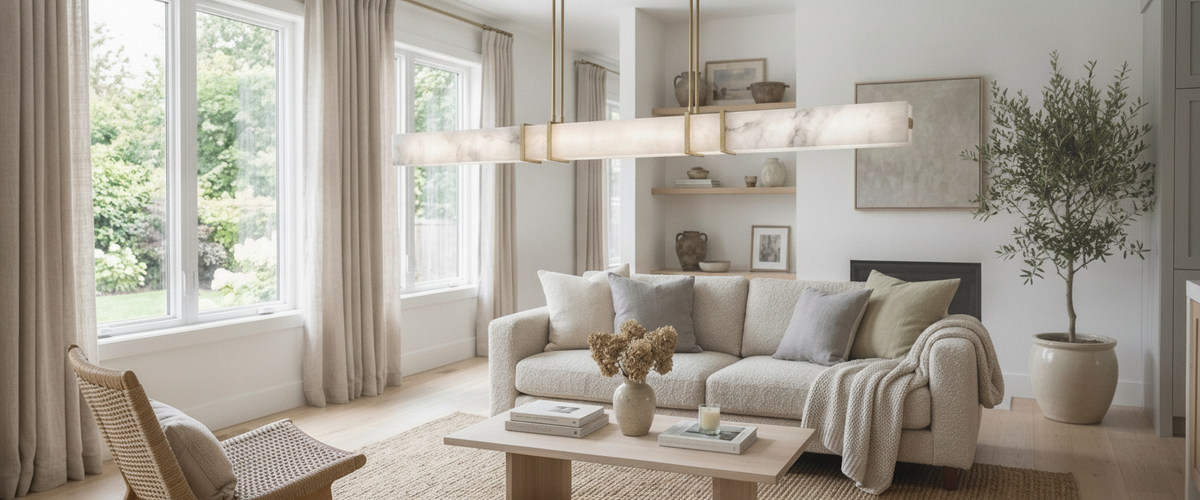

A modern chandeliers living room scheme has a harder job than the fixture hanging over your dining table. The dining light covers a fixed rectangle: table, chairs, people seated for a couple of hours. A living room is looser. Sofas shift, people sprawl, and the light needs to flatter at eight in the evening as much as it does at eight in the morning. Get the size or the height wrong and the piece either floats like an afterthought or crowds the room like it wandered in from a hotel lobby. A modern chandelier living room fixture leans on softer light and quieter materials, which is why alabaster and natural stone often work better than crystal where people relax.
So before you fall for a shape, it pays to understand how a chandelier in a living room actually behaves, and why stone does the job better than crystal in a space built for lounging. A good modern chandelier living room plan starts with behavior, not looks. Whether the room is open-plan, a snug, or a formal drawing room, the same rules on size, height and light hold true.

Key Takeaways
Size the fixture to the seating group and room proportions, not the ceiling alone.
On a standard ceiling, aim for the base of the fixture roughly 7 feet (2.1 m) off the floor over open circulation space.
Alabaster and stone give a warm, diffused glow that suits a room built for lounging, where crystal can feel too formal.
A modern chandelier living room piece should never be the only light source; pair it with table and floor lamps.
Put the whole scheme on dimmers so the room can move from bright daytime to a low evening glow.

Why a Living Room Chandelier Behaves Nothing Like the Dining One
Over a dining table you can hang low. The tabletop stops anyone walking into the fixture, so designers routinely drop a pendant to around 30 to 34 inches (76 to 86 cm) above the surface. A living room has no such anchor. People stand, cross the room, and gather in clusters, so the same low drop becomes a hazard and a sightline problem.
The other difference is mood. A dining fixture performs during a meal and then the room empties. A chandelier in a living room is on from the school run to the last cup of tea, which means it has to look right across a much wider range of moments. That is exactly why a modern chandelier living room scheme leans on softer light and quieter materials than a dining scheme can get away with.
Read the Ceiling Height and Sofa Layout First
Two measurements decide most of this before you look at a single product. First, ceiling height. A room with 8-foot (2.4 m) ceilings wants a flush or semi-flush fixture with a compact drop, while a room with 10 or 12 feet (3 to 3.7 m) can carry a tiered piece with real presence. Second, the seating plan. A single sofa facing a fireplace reads very differently from an L-shaped sectional wrapped around a coffee table.
A modern chandelier living room piece usually wants to center on the seating group or the coffee table, not the geometric middle of the room. In older homes with a chimney breast and an off-center ceiling rose, that can mean re-siting the fixing point. Worth doing. A fixture hung over dead floor space, with the sofas parked to one side, always looks like a mistake nobody wanted to fix.
Alabaster and Stone: the Quiet Answer to a Room That Cannot Take Crystal
Crystal throws sharp, glittering light. It is theatrical, and in a formal drawing room it can be right. In most modern living rooms, though, it fights the sofas, the throws, and the general business of relaxing. Alabaster does the opposite. The stone is faintly translucent, so light travels a short way into the material before it leaves, and what reaches the room is soft and warm rather than pin-sharp. The gypsum form of alabaster has been carved for lamps and vessels since antiquity precisely because it glows rather than glares. That warmth is why so many people choose alabaster for a modern chandelier living room scheme.
Every block of alabaster carries its own veining, so no two shades diffuse light in quite the same way. That variation is part of the appeal, and it reads as considered rather than showy. Where a room needs a soft, diffused glow rather than a hard sparkle, a plaster-white piece such as the Annie 6 Light Chandelier sits closer to the right design language, holding a large room without shouting. That makes it a natural fit for open-plan living where the fixture is on view from the kitchen and hallway too. You can see the range of forms across the alabaster lighting collection, from tiered chandeliers to lower-profile ceiling pieces.
Marble and onyx sit in the same family with more drama in the stone itself. Onyx in particular carries banded, amber veining that comes alive when backlit, though it is best used where you want the fixture to be a genuine focal point rather than a background glow. Travertine and limestone read quieter still, with a matte, sandy character that suits Scandinavian and Japandi rooms, while polished marble leans more classical. Matching the stone to the room style keeps a chandelier in a living room feeling native rather than dropped in.
Drop and Diameter: Sizing the Piece to the Seating
Here is the sizing rule most people reach for, and where it goes wrong. The old decorator formula adds the room's two dimensions in feet and reads the total as inches of diameter. A 16 by 20 foot room suggests roughly a 36-inch (91 cm) fixture. It is a useful starting point, but it treats the room as an empty box.
For a modern chandelier living room, sanity-check that number against the seating. The fixture should relate to the coffee table or the sofa group beneath it, sitting within the footprint of that furniture rather than overshooting it. A piece wider than the coffee table below tends to look top-heavy. One that is too slight disappears the moment you add a pair of floor lamps.
Diameter: start with the room formula, then check it against the coffee table width. The fixture should feel of a piece with the furniture group.
Height of the fixture: for double-height or vaulted rooms, tiered chandeliers with real vertical presence read better than a wide, flat disc.
Drop: over open circulation space, keep the base around 7 feet (2.1 m) from the floor. Over a coffee table you can go a little lower, provided nobody walks under it.
For high entrances and stairwell-adjacent living spaces, a longer drop keeps the fixture in proportion with the volume above it. In a double-height room that wants a genuine focal point, a wide radial form such as the Jax 10 Light Starburst Chandelier carries the vertical volume far better than a flat disc would. In a standard room, resist the urge to hang low for effect; a fixture that clips tall guests is a daily annoyance, not a feature.
The Single-Source Trap: Why the Chandelier Needs Lamps
The most common mistake we see is treating the modern chandelier living room piece as the whole lighting plan. It cannot be. A ceiling fixture lights the room from one direction, from above, which flattens faces and leaves the corners in gloom. Beautiful at first glance, tiring after an hour.
A living room wants at least three or four light sources at different heights. The chandelier does the overhead layer. Table lamps on side tables and a console bring the light down to eye level where it flatters. A floor lamp fills a reading corner. Alabaster table and floor lamps pair naturally here because they share the same warm, diffused character as the overhead piece, so the layers read as one scheme rather than a collision of styles. The wider lighting range is worth browsing with that layering in mind.
We once shipped a large tiered alabaster fixture to a client with a double-height sitting room and no other lights planned. They came back a fortnight later asking why the room felt cold in the evenings. The answer was simple: nothing was lit below head height. Two alabaster table lamps and a floor lamp later, the room finally settled. It is a lesson worth applying to any modern chandelier living room scheme.
Dimming: From Daytime Bright to a Low, Settled Glow
A chandelier that runs at one brightness is only doing half its job. The whole point of the space is that it changes character through the day, and the lighting should move with it. Put the fixture on a dimmer, and ideally put the lamps on dimmers or smart bulbs too, so the whole room can drop together into a low evening glow.
For alabaster and stone, warm color temperature matters as much as brightness. Aim for bulbs in the 2400K to 2700K range; the warmth reads correctly through the stone and keeps the veining looking amber rather than gray. As a rough guide, a main living room seating area wants somewhere around 1,500 to 3,000 lumens spread across the layers, not concentrated in one bright source. Choose dimmable LED lamps and check they are compatible with your chosen dimmer, since a trailing-edge dimmer suits most LEDs better than an older leading-edge unit. Guidance from the Chartered Institution of Building Services Engineers is a sensible reference point for getting light levels right across a domestic scheme. If any part of the install involves altering the mains supply or moving a fixing point, use a qualified electrician.
A Quick Buyer's Checklist
Measured the room and checked the diameter against the coffee table, not just the walls.
Confirmed a drop that keeps the base around 7 feet (2.1 m) over walkways.
Chosen alabaster or stone if you want warmth, crystal only if the room is formal.
Planned table and floor lamps so the modern chandelier living room piece is not the only source.
Specified warm, dimmable LED bulbs and a compatible dimmer.
Booked an electrician if the ceiling point needs moving or upgrading.
Care So the Glow Lasts
Alabaster is a soft stone, so it wants gentle handling. Dust with a dry, soft cloth; skip household sprays, which can mark or dull the surface over time. Keep it away from steady moisture, and turn the fixture off before wiping so the bulbs are cool. Handled this way, a stone modern chandelier living room piece stays as warm and even in year ten as it was on the first evening it was switched on.