
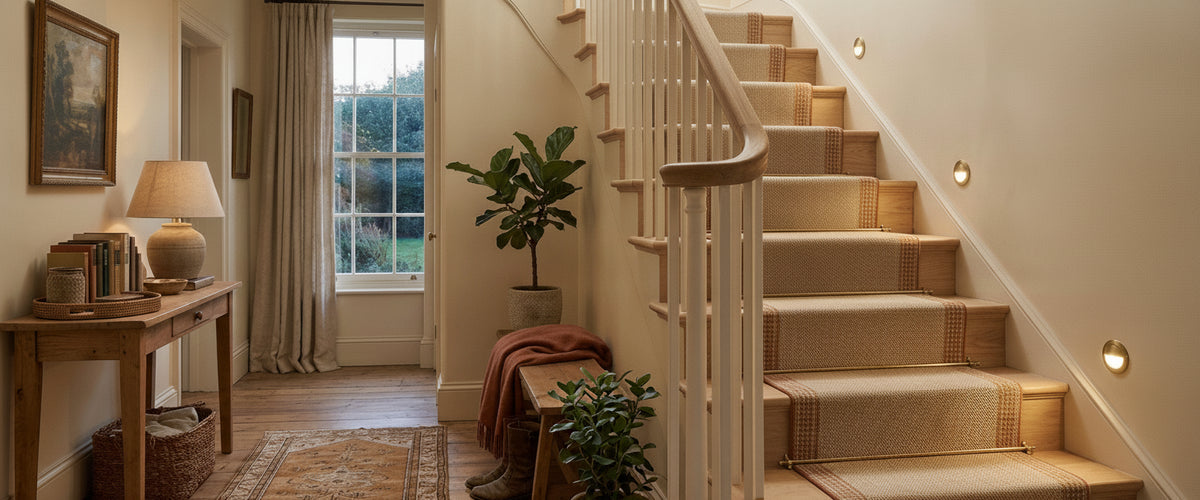

The most dangerous moment on a staircase is the first step down in the dark, when your eye is still adjusted to a bright landing and the tread edge disappears. Good indoor stair lighting solves that one problem first. Everything else, the drama of a pendant falling through a stairwell or the soft wash of stone on a wall, comes second. Plenty of stair schemes, and plenty of indoor stair lights, get that order the wrong way around.
At a glance
Light the tread edge, not the air above it. The nosing of each step is what your feet need to see, so aim your indoor stair lights there.
Hide the light source from the descending eye. Glare on stairs almost always comes from fittings you can see directly while walking down.
Layer two kinds of light. Low-level step lights for safety, wall or pendant light for atmosphere and faces.
Choose warm, dimmable light. Around 2700K, with a low night setting, keeps the stair usable at 3am without waking the house.
Settle the wiring before plastering. Recessed fittings and switching positions are far harder and messier to add after decoration.

Why a Staircase Earns Different Light Than a Room
A room is somewhere you arrive. A staircase is somewhere you pass through, usually while carrying something, often while looking at your phone, and frequently at the edges of the day when your eyes are adjusting between two very different light levels. That changes the brief for stair lights indoors. Indoor stair lighting has to work for a moving viewer whose line of sight tilts upward going up and sharply downward coming down.
Falls on stairs are one of the most common causes of serious injury at home, and the Royal Society for the Prevention of Accidents repeatedly points to poor lighting as a contributing factor. The fix is rarely more light. What helps is contrast in the right place: a clearly lit horizontal tread against a slightly darker vertical riser, so each step reads as a separate shape.
A staircase also connects two spaces that may have very different moods. A bright kitchen hallway below and a dim bedroom landing above need a stair that steps the light level down gently, which is where dimmable indoor stair lights earn their keep.

Stair Lights Indoor Compared: Sconces, Step Lights and Pendants
Each fitting type reveals something different. Pick according to what you want the eye to find.
Wall Lights and Sconces
As indoor stair lights, wall lights reveal the stair as a space. They light faces, the handrail, artwork and the texture of the wall itself, and they spill enough light down onto the treads for most domestic staircases. An alabaster sconce is particularly good here because the stone diffuses the lamp into a low, even glow without a harsh hot spot. You see a softly luminous object at eye level rather than a bulb. On a stair, where you pass within inches of the fitting, that matters more than anywhere else in the house.
Stone diffuses the lamp, so the sconce glows rather than dazzles.
Recessed Step Lights
Stair step lights are small fittings set into the wall just above the tread, or into the riser itself. Indoor stair tread lights reveal exactly one thing: the walking surface. They are the most effective safety light you can install and the least atmospheric on their own. Recessed stair lights indoors work best with a shielded or louvered face that throws light down and across, never outward.
A hooded face keeps the light on the tread and out of your eyes.
Pendants and Chandeliers
An overhead fitting reveals volume. In a double-height stairwell a pendant or chandelier gives the stair a center of gravity and lights the landing generously. What it does not do well is light the treads, because your own body casts a shadow onto the step in front of you when light comes from above and behind. Treat a stairwell pendant as the room light for the void, and pair it with wall-mounted or step-level indoor stair lights for the stair itself. Browse the alabaster lighting collection with that split in mind: a large pendant for the void, smaller sconces for the run.
Where Glare Actually Comes From on a Stair Run
Glare from stair lights indoors is a geometry problem. Coming down, your eyes point at the lower wall and the bottom of the stair. Any fitting with a visible bright source in that zone will dazzle you at the exact moment you need to judge a step.
The usual culprits:
Exposed-lamp wall lights fitted too low, so the bulb sits directly in the descending sightline.
Step lights with a clear lens that face straight out across the stair. Pleasant from the bottom, harsh from the top.
Bare or open-bottomed pendants seen from the landing above, where you look straight down into the lamp.
Polished surfaces, such as gloss-painted walls or polished marble treads, that bounce a reflected image of the source back up.
Fittings that avoid it share one trait: the light-emitting surface is large and low in brightness, or it is fully shielded. Alabaster and onyx do the first job naturally. The stone spreads the light across its whole surface, so the fitting glows rather than glares. For LED stair lights indoors, the second approach works: an asymmetric optic or a hooded face that keeps the diode itself out of view. Judge any step light from the top of the stair, not the bottom. A fitting that looks crisp in a product photo can leave everyone descending the stair shading their eyes, while a hooded, dimmer version does the job far better.
Height and Spacing: Safe Scheme or Dramatic Scheme
These are working guidelines for stair lights indoor rather than rules, and your electrician or designer should check them against the actual stair.
Wall lights: mount roughly 5 ft 7 in to 6 ft (1.7 to 1.8 m) above the pitch line of the stair, measured from the tread nosings. Keep the height consistent along the rake so the fittings follow the stair rather than the floor.
Wall light spacing: one at the bottom, one at each landing or turn, and intermediate fittings every few steps on long straight runs. Gaps that leave a tread in shadow are the ones people trip on.
Step lights: set low, typically 6 to 12 in (150 to 300 mm) above the tread. Every step gives the most even result; every other step is enough on a straight flight with good ambient light.
Pendants: hang so the bottom of the fitting clears head height at every point anyone walks beneath it, including the stair and any landing, not just the hall floor.
The difference between safe and dramatic is mostly about ratio. A safe scheme keeps the light level fairly even from top to bottom. A dramatic one lets the walls fall darker between sconces and relies on low-level indoor stair lights to carry the safety job. Both work. The mistake is aiming for drama without the low-level layer underneath it.
Projection matters too. Stairs are narrow, and people carry suitcases, laundry baskets and furniture up them. Choose shallow wall lights, and position anything carved or delicate where a swinging bag will not reach it.
Finishes That Survive a Narrow, High-Traffic Stair
A staircase is effectively a corridor that everyone touches. Finishes on indoor stair lights need to cope with hands, shoulders and dust without looking like a hospital.
Brass: aged or unlacquered brass develops a soft patina that hides fingerprints. Polished chrome shows every mark and reads cold under warm light.
Alabaster: soft and slightly porous, so it suits wall positions above hand height. Dust it with a dry, soft cloth; never use water or sprays, which can leave marks in the stone.
Marble and onyx: a honed finish on a backplate or shade reflects far less glare than polished, and wears more gracefully.
Glass details: opal or frosted glass diffuses well; clear glass should always be paired with a shielded lamp.
Color temperature is part of the finish. Cool white stair lights indoors, set against white walls, turn a stair clinical in seconds. Warm light at around 2700K flatters stone, timber treads and skin, and it reads as welcoming at night.
How to Choose Indoor Stair Lights: A Buyer's Checklist
What is the stair's job? A family stair used at night needs step lights; a grand hall stair can lead with sconces and a pendant.
Can you see the source while walking down? If yes, choose a diffusing material or a shielded fitting.
Is the wall masonry or stud? This affects whether recessed step lights are practical and how much disruption they cause.
How will it be controlled? Two-way switching at top and bottom is the minimum. Dimming, or a low-level night circuit on a sensor, is better.
Will it clear people and luggage? Check projection against the narrowest point of the stair.
Does the finish suit how the stair is used? Busy family stairs favor forgiving patinas and stone set above reach.
For a wider look at fitting types before narrowing down, the full lighting range covers pendants, wall lights and table lamps, which makes it easier to plan indoor stair lights and landing fittings together.
The Installation Conversation to Have First
Stair lighting indoor is one of the few areas where the order of work decides the outcome. Recessed fittings need back boxes set into the wall at first fix, before plastering. Cables for wall lights have to be chased in at the right height along a rake, which is harder to measure than a flat wall. LED step lights usually need a driver, and that driver must sit somewhere accessible for future replacement, not sealed behind a finished wall.
Bring these questions to your electrician before ordering any stair lights indoors: where the switches go, whether the step lights and wall lights will run on separate circuits so you can use them independently, what dimmers are compatible with the chosen lamps and drivers, and whether a sensor-controlled night level is wanted. In England and Wales new circuits are notifiable under Part P of the Building Regulations, and all lighting work should be carried out by a qualified, registered electrician working to the BS 7671 wiring regulations. That is not a job to improvise on a ladder over a stairwell.
Get the plan agreed, then choose the indoor stair lights. At Niori we are always happy to talk through scale and placement for alabaster and natural-stone pieces on a specific stair. For larger stairwells or hospitality projects, a tailored quote is the sensible starting point, since cost depends on material, scale, engineering, installation and finishing.