
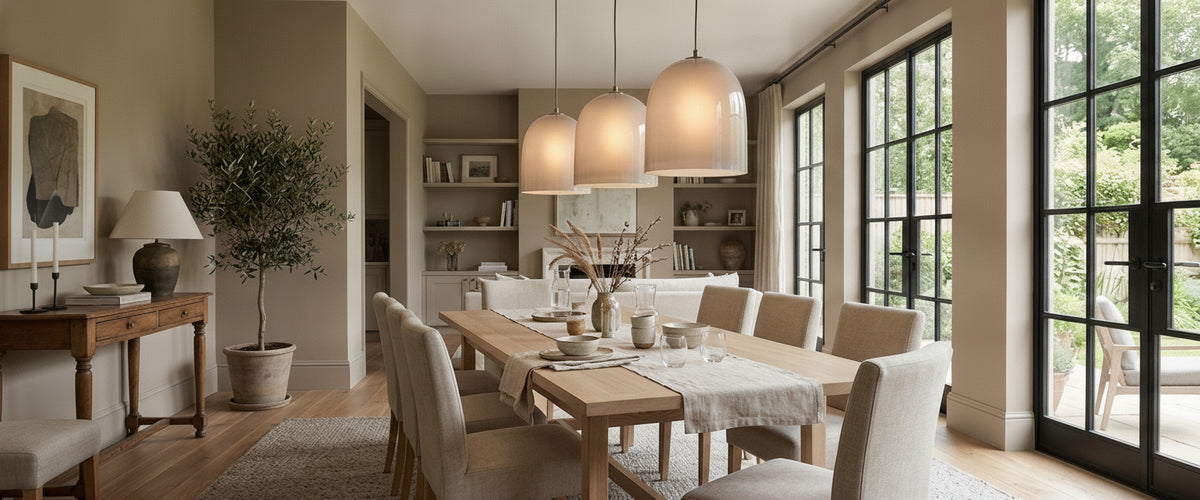

A smoked glass pendant lights can make a dining table look like the best seat in a candlelit restaurant, or it can make your kitchen feel like a power cut. The difference rarely comes down to the fixture's looks. It comes down to how dark the glass is, how thick it is, what shape it takes, and which bulb sits inside. At Niori we spend most of our days with alabaster and natural stone, materials that glow from within and spread light generously. Smoked glass does the opposite. It holds light back, and that restraint is exactly why people fall for it and exactly why so many are disappointed once it is hung.

At a Glance
- Smoked glass cuts output in every direction, so a smoked glass pendant light rarely works as the only light in a room.
- Density and wall thickness decide how dark the cone below becomes; a pale smoke and a heavy smoke are different products.
- Open, wide shades keep a useful pool of light on the table. Narrow, closed cylinders mostly glow.
- A 2200K filament bulb reads amber and intimate through smoke; a 2700K LED can look flat and grey unless you choose carefully.
- Clusters and lower drops recover lost light without losing the mood.

Smoked, Frosted or Clear: What Happens to the Light Below
Clear glass is almost a non-event optically. The bulb does the work, the glass adds sparkle, and the pool of light beneath is bright and sharp-edged. Frosted glass scatters that light, softening shadows and spreading a gentle glow across the ceiling and walls, much as alabaster does, though alabaster adds warmth and veining that frosted glass cannot.
Smoked glass tints rather than scatters. Light passing through the side walls is dimmed and shifted toward grey, bronze or brown depending on the recipe, while light escaping through the open base of the shade arrives at full strength. The result is a strong contrast: a dark, glossy object hanging in the room, with a concentrated puddle of brightness directly underneath. That downward cone is the whole point of a smoked glass pendant light. If the shade is open at the bottom, you get a moody fixture that still lights the table. If it is sealed, you get a lantern that looks beautiful and lights very little.
Smoke Density and Wall Thickness Set the Mood
Think of these as two separate dials. Smoke density is the amount of tint in the glass itself, and makers use the word "smoked" for everything from a faint grey wash to glass that looks nearly black when unlit. Wall thickness multiplies whatever density you choose. Hand-blown glass tends to vary, thicker at the base and thinner at the shoulder, which is why a hand-blown smoke glass pendant lights often shows a gradient when lit: honey at the thin points, deep tobacco where the glass pools.
For most homes, a light to medium smoke is the safer buy. It still reads as smoked in daylight, still hides the bulb's glare, and still lets enough light through the walls to warm the ceiling. Heavy smoke belongs in rooms where ambient light is already handled by other sources. In a home bar or a dining room that already has wall lights doing the ambient work, a darker finish such as the Opaz 3 Light Cluster Pendant in Smoked Black makes sense, because spreading that heavier tint across three shades gives you three pools of light rather than one dim lantern. If you want a sense of how glass colour is made and why it varies batch to batch, British Glass is a useful industry reference.
Bell or Cylinder? Shade Shape Decides Moody or Merely Dim
A wide bell or dome throws its opening across a broader area, so the pool of light on the table is generous and soft-edged. The tinted walls then do what smoked glass does best, glowing faintly around that pool. This is the shape that makes a smoked glass pendant light feel intentional.
A narrow cylinder or closed globe concentrates the bulb deep inside the tint. Less light escapes, the pool is small and tight, and the fixture tends to look dim rather than atmospheric. Cylinders can still work, particularly in multiples or over a bar where you want pinpoints of light, but a single narrow smoked shade over a dining table almost always under-delivers. Globes are the most decorative and the least functional: lovely for glow, weak for task.
Filament at 2200K Versus LED at 2700K in Smoked Glass
On paper, 500K is a modest gap. Inside a smoked glass pendant light it looks far bigger. A 2200K filament bulb is already rich in red and amber, and warm-toned smoke leans the same way, so the glass lights up like a glass of whisky held to a candle. A 2700K LED carries more blue, which grey smoke absorbs unevenly; the glass can turn cool and ashy, and cheaper LEDs with weaker colour rendering sometimes pick up a faint green cast.
We saw this vividly in the studio when testing a smoked grey and brandy cluster side by side with two bulb types. Under 2200K filaments the brandy shades glowed and the grey ones went a warm charcoal. Under 2700K LEDs the brandy survived but the grey shades looked almost dead. The fix is rarely to abandon LED. Choose a warm-dim or 2200K LED filament bulb with high colour rendering, check that it is dimmable, and pair it with a compatible dimmer. The Energy Saving Trust has clear guidance on reading lumens and colour temperature on bulb packaging, which matters more here than with clear glass because you are starting with less light.
Where a Smoked Glass Pendant Light Earns Its Place
A smoked glass pendant light holds real authority over surfaces that bounce light back. Pale marble, honed limestone, white oak and light plaster return that downward cone into the room, so the fixture feels moody without leaving you squinting at dinner. Dining tables, kitchen islands with separate under-cabinet task lighting, home bars, hotel lobbies and restaurant banquettes are all natural homes. Tall stairwells and double-height halls suit them too, because a dark shade reads as a strong object against pale walls.
It kills the light in small north-facing kitchens, low-ceilinged rooms, home offices and anywhere it is the only source. It also struggles over dark surfaces. One client in a Victorian terrace in Leeds hung a heavily smoked single pendant over a black granite island with walnut cabinetry; everything that left the shade was swallowed by the surfaces. We suggested adding alabaster wall lights on either side of the range to wash the walls in warm, diffused light, and the pendant went from gloomy to deliberate overnight. That combination of dark glass for drama and alabaster lighting for ambient glow is one we recommend often.
Clusters and Drop Heights That Keep the Drama Useful
Multiples are the easiest way to rescue a smoked design. Three pendants over an island deliver three downward cones, and a cluster of five to thirteen shades at staggered heights produces a pool of light no single smoked shade can match, while keeping the dark, glinting look. For a double-height hall or a long dining table that needs genuine volume of light, a large mixed-tone cluster such as the Ovila 13 Light Glass Cluster Pendant in Smoked Grey and Brandy is closer to the right scale than any single shade, and the pairing of cool grey with warm brandy glass keeps the cluster from reading as one flat block of tint.
- Over a table or island: hang the lowest shade roughly 30 to 36 inches (76 to 91 cm) above the surface. Smoked glass tolerates the lower end of that range because it glares less than clear.
- Spacing in a row: leave gaps of roughly one to one and a half times the shade diameter so each cone overlaps slightly.
- Staggered clusters: vary drops by a few inches between neighbours; too much variation looks accidental.
- Dimming: clusters with remote or wall dimming let you run bright for cooking and low for dinner.
Remember that a large smoked glass pendant light cluster is heavy. Glass adds up quickly, and ceilings may need extra support. Installation should always be carried out by a qualified electrician.
A Buyer's Checklist for Smoked Glass
- Role: is the smoked glass pendant light the main light or a feature? If main, choose light smoke, open shades, or a cluster.
- Density: view photos lit and unlit; ask how dark the glass looks when switched on.
- Shape: bell or dome for tables, cylinders in multiples, globes for glow only.
- Tone: grey smoke suits cool, modern schemes; brandy or bronze smoke flatters warm woods and brass.
- Bulb: warm 2200K to 2400K, dimmable, high colour rendering, with a matching dimmer.
- Surfaces: pale reflective surfaces below, or plan extra lighting.
- Support: confirm weight and ceiling fixing with your electrician before ordering.
Budget depends on glass quality, whether it is hand-blown, the number of shades, the metalwork and the installation. For larger schemes or hospitality projects, it is worth requesting a tailored quote. You can compare pendants, chandeliers and wall lights across our full lighting collection to see how smoked glass sits alongside alabaster and stone.
Living With Smoked Glass
Dust and fingerprints show more on dark glass than on frosted or clear, especially when the shade is lit from within. Wipe shades with a soft microfibre cloth and a little diluted washing-up liquid, always with the power off and the bulb cool, and dry immediately to avoid water marks. Skip abrasive pads and ammonia-heavy sprays on any metal fittings. Treat it well, pair it with warmer light elsewhere, and a smoked glass pendant light will keep that dark, amber-edged glow that made you want one in the first place.