

A single bright fitting in the centre of the ceiling is the fastest way to make a small bathroom feel like a service corridor. It throws hard, flat light straight down, casts shadows under the eyes at the mirror, and leaves the corners dead. The best small bathroom lighting ideas start by rejecting that one-light habit and spreading the load across a few smaller, warmer sources instead. You can see how those roles split across the bathroom lights range before you settle on a layout.
The paradox of a compact room is that it needs more light points, not fewer, but each one should do a specific job. Get that right and a two-metre-square room reads calm and layered. Get it wrong and it feels like a lift. The small bathroom lighting ideas worth keeping all share this logic: less glare, more placement.
Layered fittings at different heights keep a tight bathroom calm rather than clinical.

Key Takeaways for Lighting a Small Bathroom
Replace one central fitting with three or four smaller sources at different heights.
Light the face at the mirror, not the top of the head.
Check the IP rating for each zone before you fall for a fixture.
Stay warm (around 2700K) so tile and skin look right.
Keep fittings shallow and wall-hugging to protect precious floor and wall space.

Why One Ceiling Fitting Flattens the Room
Downlight alone is unflattering because it comes from a single direction. In a bigger bathroom you can hide that with daylight and reflected surfaces. In a small one there is nowhere for the light to bounce kindly, so every hard edge and grout line gets emphasised. Most small bathroom lighting ideas that work start here, with layering: a low-level general glow, a task layer at the mirror, and a soft accent that gives the room depth after dark.
Think of it as three quiet layers rather than one loud one. A recessed downlight or two for circulation. Wall lights beside or above the mirror for faces. And, where the wiring allows, a low warm source near the floor or plinth that keeps the room usable at night without the full ceiling glare. The wider lighting range is a useful place to see how those roles split across fixture types before you commit to a layout.
Stacking Task, Mirror, and Low-Level Light
When floor space is measured in centimetres, you build upward and outward on the walls rather than out into the room. Mirror lighting is the task layer that earns its keep every morning. Position it so light hits the face from both sides at roughly eye level; a pair of slim wall lights flanking the mirror does this far better than a single fitting above it, which drops shadow into the eye sockets. Where the mirror is narrow and only one wall fitting will fit cleanly, a compact IP44 piece such as the Eliot 1 Light Bathroom Wall Light keeps the profile shallow without crowding the glass.
Low-level light is the layer most people skip, and it is one of the small bathroom lighting ideas that pays off fastest. A discreet warm source near the floor, tucked under a vanity or run along a plinth, turns a 3am trip into something gentle rather than a full wake-up. It also stretches the perceived depth of the room, because the eye reads a second plane of light below the main one. In a windowless cloakroom, that low glow can do more for the sense of space than any amount of extra ceiling wattage.
A Simple Task Checklist
Mirror light at eye level, ideally from both sides.
General light offset from the mirror so it does not double up.
One low or accent source for atmosphere and night use.
Every fitting on a dimmable circuit if the driver allows.
IP Zones in Miniature
In a small bathroom the wet zones sit almost on top of each other, so proximity to the basin and shower dictates which fixtures are even legal to fit. UK wiring rules divide a bathroom into zones by how likely a fitting is to meet water, and each zone sets a minimum ingress protection (IP) rating. The official guidance from Electrical Safety First is worth reading before you buy anything, because any list of small bathroom lighting ideas has to respect it first.
In brief: Zone 1, directly above the bath or in the shower, needs a fitting rated at least IP44, often IP65 if it might take a direct spray. Zone 2, the area around the basin and within roughly 60cm of the bath, also wants IP44 as a minimum. Outside those zones you have more freedom, but in a tight room almost everything falls inside a zone, so assume you need rated fittings unless a qualified electrician tells you otherwise. Bathroom-specific fixtures exist precisely because standard decorative lights are not sealed for the job; a polished chrome IP44 wall light such as the Concord 1 Light Bathroom Wall Light is built for Zone 2 placement in a way a living-room sconce is not. Always have bathroom circuits installed and tested by a qualified electrician.
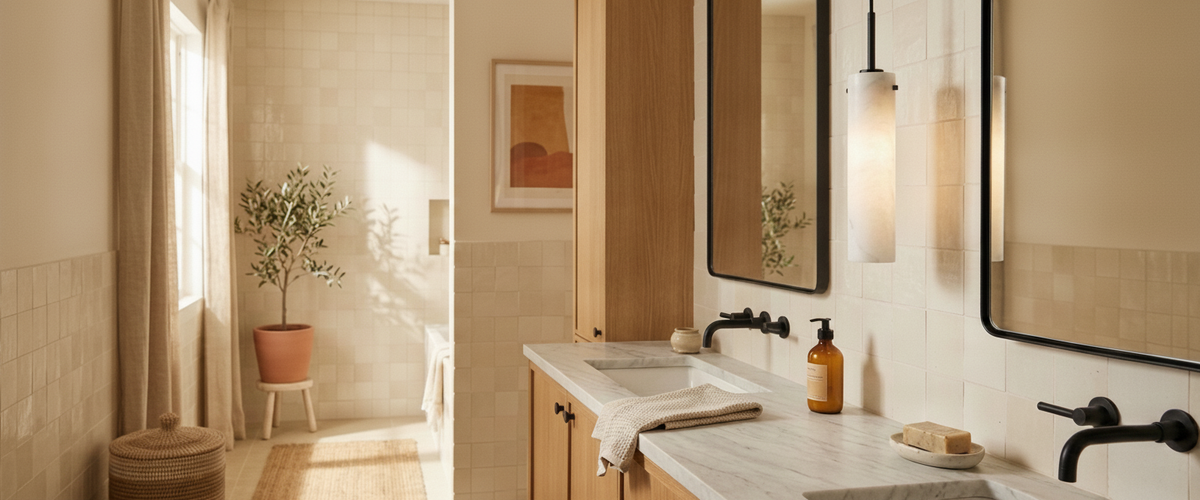
A translucent stone fitting warms hard tile and chrome without adding bulk.
Softening a Hard, Tiled Box with Alabaster
Tile, glass, chrome, and mirror are reflective and cool. Stack enough of them into a small room and the light bounces hard and the whole space feels clinical. This is where a warm alabaster wall light earns its place, and it is one of the small bathroom lighting ideas people overlook. Alabaster is naturally translucent, so light passes through the stone and comes out diffused and soft rather than glaring. In a small bathroom that quality does a lot of heavy lifting: it warms the reflections and breaks the hard-surface monotony without adding bulk.
Where the fitting sits outside the wet zones, or where it carries a suitable rating, an alabaster wall light beside a mirror or on the wall opposite gives a compact room a calm that no amount of downlight can. The veining in natural stone catches the light differently across the day, so the wall never reads as flat as painted plaster. You can see how that translucency behaves across the alabaster lighting collection, which helps when you are trying to picture the glow before it arrives. Confirm the IP rating and zone placement with your electrician for any stone fitting near water.
Mirror Light That Reads Faces Honestly
The mirror is where a bathroom is judged. Light it badly and you shave, apply make-up, or check your face in shadow. The rule is even, frontal light at roughly the height of the face; it is one of the small bathroom lighting ideas that pays back every single morning. Two slim wall lights on either side of the mirror deliver that; a bar across the top is the fallback when width is limited, though it tends to cast a slight downward shadow.
Keep the fittings shallow so they do not eat into the wall or clip you as you lean in. Slim, wall-hugging profiles matter more here than in any other room. Where you want a low-energy source that still sits tight to the wall, a G9 LED fixture like the Shirebrook 1 Light Bathroom Wall Light keeps the depth down while giving you an even, close-work beam. Avoid pointing a bright source directly at the mirror glass, which throws glare straight back at you; you want the light on the face, not the reflection.
Colour Temperature in a Small Room
Colour temperature decides whether a small bathroom feels warm or murky, so it belongs in any run of small bathroom lighting ideas. Go too cool, above 4000K, and the room reads like a clinic; skin looks grey and tile looks harsh. Go too warm and dim at the same time and the space can feel dingy. The sweet spot for most compact bathrooms is around 2700K, warm but still clean, with a high colour rendering index (CRI 90 or above) so colours stay true at the mirror.
Warmth and brightness are separate controls. Keep the colour warm, but make sure the mirror layer is genuinely bright enough for close work, then dim it down in the evening. A dimmable warm source gives you a well-lit room in the morning and a soft one at night from the same fittings. If you are choosing paint or a shower curtain to sit alongside, note that a light green bathroom reads fresh under 2700K but can drift olive under cooler light, so test the colour under the bulbs you actually plan to fit.
The Crowding Mistakes That Shrink a Small Bathroom
The most common error is over-fitting. People panic about a dark room and pack in six downlights plus an over-mirror bar plus a pendant, and the ceiling becomes a grid of glare that makes the room feel busier and smaller. Restraint reads as space. The strongest small bathroom lighting ideas nearly always subtract rather than add.
A few other traps worth avoiding:
Deep or projecting fittings that intrude into a room where every centimetre counts.
A single central downlight doing all the work, which is where we started.
Mismatched colour temperatures across fittings, which the eye reads as a fault.
Ignoring the low-level layer, then wondering why the room feels flat at night.
Buying decorative lights not rated for the zone because they looked good in a living-room photo.
Handle those, keep the palette warm, and let one soft stone fitting carry the character. The best small bathroom lighting ideas come down to this: a small bathroom does not need more light. It needs light placed with intent, which is the difference between a room that feels tight and one that feels considered.