
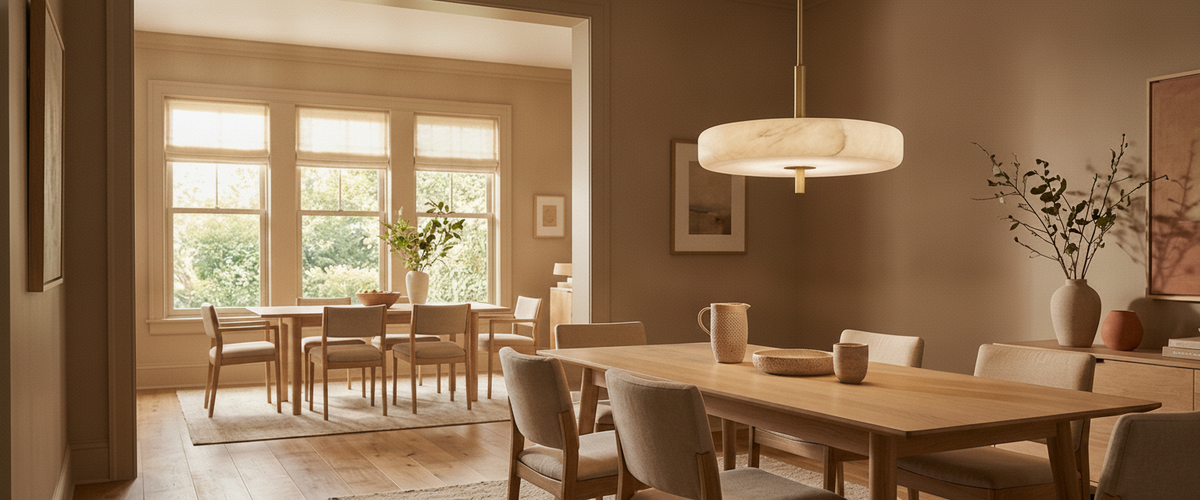

Two alabaster pendants can sit side by side in the studio, wired to the same bulb, and throw noticeably different light. The reason is the stone itself. A natural stone light does not just diffuse a bulb; it tints it. The base colour of the stone, the direction of its veining and how much light actually passes through the material all decide what lands on your walls, your worktop and your guests. Get the tone wrong and a warm room can turn faintly grey; get it right and the glow feels lit from within.
This is the part buyers underestimate. People choose stone by how the slab looks switched off, in daylight, on a supplier's shelf. What matters is how a natural stone light behaves switched on, at night, in your room.

Quick Answer: What to Check Before You Buy
Base colour tints the glow. Cool stones cool the light; warm creams push it golden.
Veining is not neutral. Green and grey veins colour the light that passes near them.
Translucency matters more than surface colour for pendants and wall lights that glow from behind.
Match colour temperature to the stone. A cool bulb in a cool stone can read clinical.
Test with your real bulb and your room's daylight before committing to a big fixture.

The Base Colour Decides the Glow
Every translucent stone acts like a filter. Push a warm bulb through a cream alabaster and the light comes out honeyed and soft. Push the same bulb through a cooler, greyer stone and it arrives more silver, more restrained. This is why we always talk clients through the base colour of a natural stone light before form. The shape sells the fixture in a photo; the base colour is what you live with after dark.
Alabaster, marble and onyx all carry these undertones differently. Onyx tends to be the most dramatic because its banding is strong and translucent, so the light picks up whole ribbons of colour. Alabaster is gentler and more even, which is why so much of the diffused, glowing lighting people love is carved from it. To see how these materials read as finished fixtures, the alabaster lighting range is the clearest place to compare a warm and a cool natural stone light in one place.
Light Blue Natural Stone: Cool, Coastal and Unforgiving
A light blue natural stone is beautiful in the right room and merciless in the wrong one. Blue undertones cool the transmitted light, so in a north-facing space that already leans grey, a blue-toned fixture can tip everything towards cold. We shipped a pair of pale blue-grey wall lights to a coastal home once. The client loved them in the south-facing hallway and quietly moved them out of the north bedroom within a month. Same stone, same bulb, completely different feeling.
Use a light blue natural stone light where you have warmth to spare: a sunny kitchen, a west-facing living room that catches the evening, a bathroom with generous daylight. Pair it with a warmer bulb to counter the chill. Avoid it as the only light source in a room that is already cool and short on daylight.
Light Green Natural Stone: Veining That Tints Everything
With a light green natural stone, the veining is the story. Green stones rarely read as a flat single colour; they carry threads of deeper green, grey and sometimes gold that the light travels through. Where a vein sits near the lit surface, it colours the glow around it, so the fixture throws a subtly variegated light rather than an even wash.
That is a feature, not a fault, if you place it well. A green-toned natural stone light sits happily with brass and warm metals, which is why so many pieces mix a green or veined shade with a brass base or arm. In a dining room it gives the table a soft, slightly organic pool of light. Just be aware that strong green veining will nudge nearby paint and timber towards the same tone, so test it against your wall colour before you commit to a large chandelier.
Light Grey Natural Stone: The Quiet Neutral
A light grey natural stone is the safe choice, and "safe" here is a compliment. Grey is the neutral that takes direction from your bulb. Put a warm bulb behind it and it warms; put a cooler bulb behind it and it holds its composure without turning cold. That flexibility is why a grey-toned natural stone light works across so many rooms, from a Californian open-plan kitchen to a restrained NYC study. For a dining table that wants an even, warm wash rather than a single dramatic point of light, a linear piece such as the Petra LED Linear Chandelier in brass with natural alabaster pairs the neutral stone with warm metal so the glow stays balanced along the length of the table.
The trap with grey is going too cool on both stone and bulb at once. A cool grey stone with a 4000K bulb can read like a hospital corridor. Keep at least one element warm. If the stone is cool, warm the bulb. If you want a crisp white bulb, choose a stone with a hint of cream in it.
Translucency Versus Surface Colour: What the Room Receives
Here is the distinction that changes buying decisions. Surface colour is what you see reflected off the stone in daylight. Translucent colour is what passes through it when the light is on. They are not always the same. A slab that looks pale grey on the shelf can glow surprisingly warm because the thin, lit sections transmit the cream buried in the stone. As a rough guide, alabaster panels around 8mm to 12mm thick transmit light well; go much thicker and the glow drops off fast.
For a table lamp or floor lamp where the shade glows, translucency is everything. For a wall light that mostly bounces light off the surface, surface colour matters more. Pendants and chandeliers give you both at once, which is why a natural stone light rewards a proper test. When you browse the wider lighting collection, sort in your head by whether the piece glows through the stone or throws light past it; that tells you which colour will dominate.
Matching Stone Tone to Colour Temperature
Colour temperature is measured in Kelvin, and it decides whether your natural stone light reads inviting or flat. Most residential warm-white bulbs sit around 2700K; a crisper white sits nearer 3000K to 3500K. Warmer stones can take a cooler bulb without turning cold. Cooler stones usually need a warmer bulb to stay comfortable.
Cream or honey alabaster: 2700K to 3000K keeps the glow soft and golden.
Light grey stone: 2700K for warmth, up to 3000K if the room has warm timber to balance it.
Light blue stone: stay at 2700K and give it a warm room; a cool bulb pushes it clinical.
Light green stone: 2700K to 3000K, and lean on brass fittings to hold the warmth.
Use dimmable LEDs and confirm the dimmer is rated for LED loads. Dimming a good warm bulb slightly is one of the simplest ways to stop a natural stone light reading muddy in the evening. The Chartered Institution of Building Services Engineers publishes helpful guidance on lighting levels and colour if you want the technical background (cibse.org).
How to Choose: A Short Buyer's Checklist
Start with the room's daylight. North-facing and cool? Warm the stone and the bulb. South-facing and bright? You have room for a cooler stone.
Decide glow versus reflected light. Pendants and shaded lamps glow through the stone; many wall lights bounce off it. That changes which colour wins.
Test the stone lit, not just on the shelf. Ask to see it switched on with the bulb you intend to use.
Check the veining direction against your walls and worktops so it does not fight your palette.
Confirm the fixing and weight. Stone is heavier than glass; the mount has to suit both the fixture and the wall.
On budget, resist any figure quoted before the specifics are known. What you pay depends on the material, the scale of the piece, how complex the carving is, the metalwork and finishing, and installation. The honest move is to request a tailored quote once you know which natural stone light and which room you are working with.
Mounting and Care Without Damaging the Stone
Mounting a stone fixture is not the same as hanging a glass one. A natural stone light is dense and heavier for its size; alabaster runs around 2.3 grams per cubic centimeter, so a shade can weigh several times what a glass one of the same size would. Use fixings rated for the fixture's weight and appropriate to your wall type, whether that is masonry, plasterboard with a suitable anchor, or a stud. For anything hardwired, use a qualified electrician; the connection and the mechanical fixing both need to be right. Electrical safety guidance is worth a read before any wiring work (electricalsafetyfirst.org.uk).
Day to day, keep it simple. Dust with a soft dry cloth. For marks, use a slightly damp cloth and dry immediately; avoid acidic or abrasive cleaners, which can etch and dull the surface. Light surface scratches on a stone counter or a lamp base can sometimes be reduced with a fine stone polish, but test in a hidden spot first and expect deep scratches to need a professional refinish. As for lightening stone, colour is largely set by the material; a good clean can brighten a dull or grimy surface, but genuinely changing the tone of a natural stone light is a specialist job and often not advisable, since aggressive treatment can affect how evenly it transmits light.
Choose the base colour with the same care you give the shape, and a natural stone light stops being a decorative object and becomes the thing that sets the mood of the room. Warm where you need warmth, cool where you have light to spare, and always test your natural stone light switched on.