
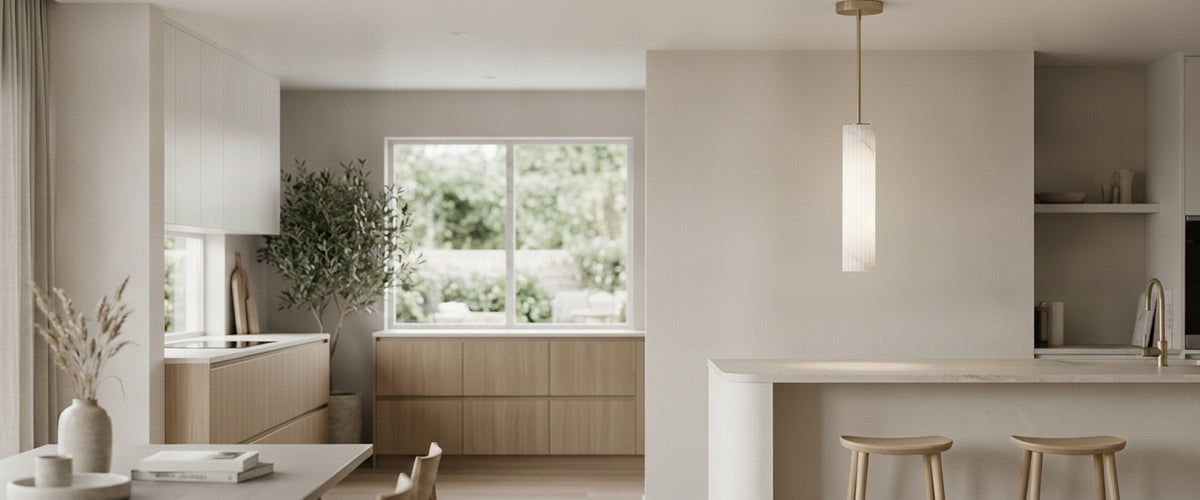

Wattage is the first thing most buyers ask about and just about the last thing that changes how a room feels. Specify a beautiful fitting, then push a cool, high-output lamp into it, and you get a space that photographs bright and lives cold. Getting modern white lighting right is a question of kelvin and colour rendering, and those two numbers do almost all of the visible work in a room. Everything else is plumbing.

Key Takeaways
- Wattage tells you consumption, not character. Colour temperature (kelvin) and colour rendering index (CRI) decide whether modern white light looks warm and considered or flat and institutional.
- 2700K to 3000K covers most British interiors. Reserve 4000K for genuine task and utility zones.
- Cool white is the enemy of natural stone. It drains the amber and honey tones out of alabaster, onyx and warm-veined marble.
- CRI 90 or above, with a decent R9 red value, is the realistic minimum for a room with timber, plaster and stone in it.
- Mixing temperatures works only in zones, not side by side in the same sightline.

Wattage Is a Red Herring: Colour Temperature and CRI Do the Visible Work
An LED lamp rated at 6W can throw more light than an old 40W incandescent, so wattage has stopped being a useful shorthand for brightness. Lumens tell you output. Kelvin tells you the tint of the white: lower numbers sit at the amber end, higher numbers move towards blue-white daylight. CRI tells you how honestly that light renders colour against a reference source, on a scale up to 100. The International Commission on Illumination maintains the colorimetry standards these figures are built on, and newer metrics such as fidelity and gamut scores are gradually appearing on better spec sheets.
Here is the practical version. Two lamps can be identical on lumens and wattage while one makes an oak floor look like honey and the other makes it look like cardboard. The difference is spectral: cheap warm-white LEDs often have a dip in the deep red part of the spectrum, which is why skin tones and terracotta go slightly grey under them. That is measured as R9, a single value inside the wider CRI test, and it is the one number most manufacturers quietly leave off the box.
If you take one habit away from this piece, make it this: read the kelvin and CRI figures before you look at anything else on the packaging. Modern white light that flatters a room almost always comes from a lamp with a stated colour temperature at the warm end and a CRI in the nineties.
Modern White Light on Plaster, Oak, Marble and Brilliant White
Surfaces are not neutral. They edit modern white light before your eye ever gets it, which is why the same lamp behaves so differently across four common finishes.
Lime Plaster
Lime plaster has a slightly chalky, open surface that scatters light beautifully. At 2700K it glows and the trowel marks read as texture rather than defect. At 3000K it stays soft and gains a little clarity. At 4000K the warmth in the pigment vanishes and the wall reads as a dull grey-white; every imperfection turns into a shadow.
Oak
Oak swings hard with temperature. 2700K pushes mid-tone oak towards orange, which is lovely in a snug and slightly sickly across a large kitchen floor. 3000K is the honest setting: grain stays legible, the tone stays warm without going ginger. At 4000K oak flattens and the sapwood starts to look ashy.
Marble
This is where the split gets sharpest. Grey-veined Carrara can survive 3500K and even looks crisper for it. Calacatta, with its gold veining, and any warm-toned travertine or onyx need 2700K to 3000K or the veins turn brown-grey and the polish goes dull. We keep sample tiles in the studio for exactly this reason, because clients rarely believe how much a vein colour shifts until they see it swapped live.
Brilliant White Emulsion
Trade brilliant white is formulated to look bright, and under a 4000K source it frequently tips slightly blue. Paired with cool downlights and a white ceiling, that reads as a dental surgery. At 2700K the same paint looks creamy and calm. If you have already painted brilliant white throughout and cannot repaint, warm lamps are your correction tool.
The Rooms That Take Cooler White, and the Ones That Never Do
Cooler white earns its place where the job is visual accuracy and the stay is short. Utility rooms, boot rooms, pantries, garages, workshops, home gyms and under-cabinet task strips all read better at 3500K to 4000K. So does a mirror light in a windowless bathroom where someone shaves or applies make-up, provided the CRI is high enough to render skin properly.
The rooms that never take it: bedrooms, sitting rooms, snugs, dining rooms, staircases, and any hallway used mainly after dark. In these spaces modern white light needs to sit firmly at the amber end, because the eye is adapting down as the evening goes on and a cool source fights that adaptation. A dining table lit at 4000K makes food look refrigerated. Swap a single 4000K pendant lamp for 2700K over a walnut dining table and the room usually reads as finished, with nothing else about it altered. Where a hallway or stairwell needs a soft wash of light up and down the wall rather than a hard downlight overhead, a fitting such as Marley Up Down Wall Light, White is closer to the right design language for evening use, because most of what you see is reflected off plaster rather than aimed at your eye.
Bathrooms sit in the middle. Split the job: a crisper, high-CRI light at the mirror, warmer light everywhere else. Wall lights flanking a mirror, in a matt white or alabaster body, handle this far better than a single ceiling fitting trying to do both. At mirror height the scale matters as much as the temperature; a compact square such as the Bora Matt White Square LED Wall Light 12W 3000K, 18cm sits close to the face without crowding the glass, and 3000K holds the warm edge of that range so skin tones never turn clinical.
Why Cool White Flattens Alabaster and Natural Stone Fittings Into Grey Slabs
Alabaster is translucent rather than transparent. Light travels a short way into the stone, scatters through the crystalline structure, and comes back out carrying the mineral colour with it. That subsurface scattering is the entire reason alabaster lighting looks the way it does, and sculptors have exploited the stone's fine grain and light-holding quality since the medieval period, as the alabaster carvings in collections such as the Victoria and Albert Museum make clear.
Feed that stone a cool source and you strip out the wavelengths its warm mineral banding needs to show. Honey and caramel veining turns pale ash. The surface stops looking lit from within and starts looking like a backlit grey panel. In our own studio comparison, one lamp swap from 2700K to 4000K inside the same alabaster bowl pendant took the piece from candle-glow to overcast concrete. Nothing about the stone changed. Only the spectrum did.
The same logic applies to onyx pendants, marble table lamps and stone-shaded floor lamps. Anything that relies on transmitted rather than reflected light needs modern white light from a warm, high-CRI lamp behind it. If you are specifying from the alabaster lighting collection, treat 2700K to 3000K as the default and only move upward if the fitting is opaque and purely decorative in form.
Mixing Temperatures in One Room: Layered or Broken
Mixed temperatures can read as depth. They can also read as a mistake, and the difference comes down to sightlines. If two sources at different kelvin values are visible at once, the warmer one looks dirty and the cooler one looks harsh. Your eye has no reference point, so it invents one and both lose.
Rules that hold up in practice:
- Keep everything within about 500K in a single open sightline. 2700K and 3000K together is fine; 2700K and 4000K is not.
- Zone by function, not by whim. Warm across the island and dining end, cooler tucked under the cabinets where the source itself is hidden.
- Never leave a single replacement lamp at the wrong temperature. One cool downlight in a warm ceiling grid is the most common fault we hear about.
- Match temperature across a run of matching wall lights. A linear LED wall light at 3000K and its sibling at 4000K look like different products on the wall, which is why a repeated run down a corridor is easier to control with a single specification such as the Hanok White Linear LED Wall Light 14W 3000K, 41cm than with a mix of lengths and temperatures.
- Dim-to-warm fittings solve the evening problem elegantly, dropping towards amber as output falls.
In short, modern white light survives mixing only when the cooler layer is either hidden or in another zone entirely.
How Warm-End LEDs Improved, and What to Look for on the Box Now
Early warm-white LEDs deserved their reputation. Phosphor coatings were crude, the red end of the spectrum was thin, and the light had a green cast that made warm woods look muddy. That has changed substantially. Multi-phosphor and violet-pump packages now render reds far better, consistency binning has tightened so that fittings from the same batch actually match, and flicker performance on decent drivers has improved.
What to check before you buy:
- Colour temperature stated in kelvin, not marketing language such as "soft glow" or "cosy white".
- CRI 90 or higher. Below that, stone and timber suffer.
- R9 value if published. Above 50 is respectable for a domestic lamp.
- SDCM (MacAdam step) of 3 or lower if you are buying multiples that will hang in one row.
- Dimming compatibility named explicitly, with the trailing-edge or specific driver requirement listed.
- Integrated versus replaceable. Integrated LED wall lights are neat and efficient; check the expected service life and whether the module can be replaced later.
One more practical benefit worth naming: LEDs run cooler than the halogen lamps they replaced, which is kinder to a natural material like gypsum alabaster sitting a few centimetres from the source. Keep alabaster and marble clean with a dry, soft brush or a barely damp cloth, skip acidic and abrasive cleaners entirely, and let the fitting cool before you touch it.
A Buyer's Checklist for Specifying Modern White Light
Use this as a decision sequence rather than a wish list. It works whether you are lighting a single hallway or a whole hospitality floor.
- Name the task first. Reading, cooking, dining, circulation and display all want different intensities before they want different temperatures.
- Set one house temperature. Pick 2700K or 3000K as your baseline and treat anything cooler as a deliberate exception.
- Audit your surfaces. Warm timber, lime plaster, brass and gold-veined stone all pull the specification warmer. Grey stone, polished chrome and cool paint tolerate a step up.
- Check the fitting's material logic. Translucent alabaster, onyx and stone shades want warm, high-CRI lamps. Opaque metal shades give you more latitude.
- Plan the dimming circuit before you plan the fitting. Retro-fitting a compatible dimmer is far more disruptive than choosing the right one at the outset.
- Buy lamps in matched batches so replacements later do not visibly drift.
- Use a qualified electrician for any hardwired pendant, chandelier or wall light, and for anything going into a bathroom zone.
- Ask for a tailored quote on larger schemes, because cost tracks material, scale and installation complexity rather than the number of fittings on the drawing.
Considered modern white light is a specification decision made early, not a fix applied at the end. Choose the temperature and the rendering quality first, choose the fitting that suits the material palette second, and the room will look composed at seven in the evening as well as at midday. If you are still weighing pendants against wall lights or a floor lamp against a table lamp, browsing the wider lighting collection alongside your paint and stone samples is the fastest way to see which combination holds its warmth.