
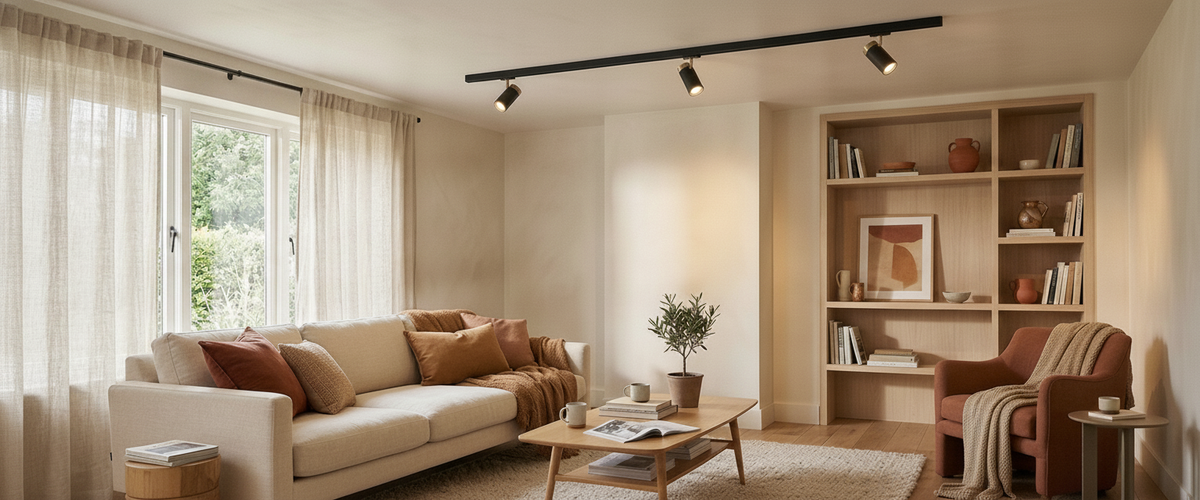

Most lighting regrets start with a single point in the middle of the ceiling. One fixture, one flat wash, and nothing aimed at the things actually worth looking at. Modern track lighting fixes that with unusual economy: a slim run of extruded metal, a set of adjustable heads, and the freedom to move light to where it earns its keep. Specified well, it reads as architecture. Specified badly, it reads as a shop fit at closing time.

Key Takeaways
- Track is a tool, not a scheme. It handles aimed, directional light. Pair it with a diffused source such as an alabaster pendant or wall light for the soft layer.
- Placement beats quantity. A short run in the right position outperforms a long run of evenly spaced heads.
- Beam angle is the specification that matters most. Narrow for art and objects, medium for worktops, wide only when you want a wash.
- Match colour temperature across every layer. 2700K throughout is the safest choice in a home; mixing 3000K spots with 2700K alabaster looks like a mistake because it is one.
- Finish should disappear. Matt white on plaster, matt black on dark or shadowed ceilings, titan grey against concrete and timber.

What Modern Track Lighting Suits, and Who It Is For
Track earns its place wherever the lighting brief is specific. Art walls, open-plan kitchens, galleries and showrooms, hallways with joinery, double-height spaces where a ladder is a nuisance. The virtue is adjustability: you can rehang a picture, move a console, or reconfigure a display and re-aim the light in ten seconds without touching the ceiling.
It suits three groups particularly well. Homeowners renovating a period property where chasing new circuits into lath and plaster is painful and a single surface-mounted run is not. Interior designers working with clients whose art collections rotate. And venue owners, from small galleries to restaurant groups, who need to relight a room seasonally without calling in a contractor each time.
Where modern track lighting is the wrong answer: over a dining table, where a pendant does the emotional work far better, and in a bedroom, where downward spots at close range are unforgiving. We had a client in Bath last spring who wanted track across a bedroom ceiling to light bedside reading. We talked them out of it. Two alabaster wall lights either side of the bed did the job with a fraction of the fuss and none of the glare.
Sizing, Height and Placement That Actually Works
Start with the wall, not the room. If you are lighting artwork or joinery, run the track parallel to that wall rather than centring it in the ceiling. As a working rule at a standard 2.4m ceiling (roughly 8ft), set the track around 700mm to 900mm (about 28 to 36 inches) out from the wall face. That geometry lets you aim heads at roughly 30 degrees from vertical, which is the angle that puts light on the picture without bouncing glare straight back into your eyes or throwing your own shadow onto the frame. Higher ceilings push the track further out; lower ceilings pull it in.
In kitchens, the same logic applies to worktops. Run the track over the front edge of the counter, not behind your shoulders, or you will stand in your own shadow while chopping. For island lighting, track is a reasonable option when you want adjustable task light plus the ability to graze a splashback, though many clients end up combining a short track run with pendants over the island itself.
Modern track lighting systems typically come in modular lengths, commonly 50cm, 100cm and 160cm (about 20, 39 and 63 inches), which can be joined and cut into L or U configurations. Scale the run to the job rather than the ceiling: an alcove, a stair landing or a single framed picture rarely needs more than something like the DUOline 50cm Track, Matt Black, while a gallery wall or a full worktop run is where the 160cm length starts to make sense. Resist the urge to fill every metre with a head. A 160cm run with three well-aimed spots looks considered. The same run with seven heads looks like a car park. The Chartered Institution of Building Services Engineers publishes detailed guidance on illuminance levels and glare control if you are specifying for a commercial fit-out where numbers have to be justified.
Mounting matters too. Surface-mounted track sits proud of the ceiling and is the simplest retrofit. Recessed track sits flush and reads as a slot in the plaster, which is the cleanest look but needs planning before the ceiling closes up. Suspended track drops the fixture into the room and works in tall spaces where surface mounting would put the light too far from what it needs to hit. All three need a qualified electrician; modern track lighting carries mains voltage along its conductors and is not a Saturday afternoon job.
Materials, Finishes and Light Quality
Finish selection in modern track lighting is a game of disappearance. Matt white vanishes against painted plaster and is usually the right call in a domestic ceiling, which is why a profile such as the DUOline 100cm Track, Matt White tends to read as a shadow line rather than a fixture. Matt black holds its line against dark ceilings, exposed steel, or shadow gaps, and it is the standard choice in galleries because black edges recede when the eye adjusts to lit artwork. Titan and warm grey finishes sit comfortably against concrete soffits, oak, and the greyer end of stone; on an exposed concrete ceiling the DUOline 160cm Track, Titan is closer to the right design language than either black or white, both of which would draw the eye.
Now the part that matters more than the metal. Specify lamps with a colour rendering index of 90 or above. Anything lower and the light will make warm timber look muddy and, critically, will drain the character out of natural stone. Alabaster and onyx depend on subtle warm veining; poor colour rendering flattens it into beige. Choose 2700K as your baseline, and consider dim-to-warm lamps if you want the light to deepen towards amber as it dims, which reads far more like candlelight than a straight dimmed LED.
Beam angle is where most people underspecify. A 15 to 24 degree beam is a spotlight; use it on a single painting, a sculpture, or a stone bowl. A 36 to 40 degree beam covers a worktop section or a run of shelving. A 60 degree beam is a wash, useful for grazing a stone or brick wall but wasteful if aimed at empty floor. Buy a mix and swap them once the furniture is in.
Track alone will always give you a crisp, directional room. That is exactly why we recommend building the soft layer alongside it. A translucent alabaster pendant or a pair of stone wall lights introduces the diffused glow that spots cannot produce, because light passing through gypsum alabaster scatters inside the material rather than reflecting off a shade. The British Museum collection holds alabaster vessels thousands of years old whose translucency was prized for exactly this reason. Browse the full niori lighting range and you will see how the two behave differently in the same room: track defines, alabaster softens.
Common Mistakes With Modern Track Lighting
- Centring the track in the room. Ceilings are not symmetrical problems. Position track relative to what you are lighting.
- Too many heads on one run. Every extra spot flattens the contrast you installed track to create.
- Mixed colour temperatures. Cool spots against warm pendants make both look wrong.
- Ignoring dimming compatibility. LED track heads need a driver and dimmer that talk to each other. Trailing-edge dimmers suit most modern LED loads, but confirm compatibility before ordering, and never assume a legacy dimmer from a halogen scheme will behave.
- Aiming everything downwards. Vertical surfaces are what make a room feel bright. Light the walls and the art before you light the carpet.
- Forgetting circuit separation. Track and decorative fixtures should sit on separate circuits so you can run the soft layer alone in the evening.
- Leaving heads permanently on full. Track is designed to be re-aimed and dimmed. Treat it as a live element of the scheme.
A Specification Checklist Before You Order
- Mark on a plan exactly what each head will light. If a head has no job, delete it.
- Measure ceiling height and set the track offset from the wall accordingly.
- Confirm surface, recessed, or suspended mounting with your electrician before plastering.
- Choose a finish that matches the ceiling condition, not the furniture.
- Specify CRI 90+ and a single colour temperature across the whole scheme.
- Order a mix of beam angles rather than a single spread.
- Check dimmer and driver compatibility, and put track on its own circuit.
- Plan the diffused layer at the same time: pendant, wall light, or table lamp.
- Request stone samples so you can see veining under your chosen lamp temperature.
How Niori Can Help With Lighting Projects
Niori works in alabaster and natural stone, so our instinct on any project is to ask what the light will be falling on before we ask what fixture goes in the ceiling. Stone rewards good light and punishes bad light more visibly than almost any other material. When a client sends through elevations, we will usually suggest where a modern track lighting run should sit and where a stone fixture will do more for the room than another spot.
For hospitality and residential schemes we can supply samples so specifiers see how a particular block of alabaster behaves when lit, since no two pieces vein identically. If you are building a scheme around a feature fixture, the alabaster lighting collection is the place to start, then work the aimed layer around it.
Budget for a project like this depends on material, block quality, scale, engineering, installation complexity and finishing, which is why we quote per project rather than publishing a figure. Send us the room dimensions, ceiling height and a photograph, and we will come back with a considered recommendation.