
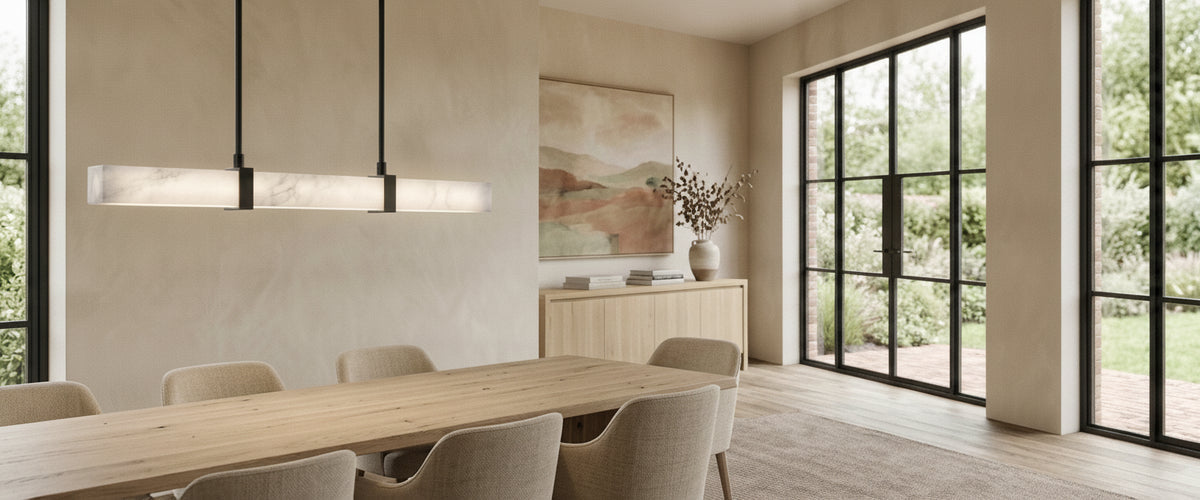

Most modern chandeliers dining room buyers shortlist are picked from the doorway and judged from a dining chair, and that gap is where they go wrong. Standing up, you see a piece of sculpture. Seated, with your eyes about 4 feet (1.2 m) off the floor, you see the underside of the fixture, the bare bulbs and the way light lands on plates and faces. This guide closes that gap with real numbers: how wide the fixture should be against your table, how low it should hang, which materials give flattering light, and how to dim it for a long dinner. Guests spend two or three hours under the modern chandeliers dining room hosts choose, so comfort at seated eye level counts for far more than how a fixture looked in the showroom.
At Niori we design and ship alabaster and natural-stone lighting to dining rooms from London mews houses to country kitchens, and the same few mistakes with the modern chandeliers dining room owners pick come up again and again. Below we take each in turn, along with the point where one fixture stops being enough.

Quick Answer
Diameter: size a modern dining room chandelier at roughly half to two-thirds of your table's width, and keep at least 6 inches (15 cm) clear of the table edge on each side.
Drop height: hang the lowest point 30 to 36 inches (76 to 91 cm) above the tabletop in a standard-height room.
Light quality: choose diffused light over bare sparkle if you want faces and food to look good.
Color temperature: use 2700K, dimmable, with a CRI of 90 or higher.
Long tables: two fixtures or one linear chandelier usually beats a single oversized piece.

Why Dining Room Chandeliers Go Wrong at the Table
Most buyers choose a modern dining room chandelier standing up. They picture it from the doorway, at eye level, as a piece of sculpture. Nobody eats standing up. Seated, your eyes sit around 4 feet (1.2 m) off the floor, which means you see the underside of the fixture, the bulbs, and the way light falls across plates and faces.
That shift in viewpoint explains most of the complaints we hear about the modern chandeliers dining room owners live with. The fixture is too wide, so people duck around it. It hangs too high, so the table feels lit by the room rather than by the chandelier. Or the bulbs glare straight into the eyes of whoever sits at the end. Get the table right and the ceiling tends to look after itself.
Sized to the table and hung low, a diffused alabaster fixture lights faces without glare.
Sizing Modern Dining Room Chandeliers: Ratios Most Buyers Skip
The ratio that matters is the fixture diameter against the table, not against the room. For the modern chandeliers dining room tables need, room size is secondary; the common rule is half to two-thirds of the table's width. A 40-inch (100 cm) wide table suits a chandelier of roughly 20 to 26 inches (50 to 66 cm) across. Go wider and diners on the long sides start to feel something looming over their shoulders.
For round tables the same logic holds, but you have more freedom, because nobody sits at an awkward end. For rectangular tables longer than about 6 feet (1.8 m), a round modern dining room chandelier will light the middle and leave the ends dim. That is the point to think about length rather than diameter, which we cover further down.
Room size still plays a role as a sense check. The old shorthand adds the room's length and width in feet and reads the total as a diameter in inches, so a 12 by 14 foot room suggests around 26 inches. Use it to catch a fixture that will look lost in a large space, then let the table make the final call.
Drop Height: Where Formal Turns Intimate
A couple of inches change the whole mood. Hang a modern dining room chandelier 30 to 36 inches (76 to 91 cm) above the tabletop in a room with a ceiling of around 8 feet (2.4 m). For every extra foot of ceiling height, raise it by roughly 3 inches (7.5 cm), but never let it drift up toward the ceiling in a tall room; the table loses its anchor and the light spreads thinly.
Hung low, the modern chandeliers dining room guests remember draw a room around the table and make six people feel like a party. Hung too low, they block sightlines across the table and guests start talking around them. Hung too high, they make dinner feel as if it is taking place in a hotel lobby.
Tall Victorian townhouses are where this goes wrong most often. The instinct is to follow the ceiling and hang an alabaster chandelier 40 inches or more above the table, and the room ends up feeling formal and slightly empty. Dropping the same fixture a few inches, back toward 36, usually turns it warm; with the modern chandeliers dining room designers favor, warmth lives in those last few inches. Mark your preferred height with tape and a length of string, sit down, and look across the table before the electrician fixes anything.
Modern Silhouettes Versus Period Frames
A contemporary dining scheme with a plain oak or stone table, upholstered chairs, and limewashed walls can take a period chandelier, but only if the choice is deliberate. An ornate arm frame over a minimal table reads as a statement. Hung over an equally ornate table, it quickly looks like a film set.
The modern chandeliers dining room specialists reach for are easier to live with: tiered discs, clean-lined arms in brushed or polished nickel, linear bars in satin black and brass, sculpted bowls of stone. They keep sightlines open and let the material do the talking. If your table is the star, choose a simpler frame. If the room is quiet and the table plain, the chandelier can carry more shape.
Where the room can take a little more shape but the bulbs still need to stay out of seated eyelines, a shaded design such as Lucerne 6 Light Chandelier, Brushed Nickel with Grey Shades is closer to the right design language than an open arm frame with bare lamps.
Crystal, Glass or Alabaster: Light That Flatters Food and Faces
Crystal throws sparkle, and of all the modern chandeliers dining room buyers consider, it is the one they misjudge most. A cut-crystal chandelier breaks light into points and flecks across walls, which is lovely in a hallway and harder work at the table, where those same points can glint in the eye. Frosted or opal glass softens the source and spreads light more evenly. If you still want some sparkle over dinner, keep the scale modest: over a smaller round table, a compact piece such as Aries 4 Light Small Crystal Chandelier, Polished Nickel makes more sense than a wide cascade of crystal hanging in everyone's line of sight.
Alabaster goes further. It is a fine-grained form of gypsum, and light passing through it picks up the warmth of the stone and scatters through its veining, so there is no hard hotspot and no glare. Faces look rested, food looks appetizing, and white linen reads as warm rather than blue. In the studio we often test new shades with a clear bulb behind them in a dark room; you can see how evenly a good piece of stone takes the light, with the veining glowing as though it is lit from within. If diffused light is the priority, our alabaster lighting collection shows how shade thickness and veining vary from piece to piece.
Marble and onyx behave differently in the modern chandeliers dining room schemes call for. Onyx tends to glow in honey and amber tones; marble is denser and works best as a detail on a frame or canopy rather than as the main diffuser.
Color Temperature and Dimming for Long Dinners
Set the lamps in your modern dining room chandelier at 2700K. Cooler light around 4000K suits a kitchen worktop but makes a dining table feel clinical. Look for a color rendering index (CRI) of 90 or above so reds, greens, and skin tones render truthfully; the Lighting Industry Association publishes useful guidance on LED quality if you want to compare specifications.
Dimming matters just as much on the modern chandeliers dining room hosts rely on for long evenings. Light that is right for serving at full brightness is too bright by dessert. Warm-dim LEDs, which drop toward 2200K as they dim, mimic candlelight and work beautifully behind alabaster. Check that your lamps and dimmer are compatible; many LED lamps need a trailing-edge dimmer to avoid flicker or buzzing.
When One Chandelier Is the Wrong Answer
A single modern dining room chandelier can only light a certain length of table well. Beyond about 7 feet (2.1 m), or in an open-plan space where the dining area shares a room with a kitchen or sofa, one fixture either ends up oversized or leaves the ends of the table in shadow.
Better options include two matching chandeliers spaced evenly along the table, a linear chandelier running about two-thirds of the table's length, or a central chandelier supported by alabaster wall lights that lift the room's ambient level. For a long rectangular table in a contemporary scheme, a linear design such as Zuma 6 Light Linear Chandelier, Satin Black/Gold spreads light along the table rather than pooling it in the middle, and the satin black and gold finish sits comfortably against oak or stone.
On tables over 7 feet, a linear fixture spreads light to both ends.
When planning the modern chandeliers dining room layouts depend on, let position follow the table rather than the center of the ceiling, especially in open-plan spaces. Moving a ceiling point is a small job compared with living with a fixture that floats over empty floor. Our wider lighting collection includes pendants and wall lights that pair well with a chandelier across a long space.
A Buyer's Checklist Before You Order
Measure the table width and length, not just the room.
Confirm ceiling height and check the fixture's adjustable drop or chain length.
Check the fixture weight and that the ceiling can support it; stone is heavier than glass.
Decide on diffused glow or sparkle, and pick the material to match.
Specify 2700K, CRI 90 or higher, and dimmable lamps.
Confirm dimmer compatibility with your electrician.
For tables over 7 feet (2.1 m), consider two fixtures or a linear design.
Ask for a tailored quote on the larger or bespoke modern chandeliers dining room projects sometimes need; pieces at scale vary in cost with material, size, engineering, and finishing.
Installation and Care
Always use a qualified electrician to install a modern dining room chandelier, particularly a heavy stone fixture that may need a reinforced ceiling mount. In the UK, the work should meet the wiring regulations published by the IET. Ask your electrician to fit the dimmer at the same time.
Care for alabaster is simple but specific. Dust with a soft, dry cloth or a soft brush. Never use water, sprays, or cleaning products, because alabaster is soft and porous and can mark or cloud. Keep it away from steam and cooking vapors where possible, which is one more reason to hang dining lights over the table rather than near an open-plan hob. Treated gently, stone is one of the longest-lived choices among the modern chandeliers dining room owners can buy. Schemes change every few years; good alabaster will outlast several redecorations.