
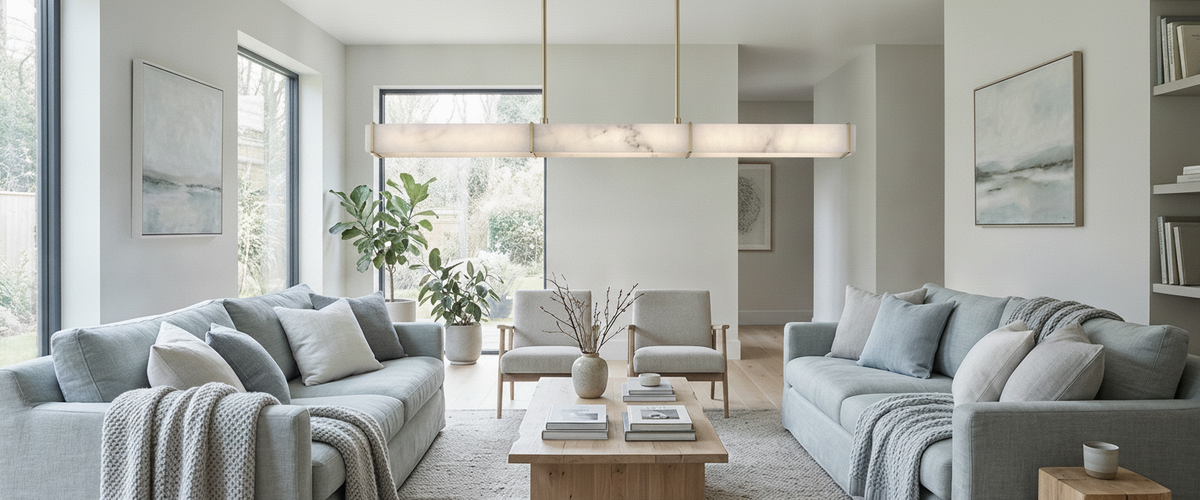

A living room with chandelier is trickier than it looks, because a dining table does half the work for you. To place a living room with chandelier well, read the room before you fall for a fixture: measure the space, hang it high, and anchor it to the seating rather than the coffee table. A dining setting fixes the centre, sets the sightline, and tells the fixture exactly where to hang. A lounge offers none of that. Put a piece over a coffee table the way you would over a dinner setting and it floats, undersized and off-axis, above a sofa that no longer relates to it.
That is the trap, and it is a common one. A chandelier in living room settings lives or dies on scale, so before we talk styles and stone, here is the short version for any living room with chandelier plans.

Key Takeaways
Measure the room, not the table. A rough guide: add the room's length and width in feet, and read that number in inches as a starting diameter (a 16 by 14 ft / 4.9 by 4.3 m room suggests around 30 in / 76 cm).
Hang high. With a standard 8 ft (2.4 m) ceiling, leave at least 7 ft (2.1 m) of clear headroom under the fixture. Raise the mount as the ceiling rises.
Anchor to the seating, not the coffee table. Centre the fixture over the main conversation zone.
Choose diffusion over sparkle. Alabaster and natural stone give warm, even light that suits a relaxed room better than cut crystal.
Let lamps and sconces do the reading light. The fixture sets the mood; it should not be the only source.

Read Your Ceiling Height and Seating Run First
Style is the last decision, not the first. Before you plan a living room with chandelier lighting, start with two measurements: your ceiling height and the length of your main seating run. A long sectional against a tall wall in a double-height space wants a very different piece from a pair of two-seaters in a London flat with 8 ft (2.4 m) ceilings.
Ceiling height sets your drop in any living room with chandelier. For every foot of ceiling above the standard eight, you can add roughly 2 to 3 in (5 to 8 cm) of fixture height and lower the mount accordingly, so the piece stays in proportion without crowding the room. On a 10 ft (3 m) ceiling a taller, more sculptural piece reads as intentional; the same fixture on a low ceiling looks like it is trying to escape.
The seating run tells you how much visual weight the fixture needs to hold. A generous sofa and a pair of armchairs form a wide conversation zone, and a mean little piece over it looks lost. This is where the room-dimension formula earns its keep: it scales the light to the whole living room with chandelier in mind rather than to whatever furniture happens to sit beneath it. For a wide seating run under a taller ceiling, a multi-arm piece like the Dynamite 6 Light Chandelier in Brass carries the weight the zone needs while the warm metal keeps it from feeling clinical.
Why Alabaster and Stone Beat Crystal Above a Relaxed Sofa
Crystal throws light in sharp points. That is its job, and it works over a dining table where you want a little theatre. A lounge is where people slump, read, and watch films, and hard sparkle fights that mood. In a living room with chandelier lighting meant to relax you, alabaster does the opposite: the stone is faintly translucent, so light passes through the material and comes out soft and warm, closer to candlelight than to a spotlight.
Each piece of alabaster carries its own veining, so no two shades diffuse light in quite the same way. The United States Geological Survey documents how the mineral structure of translucent stones like gypsum alabaster scatters light rather than reflecting it, which is exactly the quality that makes a stone fixture feel calm rather than clinical. You can see the same principle across our alabaster lighting range, where the glow reads as a wash rather than a set of bright points. It is the reason a living room with chandelier lighting in stone feels warmer than the same room in glass.
Marble and onyx sit alongside alabaster in the same family. Onyx tends to carry stronger, more dramatic banding and a warmer amber cast when lit; marble reads cooler and more architectural. For a living room with chandelier lighting where you want the light to settle rather than perform, alabaster's gentle diffusion is usually the safest bet, with brass detailing to warm the metalwork. Browse the wider lighting collection if you want to compare how the same stone behaves in pendants, sconces, and table lamps before committing to a full fixture.
Drop and Diameter Over a Coffee Table, Not a Dinner Setting
Here is where dining-room advice leads people astray. Over a dining table you hang low, roughly 30 to 34 in (76 to 86 cm) above the surface, because the table is the room and nobody walks under the fixture. A living room with chandelier is a walk-through space, so the rules flip.
Keep at least 7 ft (2.1 m) of clear space beneath the lowest point of the piece so a tall guest never ducks. On an 8 ft (2.4 m) ceiling that leaves only about a foot of drop, which is why compact, semi-flush stone fixtures often suit a lower living room with chandelier better than a long-stemmed one. As the ceiling climbs, you gain room to drop the fixture lower and let it read as a proper centrepiece.
For diameter, the room formula gets you close, but sanity-check it against the coffee table or the central rug. The fixture should feel related to the seating zone below without hanging so wide that it visually crowds the walls. If you are torn between two sizes, go up. An undersized piece is the single most common mistake we see in a living room with chandelier; an over-cautious diameter ages a room faster than a bold one. Where an open-plan living zone reads as long rather than square, a linear form such as the Essence Linear Pendant Light in Brass holds the sightline better than a round piece fighting the axis.
Let Lamps and Sconces Carry the Room
In a living room with chandelier lighting, the overhead light should not be the only source, and it should rarely be the brightest. Think of it as the top note. The working light, the reading light, the low evening glow, comes from lamps and wall lights placed at eye level and below.
We shipped a stone fixture to a client who had bought a beautiful piece for their living room with chandelier plans and then wired it to a single switch at full output. The room felt like a showroom. The fix was not a new fixture; it was a dimmer on the light, a pair of alabaster table lamps flanking the sofa, and two sconces beside the fireplace. Once it could drop to a low wash, it finally did its job, which is to set atmosphere while the lamps handle the reading. That is the sign of a living room with chandelier that has been thought through, not just switched on.
Put the overhead piece and any downlights on a dimmer, and choose warm LED lamps in the 2400K to 2700K range for that candle-like tone. Alabaster is flattering to warm light and can look gray and lifeless under anything too cool. The Chartered Institution of Building Services Engineers publishes lighting guidance on layering ambient and task light, and the principle holds for any chandelier in living room use: one bright source overhead in a living room with chandelier is a lighting mistake, not a lighting scheme.
When a Living Room Shouldn't Have a Chandelier at All
Sometimes the honest answer is no. Not every living room with chandelier is an improvement. If your ceiling sits at or below 8 ft (2.4 m) and the room is small, a hanging fixture of any real presence will feel like it is pressing down on you. A pair of alabaster wall lights and a good floor lamp will give you softer, more usable light and keep the ceiling feeling higher, and that beats forcing a living room with chandelier where it does not fit.
Open-plan rooms are another case. If your living zone flows into a kitchen or dining area, competing ceiling fixtures can clutter the sightline. Often a single linear stone pendant over the seating, echoed by a matching piece over the dining table, reads as more deliberate than a lone fixture stranded in the middle of a large floor plate. And if there is genuinely no natural centre point, no clear seating anchor and no ceiling feature, a living room with chandelier hung as an overhead statement will always look slightly adrift. Trust that instinct.
A Quick Buyer's Checklist
Measure first. Room length plus width in feet, read as inches, gives your starting diameter.
Check headroom. Minimum 7 ft (2.1 m) clear beneath the fixture.
Anchor to seating. Centre over the conversation zone, not the coffee table.
Pick stone for diffusion. Alabaster or onyx for warm, even light over a relaxed room.
Wire it to a dimmer and add lamps and sconces so the light can run low.
Use a qualified electrician for installation, especially with heavier stone fixtures that need secure ceiling fixing.
Ask for a tailored quote. Budget depends on material, scale, engineering, and finishing, so a specced quote beats a guessed number.
Get the scale and the height right and everything else follows. A well-placed living room with chandelier, properly sized, hung high enough, and paired with lower-level light, will quietly hold the space together for years. Treat the living room with chandelier as a layered scheme rather than a single fixture, and it stops competing with the sofa. That is what turns a living room with chandelier into a room that works, rather than a crystal statement piece fighting your sofa for attention.