
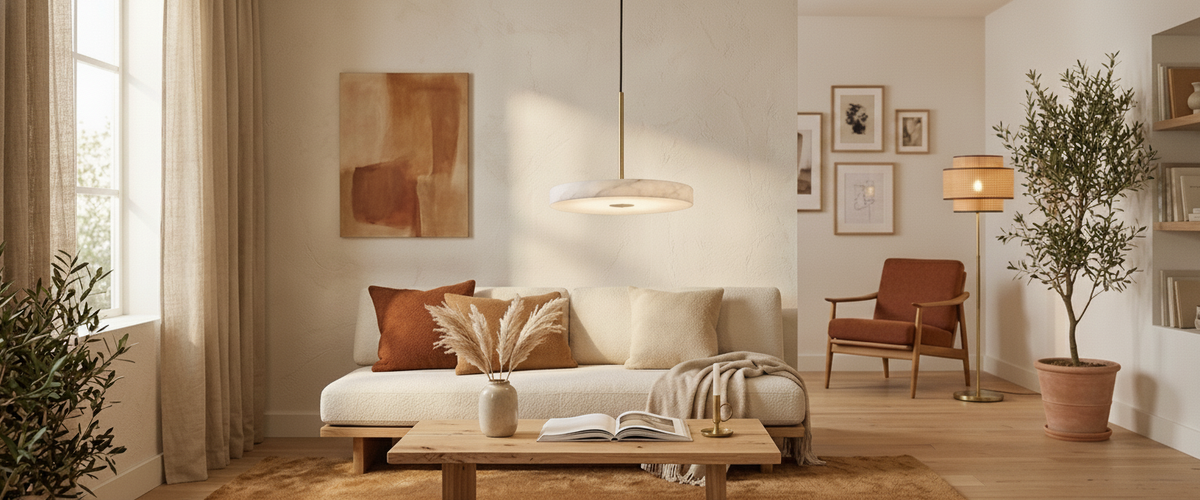

A single bright fixture in the middle of the ceiling is the most common lighting decision in a living room, and one of the least considered. It pushes flat light straight down onto the coffee table, leaves the corners in shadow, and does nothing for the way you actually use the space in the evening. Getting the living room ceiling right is less about one hero light and more about choosing the correct fixture for your ceiling height, hanging it at the right level, and letting lamps do the rest of the work.
At Niori we design alabaster and natural-stone lighting, so we think about the quality of the glow as much as the placement. Stone shades soften the source and throw a warm, even wash rather than a hard cone. That changes how a living room ceiling fixture behaves in a room, and it changes the mistakes you can afford to make.

Key Takeaways
One central living room ceiling light rarely covers a whole space. Plan for layers from the start.
Ceiling height sets the fixture type: flush and semi-flush for low ceilings, pendants and chandeliers for high ones.
Size a living room pendant to the room, not the table beneath it.
Hang pendants so they clear sightlines from the sofa, usually leaving at least 7 feet (2.1 m) of headroom in a walkway.
Dimming and a warm colour temperature do more for the evening feel than raw brightness.

Why One Central Light Rarely Serves a Whole Living Room
A living room does several jobs. You read in it, watch films, talk over drinks, and occasionally light it fully to clean or find something under the sofa. A single living room ceiling point set to one brightness cannot serve all of that. When it is the only source, you get glare on screens, a bright island around the middle of the room, and gloomy edges where the seating usually sits.
The fix is to treat the overhead fixture as the anchor of a layered scheme rather than the whole scheme. It provides shape and ambient fill; table lamps, floor lamps and wall lights handle the reading pools and the mood at the edges. An alabaster pendant or ceiling light contributes a soft ambient layer that flatters the room even before you switch on anything else, because the stone diffuses the light instead of firing it straight down.
Flush, Semi-Flush or Pendant: Matching the Fixture to Ceiling Height
Ceiling height decides your first move more than style does. Hang the wrong type and the room either feels cramped or the fixture floats meaninglessly overhead. Your living room ceiling sets the terms before any question of finish comes up.
Ceilings under 8 feet (2.4 m). Go flush or semi-flush. A flush-mounted alabaster or glass disc sits close to the ceiling and spreads a broad, low-glare wash. Where you want that soft ceiling-hugging wash rather than a hard downlight, a piece such as the Gonzalo LED Glass 29cm Ceiling Light sits close enough to preserve headroom while still reading as a considered fixture. A semi-flush drops a few inches and adds a little presence without eating headroom. This is the safe choice for most standard-height living rooms and apartments.
Ceilings from 8 to 10 feet (2.4 to 3 m). You have room for a modest pendant or a compact chandelier. This is where a stone pendant earns its place on the living room ceiling, hanging low enough to be seen and admired without blocking movement. A circular fixture with real presence, such as the Darvin 2 Light LED Circular Ceiling Light, works well at this height where it needs to read as an object, not just a light source.
Ceilings above 10 feet (3 m). Height wants filling. A larger pendant, a tiered chandelier, or a linear fixture over a long console or dining-adjacent zone reads properly at this scale. Over a long seating run or an open-plan stretch, a linear form such as the Arvin 6 Light LED Linear Ceiling Light fills horizontal space more convincingly than a single small flush light, which looks lost in a tall room. Browse the range on our lighting collection to see how the same living room ceiling can carry a flush overhead light or a sculptural pendant depending on what sits above it.
How to Choose a Pendant Light for a Living Room
Sizing is where most people go wrong, because they measure the coffee table instead of the room. A living room pendant is an architectural element, so it should relate to the space.
Diameter. A useful starting rule: add the room's length and width in feet, then read that total in inches for a sensible pendant or chandelier diameter. A 14 by 16 foot room (about 4.3 by 4.9 m) suggests a fixture around 30 inches (76 cm) wide. Adjust up for tall ceilings and down if the piece hangs over a specific low table rather than the room centre.
Visual weight. A carved alabaster pendant reads heavier than an open brass frame of the same diameter, so a slightly smaller stone piece can hold the room. Judge by presence, not just measurement.
Position. Centre the pendant on the main seating group or a coffee table, not always on the exact geometric centre of the living room ceiling. Rooms are rarely symmetrical, and lighting should follow how people sit.
Sightlines from the Sofa and How They Change What You Should Hang
Sit down before you commit. The single most useful thing you can do is take the seat you use most and look across the room. A pendant that clears the head of someone standing may still hang square in the eyeline of someone seated on a low sofa, especially in an open-plan space where you look through to a kitchen or hallway.
For a pendant over a coffee table with seating around it, aim to keep the bottom of the fixture above the sightline between facing sofas so people can talk without a light in the way. Over a walkway or open floor, keep at least 7 feet (2.1 m) of clearance underneath. In a room where the pendant sits over a reading corner rather than a table, you can hang lower, because nobody is walking through.
Alabaster helps here in a specific way. Because the shade glows rather than exposing a bare bulb, a stone pendant on the living room ceiling in the eyeline is far less punishing than a clear-glass or open fixture at the same height. You see a warm object, not a glare source.
How Low to Hang a Living Room Pendant Light
Height is contextual, so treat these as starting points rather than rules.
Over a coffee table: hang the base roughly 30 to 36 inches (76 to 91 cm) above the table surface, then check it against sightlines from the sofa.
In open floor space or a walkway: keep at least 7 feet (2.1 m) of clear headroom below the fixture.
Over a reading chair or side console: you can drop lower for intimacy, since no one passes beneath.
In a double-height room: think in proportion to the wall, hanging the fixture in the upper third of the visible space rather than marooned near the living room ceiling.
If in doubt, hang it, then live with it for a day before shortening the drop. Chains and cords are easy to adjust; a hole in the wrong place is not.
Layering Ceiling Light with Lamps So the Room Doesn't Feel Flat
Ambient overhead light gives the room its base level. On its own it is flat, because all the light comes from one direction. Adding light at eye level and lower brings depth: a table lamp on a side table, a floor lamp behind a chair, a pair of wall lights either side of a fireplace.
The trick is to keep the colour temperature consistent across the layers so the room feels coherent. Warm alabaster table and floor lamps sitting under a stone living room ceiling fixture read as one family of light. Our alabaster lighting collection is built around this idea, so a ceiling piece and a table lamp share the same warm, diffused character rather than fighting each other.
A quick studio note. We shipped a scheme to a client with a long, open-plan sitting room where a lone overhead light had always felt cold. Adding two alabaster table lamps and a floor lamp, all on the same warm output, changed the room more than any ceiling swap would have. The main fixture simply stopped being the only thing working.
Dimming and Warmth: The Settings That Make Evenings Feel Right
Brightness is not the goal in a living room; control is. A living room ceiling fixture on a dimmer lets you run it low as ambient fill in the evening and bright when you need the whole room lit. For colour temperature, warm output around 2700K suits most living rooms and matches the tone alabaster naturally throws.
Use good-quality dimmable LED lamps rated for your fixture and control, and check that your dimmer is compatible; mismatched dimmers cause flicker and buzz. The Chartered Institution of Building Services Engineers offers useful background on lighting quality and comfort in the home (cibse.org). If any of this involves altering fixed wiring, use a qualified electrician rather than attempting it yourself.
The Ceiling Mistakes That Make a Living Room Feel Like a Waiting Area
A few recurring errors turn a comfortable room clinical:
One bright fixture, no dimmer. The room only has an on and an off, and it is always too bright for the evening.
Cool white light. A bluish overhead light drains warmth from wood, textiles and skin tones. Keep it warm.
A fixture sized for the table, not the room. Small pendants in large rooms look apologetic.
Everything on the ceiling. With no lamps at lower levels, the room stays flat no matter how good the central fixture is.
Exposed bare bulbs at the wrong height. Glare in the eyeline undoes any amount of good sizing. This is where a stone shade quietly solves the problem.
Get the fixture type right for your ceiling height, size the pendant to the room, hang it against real sightlines, and layer in warm lamps on a dimmer. Do that and the living room ceiling stops being the only thing the room relies on, which is exactly when the space starts to feel finished.