
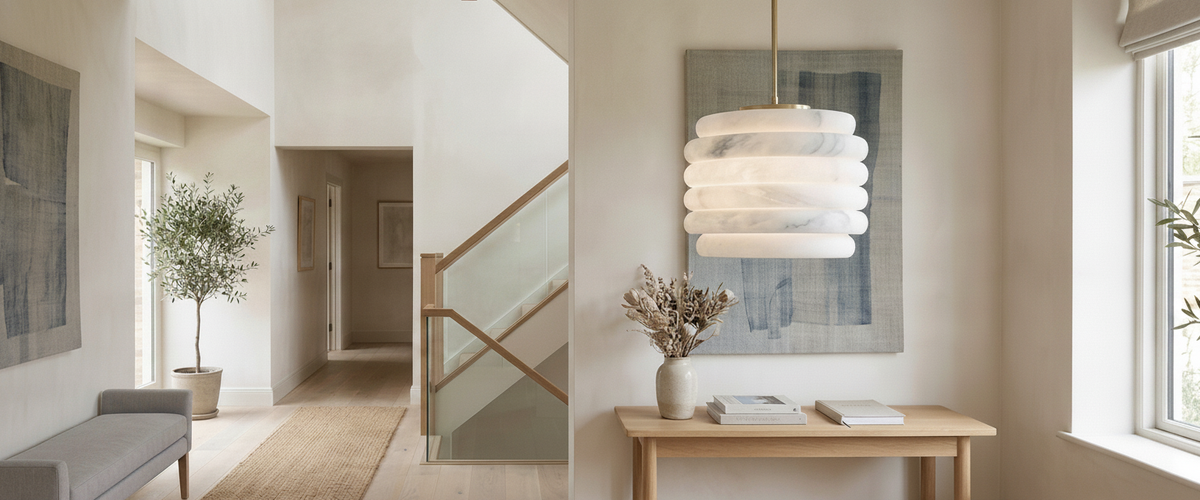

Most chandeliers that disappoint were hung wrong rather than chosen wrong. The piece is beautiful in the box, beautiful in the photographs, and then it lands 20cm too high over a dining table and the whole room reads slightly off. light and chandeliers decisions are geometry before they are taste: how far the fixture drops, what it sits against, how the beam falls on faces and surfaces, and whether the bulb inside it can be dimmed low enough to feel like evening rather than an interrogation.

Key Takeaways
- Light and chandelier planning starts by deciding the fixture's role in the room: focal object, ambient wash, or both.
- Over a dining table, aim for roughly 75 to 90cm (30 to 35in) between the tabletop and the lowest point of the fixture.
- In circulation areas, keep at least 2.1m (7ft) of clear headroom under the fixture.
- Diameter rule of thumb for a dining chandelier: around half to two thirds the width of the table.
- Alabaster and onyx glow from within and stay comfortable to look at; crystal sparkles but needs careful bulb control to avoid glare.
- Every chandelier needs a dimmer, and every chandelier needs a qualified electrician to check the ceiling fixing.

What a Light and Chandelier Scheme Looks Like in Different Rooms
A chandeliers does two jobs at once. It throws light, and it occupies volume. In a double-height entrance hall the second job dominates: the piece is sculpture that happens to be lit, seen from the stairs, the landing and the front door. In a low-ceilinged bedroom the first job dominates, because you cannot get far enough away from the fixture to read it as an object; you mostly experience its glow on the ceiling and the walls.
That difference explains why the same fixture family behaves so differently across a house. Carved alabaster discs stacked on a slim brass armature look architectural in a hall with 5m of height above them. Drop the same form into a 2.4m bedroom and it becomes an obstacle. When we talk to designers about a light and chandelier scheme for a whole property, we usually start by sorting the rooms into two lists: rooms where the fixture is a focal object, and rooms where it is a source of ambient wash. The specification follows from that split.
Scale, Mounting Height and Sightlines
Height is where most projects go wrong, and it costs nothing to fix at the planning stage. Light and chandelier proportions come down to three numbers: drop, diameter and clearance.
Over a table
Hang so the lowest point sits 75 to 90cm (30 to 35in) above the tabletop. Higher than that and the light spreads thin and stops feeling intimate. Lower and people crane around it. For ceilings above 2.7m (9ft), add roughly 7cm of drop for every additional 30cm of ceiling height, so the fixture stays in proportion to the volume above it.
In open space
Keep 2.1m (7ft) of clearance under anything people walk beneath. In a stairwell, the reference point is not the floor; it is the highest tread anyone will pass on. Sight the fixture from the first-floor landing as well as from below, because that is the view that sells it.
Diameter and mass
For a round table, take roughly half to two thirds of the table width. For a rectangular table, a linear or multi-arm fixture usually reads better than a single sphere. Consider visual weight too: a piece such as the Brianna 9 Light Chandelier in black occupies more attention than a pale stone fixture of identical dimensions, because contrast against the ceiling is doing the work. In a smaller dining room, stepping down to the six-light version of the same form keeps the silhouette without letting the fixture dominate the table beneath it.
Sightlines and reflections
Check what sits behind the fixture from the seated position. A chandelier silhouetted against a window is a black shape all afternoon. Against a plastered wall in a warm off-white, the same piece glows. Where the backdrop is already warm and you want the metalwork to settle into it rather than cut across it, a softened finish like the Kristy 4 Light Chandelier in distressed gold reads more comfortably than a hard polished frame. In rooms with a mirror over a fireplace, remember you are specifying two chandeliers, not one.
Room by Room: Where Light and Chandelier Choices Earn Their Keep
Dining room. The strongest case for a chandelier anywhere in the house. Faces are lit from above at a flattering angle, the table becomes the brightest plane in the room, and the fixture anchors the furniture layout. Add wall lights or a lamp on a sideboard so the room is not one bright pool in the middle of darkness.
Entrance hall and stairwell. Long drops belong here. This is where a tiered alabaster or onyx piece justifies itself, because you see it from several levels and the stone reveals different veining as light moves through it. Confirm access for cleaning before you commit; a scaffold tower every time a bulb fails is a poor trade.
Living room. Chandeliers here work best when they are not the only light. A central fixture on a low dimmer, plus a stone table lamp on a console and a floor lamp by the reading chair, gives you three moods from one room. Browse the wider range of pendants, wall lights and lamps in the niori lighting collection if you are building layers rather than buying a single hero piece.
Bedroom. Choose a shallow, softly diffused fixture and keep it well away from the bed's sightline. Nobody wants a crystal cluster in their peripheral vision at 3am. A compact alabaster form gives a broad, glare-free wash, which suits a room you use lying down.
Bathrooms and kitchens. IP ratings and zone rules apply in bathrooms, and any bathroom fixture must be specified and installed to current UK wiring regulations by a qualified electrician. In kitchens, keep chandeliers away from hobs and extraction; grease and stone are a bad pairing.
Hospitality. Restaurants and hotels get more out of chandeliers than most homes because the pieces are seen repeatedly, from many angles, by people sitting still for an hour or two. Guests photograph them. Specify for maintenance access and for long dimmed hours rather than for a single opening-night photograph.
Bulbs, Dimming, Backdrop and Contrast
Colour temperature sets the whole tone. For alabaster, onyx and marble, 2400K to 2700K is the sweet spot; the stone already carries warm honey and cream tones, and cooler LEDs fight it and make the veining look grey. A high colour rendering index matters more than raw output. Look for CRI 90 or above so wood, textiles and skin tones stay true.
Dimming should be part of the specification, not an afterthought. Match the driver to the dimmer module, and test the combination before the plasterer finishes, because a chandelier that flickers at 15% is a chandelier you will never run at 15%. In dining rooms we generally suggest a scene that sits around a quarter of full output; stone diffusers stay legible and softly luminous at low levels, where bare crystal can start to look dim rather than intimate. Light and chandelier quality lives in the lamp as much as the frame.
Crystal chandeliers depend on point sources to create refraction. Lead crystal was developed for exactly this kind of optical brilliance, a technique documented in glass history collections such as the Corning Museum of Glass. That sparkle comes with glare, so a crystal fixture in a low room needs shielded lamps and a generous dimming range. Modern chandeliers in stone work the opposite way: the material is the diffuser, so the eye reads a lit surface rather than a hot filament. That is the premise behind Niori's carved alabaster and natural-stone pieces, and it is why they hold up in rooms where an exposed crystal fixture would glare.
How to Shortlist a Light and Chandelier: A Buyer's Checklist
- Measure ceiling height, table width and the lowest headroom point along every walking route.
- Decide the fixture's role: focal object, ambient wash, or both.
- Check the ceiling structure. Stone chandeliers carry real weight, so joists, backing plates and fixings need confirming by an electrician or structural engineer before order.
- Choose material by mood: alabaster and onyx for warm diffusion, marble for solidity, crystal for sparkle, brass detailing to tie into ironmongery.
- Confirm dimming compatibility and colour temperature at the same time as the fixture.
- Plan cleaning access, especially for stairwell drops.
- Ask for a tailored quote rather than assuming a figure. Cost depends on stone selection, scale, metalwork complexity, engineering, installation and finishing, and two pieces of similar size can differ considerably.
If you are comparing carved stone options at this stage, the alabaster lighting collection is the fastest way to see how different thicknesses and cuts of stone change the quality of the glow.
Light and Chandelier Placement Mistakes We See in Client Projects
Buying before the table is chosen. A 1.8m table and a 2.4m table want different fixtures. One client ordered a wide multi-arm piece for a dining room, then swapped to a longer table two months later; the fixture ended up floating over the middle third with dark ends. Sequence matters.
Centring on the room instead of the furniture. The chandelier should centre on the table, not the ceiling rose the builder left behind. Moving a fixing point is a small job at first fix and an irritating one afterwards.
Ignoring the ceiling colour. A pale stone chandelier against a dark ceiling reads as a bright object; against white it reads as texture. Neither is wrong, but the decision should be deliberate.
One fixture doing everything. A single chandelier on full output flattens a room. Layer it with wall lights, a table lamp and, where the room allows, a floor lamp behind seating.
Skipping the mock-up. Cut a cardboard disc to diameter, tape it to a broom handle and hold it at the proposed drop. Five minutes of this has saved more schemes than any amount of rendering.
Living With Stone: Care Notes
Alabaster is a gypsum stone, soft enough to carve finely and sensitive to water, which is why conservation guidance for historic interiors treats it more cautiously than granite or slate. Dust with a dry, soft brush or microfibre cloth. Skip household sprays, vinegar and anything abrasive; they etch the surface and dull the translucency that you paid for. Marble and onyx tolerate a slightly damp cloth followed by immediate drying. Isolate the circuit before cleaning any fixture, and leave LED modules to cool first.
Handled properly, these pieces age well. Chandeliers have hung in British civic and country-house interiors for centuries, as the heritage records held by Historic England show, and a well-fixed stone fixture is a fitting you specify once. Get the light and chandelier decisions right at the drawing stage, and the piece will still look considered a decade after the sofa has been replaced. Start with the Niori range if you want to see how the same stone behaves across pendants, chandeliers and lamps.