
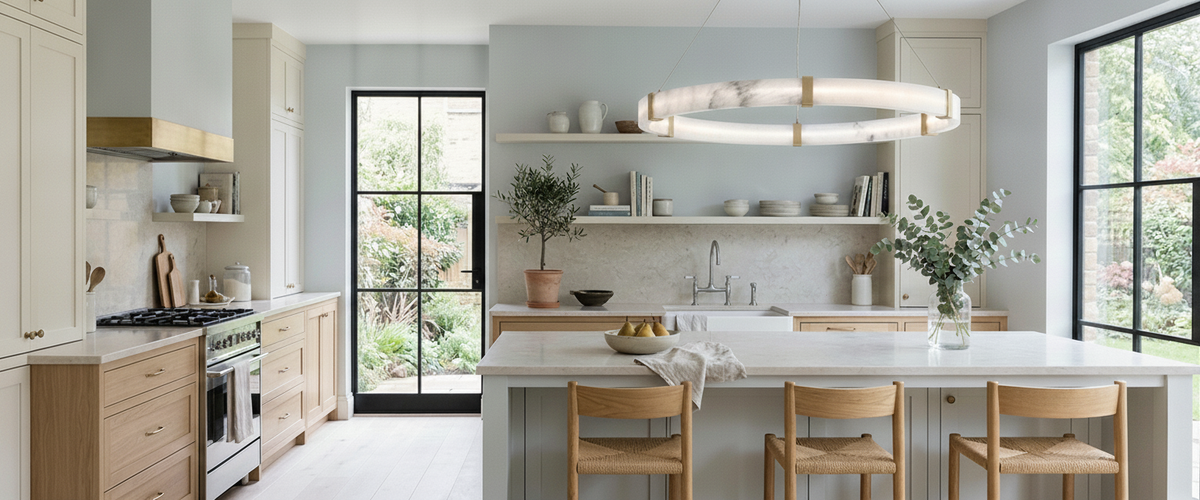

Most kitchen chandeliers fail for one of two reasons. They hang too low over a working surface and get knocked by a raised kettle or a tall guest, or they throw a hard, blue-tinged light that turns honed marble grey and makes food look faintly clinical. Both problems are fixable before you buy, and both come down to height, scale, material and the bulb you put inside. The best kitchen chandeliers are pieces of furniture that happen to glow, so they deserve the same care you would give a dining table.

Key Takeaways
- Height matters more than style. Aim for roughly 75 to 90cm (30 to 35in) between the worktop and the lowest point of the fixture, and check sightlines while seated.
- Scale to the island, not the room. A single round fixture suits a compact island; anything longer than about 1.8m (6ft) usually wants a linear form or a pair.
- Warm, high-quality light wins. 2700K, CRI 90 or above, on a proper dimmer.
- Placement protects the material. Keep porous stone away from the direct steam and grease plume of a hob or range.
- Alabaster diffuses rather than glares, which is why stone kitchen chandeliers flatter worktops, timber and skin tones in a way that clear glass rarely does.

What Kitchen Chandeliers Suit, and Who They Are For
Kitchens stopped being service rooms a long time ago. They are where people eat breakfast, work, pour a drink and sit for hours after dinner, which means the lighting has to shift between task and atmosphere without anyone rewiring the room. Kitchen chandeliers answer the atmosphere half of that brief. They give the space a visual centre, add height and material interest, and stop an open-plan kitchen reading as a run of joinery with downlights above it.
They work best in three situations. First, above a generous island where there is real ceiling height to play with. Second, over a kitchen dining table, where a decorative fixture does the same job it would in a formal dining room but with a more relaxed finish. Third, in a broken-plan layout where one hanging piece anchors the cooking zone against a taller, more architectural volume.
Kitchen chandeliers are less convincing in galley kitchens, under low ceilings below about 2.3m (7ft 6in), or directly above a hob. In those cases, wall lights and slim ceiling fixtures do more for the room. We have talked several clients out of a chandelier in narrow London flats and put stone wall lights either side of the window instead, which gave them the material they wanted without the head-height problem.
Sizing, Height and Placement for Kitchen Chandeliers
Start with the island, not the ceiling. Measure the worktop and work back. As a rule of thumb, a round or sculptural piece over an island should sit somewhere between a third and two thirds of the island's length in overall width. Go smaller and it looks like an afterthought; go larger and you lose the visual space around it that makes the piece read as deliberate.
For hanging height, 75 to 90cm (30 to 35in) from worktop to the lowest point of the fixture is the range we quote most often for kitchen chandeliers. Over a kitchen table, drop slightly lower, around 75 to 85cm (30 to 33in) above the tabletop, because nobody is standing under it with a chopping board. If your ceiling runs higher than the standard 2.4m (8ft), add roughly 7cm (about 3in) of drop for every extra 30cm (1ft) of ceiling height, or the fixture starts floating.
Then run two checks that catch most mistakes. Sit down at the island and look across it. Can you see the person opposite without a shade in the way? Stand where you would lift a pan or a tall bottle. Is there room? A client in Surrey sent us island drawings with a beautifully centred position marked on them, and only when we overlaid the extractor did it become obvious the fixture would have sat 20cm from the canopy. We moved it towards the seating end, which improved the composition anyway.
For long islands, a linear form is usually the more elegant answer, because it distributes light along the length of the worktop instead of pooling it in the middle. Where the run is 2m or more and the ceiling is flat and unfussy, a low-profile piece such as the Indira 6 Light LED Up Down Linear Chandelier in satin nickel keeps sightlines open while still reading as a single considered object. Two matched pendants can work as an alternative, but they need genuine spacing discipline: divide the island into equal thirds and centre a fixture in the outer two, keeping the ends roughly 60 to 75cm (24 to 30in) inside the worktop edges.
Materials, Finishes and Light Quality
This is where kitchen chandeliers separate into good and forgettable. Clear glass and exposed filament bulbs give you sparkle and glare in equal measure, and glare is punishing at eye level across an island. Natural stone does the opposite. Alabaster is translucent, so light passes through the body of the material and comes out softened, warm and slightly uneven, following the veining. Onyx is more theatrical, with banded amber and honey tones that show strongly when backlit. Marble tends to be denser, so it reads as a solid form with a glow at the edges rather than a lantern.
Pair stone with brass, bronze or blackened metal depending on the joinery. A distressed or antique finish sits comfortably with painted shaker cabinetry and warm timber, and on a compact island a three-arm piece such as the Aberdeen 3 Light Chandelier in distressed grey wood effect and old bronze gives you that texture without crowding the worktop; the six-light version of the same design is the one to scale up to over a longer run. Satin nickel and matt black suit crisper, more contemporary kitchens with slab fronts. Where the palette is cooler and the joinery is handleless, the graphic frame of the Brianna 6 Light Chandelier in black is closer to the right design language than anything gilded. You do not need the finish to match your tap and handles exactly; a close relationship reads as considered, an exact match often reads as a showroom set. Our alabaster lighting collection is a useful place to compare how different stone thicknesses and metal finishes change the character of the same basic form.
One material caution specific to kitchens. Gypsum alabaster is soft and water-sensitive, which is why conservators handle it so carefully; guidance from the Canadian Conservation Institute on stone and plaster objects makes the same point about moisture and abrasive cleaning. In practice that means positioning stone fixtures away from the direct steam plume of a hob, and choosing a sealed marble or a metal-and-glass piece if the only viable position is above the cooking zone.
Bulbs and Dimming
Warm white at 2700K is the default for stone. It flatters alabaster's cream and honey tones and keeps timber looking warm rather than orange. Choose lamps with a colour rendering index of 90 or above so herbs, wine and worktop veining read accurately. Frosted or opal bulbs are strongly preferable inside translucent shades; a clear bulb creates a visible hotspot that shows straight through the stone.
Most kitchen chandeliers deserve their own dimmable circuit, separate from any downlights or under-cabinet strips. Trailing-edge dimmers matched to your LED driver give smooth, flicker-free control at low levels, which is the whole point of hanging a decorative fixture over an island in the evening. Always use a qualified electrician for installation and circuit changes, and have the ceiling fixing checked before a heavy stone piece goes up.
Common Mistakes and How to Avoid Them
- Buying by photograph. Kitchen chandeliers that look modest in a 6m-wide American room can dominate a 3.5m one. Cut a paper template and tape it up for a day.
- Ignoring the extractor. Position the fixture in relation to the hob, the canopy and the seating overhang, not just the centre of the joinery.
- Leaving the lighting until second fix. Ceiling positions, joist support and dimmer circuits need deciding at first fix, before plasterboard goes up.
- One brightness setting. A kitchen needs layers: task light on the worktops, ambient light overhead, and something low for late evening.
- Over-matching metals. Two or three finishes handled with intent look richer than one repeated everywhere.
- Forgetting weight. Stone fixtures are heavier than they look. Confirm the ceiling fixing and, in older properties, whether a joist or noggin sits where you need it.
- Harsh cleaning. Vinegar, ammonia and general kitchen sprays will etch or dull natural stone over time.
A Short Care Checklist
- Dust with a dry, soft brush or lint-free cloth every few weeks; kitchen airborne grease builds up faster than in other rooms.
- For light film, use a barely damp cloth with a pH-neutral cleaner, then dry immediately. Never soak alabaster.
- Keep abrasive pads, scouring cream and acidic cleaners away from the stone entirely.
- Wipe brass and bronze with a dry cloth; leave any patina alone unless the maker advises polishing.
- Check fixings, canopy screws and cable grips once a year, and have an electrician inspect anything that flickers or feels warm.
- Replace all lamps in a multi-light fixture at the same time so colour temperature stays consistent.
How Niori Can Help with Kitchen Chandeliers
Niori designs and supplies alabaster and natural-stone lighting: pendants, chandeliers, wall lights, table lamps and floor lamps, shipped worldwide. Every block of alabaster behaves differently, and part of our studio work is choosing which slab suits which fixture. Two shades cut from neighbouring blocks can glow noticeably differently once lit, which is exactly why photographs only take you so far and why we talk clients through material samples before they commit.
For kitchen chandeliers specifically, we look at island dimensions, ceiling height, extractor position, adjacent sightlines and the finish of your joinery and metalwork before recommending a form. Designers and venue owners working to a scheme can browse the full lighting range for coordinated pieces across a kitchen, dining room and hallway, so the same stone and metal language carries through the property.
On budget: cost depends on the material and its rarity, the scale and number of light sources, the complexity of the metalwork, engineering for weight and heat, and the level of hand finishing. Rather than quote a band that will not match your specification, tell us the room and the piece you have in mind and we will prepare a tailored quote. Start at the Niori homepage if you want a sense of the house style before you send measurements.