
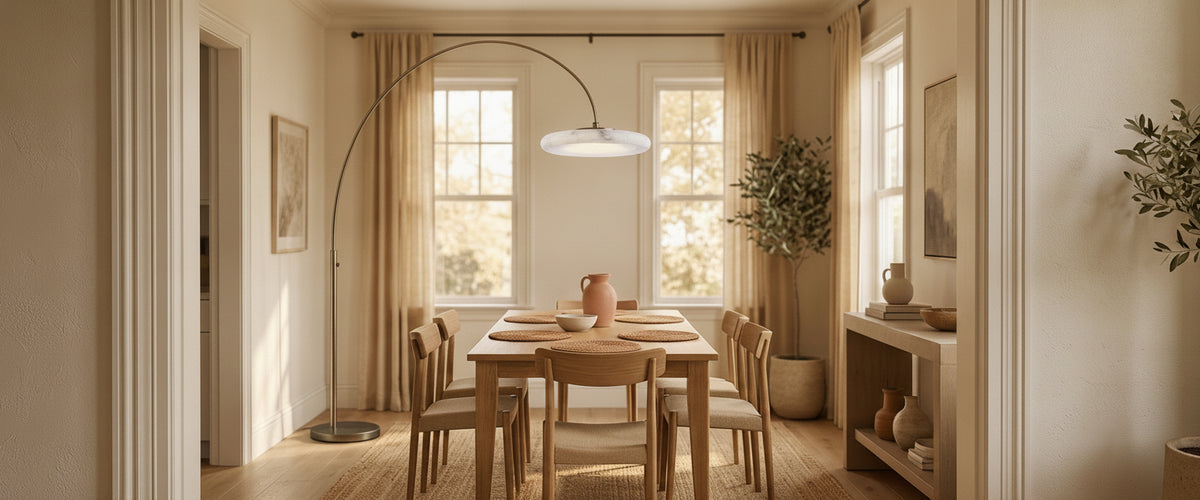

The ceiling rose is almost never where the table wants to be. Builders center it on the room; you center the table on the window, the fireplace or the run of the wall, and suddenly your pendant hangs over a chair back instead of the middle of the tablecloth. That gap is exactly where a dining room floor lamp earns its place. Done well, it puts warm light over the table with no chasing, no drilling and no arguing with a joist. Done badly, it becomes a trip hazard with a trailing flex.

Dining Room Floor Lamp at a Glance
Best for: rented flats, off-center ceiling points, extended kitchens where the table moved after the wiring was set.
Shape matters most: an arc dining room floor lamp reaches over the table; a column or tripod lights the room around it.
Height rule: the light source must sit above seated shoulder and eye level, or diners get glare across the table.
Light quality: warm 2700K, high color rendering, and a diffusing shade. Alabaster and onyx are excellent here because the stone softens the source rather than firing it straight down.
Non-negotiable: plan the cable route and the socket before you buy, not after.
Know the limit: long rectangular tables seating eight or more usually still want a pendant or a linear fitting overhead.

When a Dining Room Floor Lamp Beats a Pendant
A pendant is a commitment. It fixes the table position for the life of the room, and if the table shifts by half a meter the fitting looks wrong forever. A dining room floor lamp keeps the geometry flexible. We hear this constantly from clients in period conversions where the original ceiling rose was set for a Victorian parlor layout that nobody now uses, and from open-plan extensions where the dining zone drifted during the build.
There is also a light-quality argument. A single pendant creates one pool of light and leaves the rest of the room dark, which is fine for drama and less fine when you also use the table for homework, laptops and paperwork. A dining room floor lamp placed to one side gives directional light you can move, and it stacks nicely with candles or a sideboard lamp. In a smaller room, the vertical presence of a stone column lamp does something a flush ceiling light never manages: it gives the corner a reason to exist.
Renters get the biggest win. No landlord permission, no electrician callout for a new drop, no making good when you leave. You take the dining room floor lamp with you.
Rented Flats, Awkward Joists and Tables That Refuse to Centre
Three situations come up again and again in our enquiries. The first is the rented flat where the tenancy forbids fixed alterations. The second is the joist problem: the client wants the pendant 16 inches (40 cm) to the left, and the structural timber sits precisely where the new fixing would go, so the job turns into lifting the floor above. The third is the stubborn table, usually a round one in a square-ish room, that only looks right pushed towards the window.
In all three, a dining room floor lamp is the pragmatic answer. In one warehouse conversion we worked on, exposed steels and a fragile plaster ceiling ruled out a new outlet without serious making good. A tall arc lamp with a carved alabaster shade gave the table a soft downward wash and left the raw ceiling exactly as it was. No chasing, no scaffold tower, no remedial plaster.
Arc, Column or Tripod: Which Shape Clears the Chairs
Arc lamps
The arc is the only dining room floor lamp shape that genuinely lights the table surface, because the head cantilevers out over it while the base stays clear of the chairs. Check the reach against your table width before you buy. The base needs to sit behind the chair pull-out zone, so measure from the table edge to where a chair sits when someone stands up, then add a comfortable walking gap. Round tables make the math kinder: over something like the Blavora Round Glass Dining Table, an arc only has to cover a radius rather than the length of a rectangle, so the base can sit further back and still center the light. Weighted stone bases matter here; an arc with a light base will tip when someone catches the stem.
Column and cylinder lamps
A slim alabaster or marble column lights the room rather than the plates. Use it as a corner anchor beside a sideboard, or in a pair flanking a dining recess. The glow through natural stone is diffuse and shadow-free, which flatters faces at the table even though the lamp is nowhere near it. This is the shape of dining room floor lamp we recommend when a pendant already exists and the room simply feels flat at the edges.
Tripod lamps
Handsome, but the three splayed feet make a tripod dining room floor lamp the classic ankle-catcher in a room where people are constantly pushing chairs back. If you love the look, place it against a wall or in a corner where nobody circulates, never on the open side of the table.
Reading Height Is Not Dining Height
The most common mistake with a dining room floor lamp is buying one designed for an armchair. A reading lamp puts the bulb at roughly seated eye level so light falls onto a book. Do that beside a table and every diner opposite gets a bright source straight in the face for the whole meal.
For dining, the bottom of the shade should clear seated shoulder and eye height, so the light travels over heads and lands on the table. With an arc dining room floor lamp, the head should sit well above the tallest guest's head when they stand to serve. If the head cannot be raised, it is the wrong lamp. Opaque or stone shades help enormously because the glare is contained; a bare filament bulb on an open frame will ruin the table no matter how good the lamp looks switched off.
Pairing a Floor Lamp With an Existing Pendant
If you already have a pendant, the dining room floor lamp should not fight it. Give each fitting a job. The pendant does the table; the floor lamp lifts the corner, grazes a wall or backlights a plant so the room does not collapse into a single bright island. Put them on separate switches or separate dimmers so you can drop the pendant to 20 percent for dessert and leave the floor lamp doing the ambient work.
Material continuity holds the pair together better than matching shapes. A brass-detailed alabaster pendant and a stone-based dining room floor lamp in the same warm family will read as one scheme even if their silhouettes differ. If you want to see how the finishes sit next to each other, our alabaster lighting collection is the easiest place to compare shade tones, since alabaster varies from milky white to honeyed and veined.
Bulbs, Dimming and Why Stone Changes the Result
Dining light should be warm and forgiving. Whatever bulb goes into your dining room floor lamp, we recommend 2700K as the default, with a color rendering index of 90 or above so wine, wood and food look right. Cooler temperatures push a room towards office territory fast.
Always specify a dimmable LED and check the dimmer type. Most modern LED drivers want a trailing-edge dimmer; pairing them with an older leading-edge unit is the usual cause of flicker and buzz. Alabaster and onyx behave differently from glass or fabric here, because the stone itself is translucent and glows across its whole surface. Gypsum alabaster is soft and slightly soluble in water, which is why it transmits light so gently and why it should never be scrubbed with a wet cloth; the British Geological Survey is a good primer on how gypsum differs from harder calcite stones. Dust with a dry soft brush, keep it away from radiators and steam, and it will look the same in ten years.
Cable Routing, Rugs and Sockets: The Bits That Kill Bad Plans
This is where most dining room floor lamp plans fall apart. Work it out before you order.
Find the socket first. Stand where the lamp will go and look for the nearest outlet. If the flex would cross a walkway, change the position or add a socket.
Never run flex under a rug. It creates a trip ridge and traps heat. Route it along a skirting or behind furniture instead.
Consider a floor socket if you are already lifting boards in an extension or renovation. It is a small addition at first fix and it removes the trailing cable problem permanently.
Think about switching. Inline foot switches are convenient; a 5 amp switched socket circuit is the tidy answer if the room is being rewired.
Use a qualified electrician for any new socket, circuit or switching work. Plugging in a lamp is a homeowner job; altering fixed wiring is not. You can check a contractor's credentials through the Registered Competent Person Electrical register.
Check the base footprint against your chair pull-out zone and the route people take to the kitchen. Padded seats swallow more clearance than slim timber frames, so a set like the Alsvane Upholstered Dining Chairs pushes the usable dining room floor lamp position another few inches back.
Buyer's Checklist Before You Commit
Measure table width, chair pull-out depth and the walkway gap, then compare against the lamp's reach and base size.
Confirm the light source sits above seated eye level, and that the shade shields the bulb from anyone sitting opposite.
Choose a diffusing shade material. Alabaster, onyx and marble give warm, even light with no hot spot.
Specify dimmable, 2700K, CRI 90+, and match the dimmer to the driver.
Plan the cable route and socket position on paper.
Check base weight and stability, especially for arc shapes in households with children.
Decide how the dining room floor lamp will coexist with existing ceiling or wall fittings, and separate the switching.
Ask for a tailored quote rather than assuming a figure. Cost varies with stone selection, scale, metalwork and finishing, and a hand-carved shade is a different proposition from a molded one.
When to Admit the Room Needs a Pendant After All
Honesty helps. A dining room floor lamp struggles on a long rectangular table seating eight or more, because one light source cannot cover that span evenly and the far end always looks neglected. Extending designs make the problem worse: a table such as the Antea Extendable Dining Table changes its footprint halfway through the evening, and an arc positioned for six will be stranded at ten. It also struggles in rooms with heavy traffic, where a base on the open side of the table will be kicked weekly.
If the ceiling point is only slightly off, a swag hook, a ceiling plate with an offset cable, or a linear fitting with an adjustable drop will solve it for less disruption than you expect. When you reach that point, a pendant or chandelier in the same stone family is the better spend, and comparing your dining room floor lamp shortlist against the wider lighting range usually settles the argument quickly.
Niori works with alabaster and natural stone precisely because it is forgiving light. Whether that arrives as a dining room floor lamp reaching over a small round table in a rented flat or a carved pendant in a farmhouse extension, the aim is the same: light people want to sit under for three hours, not thirty minutes.