
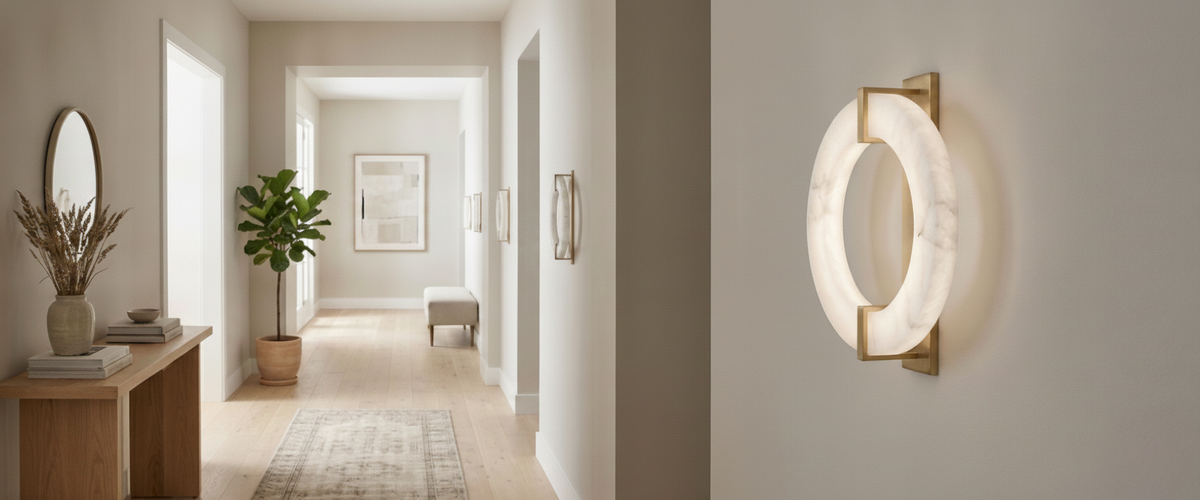

One overhead fitting in a hallway does a strange thing: it lights the floor and leaves everything else looking dull and slightly grim. Corridors have no furniture to bounce light around, so a single pendant or downlight tends to flatten the space into a tunnel. A considered run of hallway wall sconce lighting fixes that. Sconces put light on the walls, at eye level, in a repeating rhythm that gives a long space depth and a reason to move through it.
We spend a lot of time at the studio talking clients out of "just one more spotlight" in the hall. The better answer is almost always fewer, warmer sources placed on the vertical surfaces, and good hallway wall sconce lighting does exactly that. That is where alabaster earns its keep.
A repeating run of sconces gives a corridor depth and rhythm.

Key Takeaways
Sconces beat a lone ceiling light for depth, warmth and a sense of scale in a corridor.
Space them evenly, roughly every 6 to 8 feet (1.8 to 2.4 m), so the wall reads consistent rather than patchy.
Mount at around 60 to 66 inches (152 to 168 cm) to centre so light clears heads and still touches faces.
Alabaster diffuses the source into a soft glow; glass often shows a hard hot spot in a tight space.
Switch a long run in stages or on sensors so you never walk into the dark.

One Overhead Fitting Flattens a Hallway, a Run of Sconces Builds It
A hallway is mostly vertical surface and very little else. When the only light comes from above, the walls fall into shadow, the ceiling picks up a bright patch, and the whole passage feels lower than it is. Hallway wall sconce lighting reverses the logic. By washing light across the walls at a human height, it gives the eye something to read along the length of the corridor, and the space feels taller and more generous as a result.
This is the single most useful change we see in hallway projects. Swap the instinct to light the floor for the instinct to light the walls. A pair or a run of sconces creates pools of warm light that repeat down the hall, and that repetition is what makes a plain corridor feel designed rather than left over. If you want to see how wall fixtures behave across different rooms, our full lighting range is a good place to compare forms before you commit.
Spacing the Rhythm: How Far Apart Before the Wall Goes Patchy
Rhythm is everything in a corridor. Sconces spaced too far apart create dark gaps between bright pools, and the wall looks blotchy. Too close together and you have spent money on a light show nobody asked for.
As a working guide for hallway wall sconce lighting, place fixtures every 6 to 8 feet (1.8 to 2.4 m) along the run, and keep them a consistent distance from each end wall so the sequence reads deliberate. In a short hall of 10 to 12 feet (3 to 3.7 m), a single pair often does the job. In a long run, divide the wall into equal segments first, then position fixtures at the centre of each segment rather than measuring from the door.
Short hall (under 12 ft / 3.7 m): one pair, centred on the longest clear wall.
Medium hall (12 to 20 ft / 3.7 to 6 m): two to three fixtures, evenly divided.
Long run (over 20 ft / 6 m): repeat every 6 to 8 ft (1.8 to 2.4 m) and check the gaps read even at night, not just in daylight.
Mounting Height That Clears Heads and Still Lights Faces
Get the height wrong and a beautiful sconce becomes a hazard people knock with a shoulder. For most homes, mount hallway wall sconce lighting with the centre of the fixture around 60 to 66 inches (152 to 168 cm) from the floor. That keeps the light near eye level so it flatters faces as people pass, and keeps the body of the fixture above the shoulder line in a narrow passage.
Centring a sconce around 60 to 66 inches keeps light near eye level.
Two adjustments worth making. In a hallway with tall ceilings, you can lift the fixtures slightly and let a taller design carry the extra height; a vertical piece such as the Essence Round Wall Light 115cm, Brass is built for exactly this kind of proportion. In a tighter hall with standard ceilings, the same design at a shorter scale keeps things in balance, where the Essence Round Wall Light 75cm, Brass holds the rhythm without overwhelming the wall. In a narrow corridor where a projecting sconce would catch people, choose a flatter, shallower profile so nothing intrudes into the walking line. A slim square or round wall light sitting close to the plaster reads cleaner and stays out of the way.
Uplight, Downlight, or Diffused for a Corridor That Reads Even
How a sconce throws light matters as much as where you put it, and it shapes the whole character of your hallway wall sconce lighting.
Uplight sconces push a fan of light up the wall and onto the ceiling, which lifts the whole corridor and hides a low ceiling. They are gentle and architectural, though they leave the floor darker.
Downlight sconces do the opposite, grazing light down the wall toward the skirting. They give a dramatic, hotel-corridor feel but can leave a scallop pattern if spacing is off.
Diffused sconces glow in all directions and are the most forgiving choice for an even wash. This is where a translucent material does the heavy lifting: instead of a single bright bulb, you get a soft luminous panel that fills the space without glare. For a passage people use at all hours, diffused hallway wall sconce lighting is usually the safest specification, and it is the quality alabaster does best.
Why Alabaster Sconces Warm a Transitional Hall Better Than Glass
Hallways are transitional spaces. You move from a bright kitchen to a dim bedroom, or from a cold porch into the body of the house, and the light needs to bridge those moods without jarring. Alabaster hallway wall sconce lighting is unusually good at this. The stone is naturally translucent, so light passes through the material and comes out softened, warm, and free of the hard hot spot you often see through clear glass in a tight corridor. Because alabaster is a form of gypsum, its fine crystalline structure scatters light rather than transmitting it straight, which is exactly why it has been used for lamps and windows since antiquity, as the Metropolitan Museum of Art notes in its collections of carved gypsum lighting.
There is a practical dividend too. Every slab of alabaster carries its own veining, so a run of sconces down a hall reads as a set of related pieces rather than identical copies, which keeps a long wall from looking mechanical. Where a hall calls for a crisper, more geometric line rather than a curve, a piece like the Essence Square Wall Light 75cm, Brass gives the same diffused glow with a sharper edge against the plaster. Paired with a brass surround, the warm metal picks up the glow and holds it. If you want to compare forms and finishes for a corridor, our alabaster lighting collection is the clearest way to see how the stone handles light before you specify your hallway wall sconce lighting.
Glass has its place, but in a narrow hall it tends to reveal the bulb and throw a sharper shadow. We shipped a set of round alabaster wall lights to a client renovating a long Victorian hallway with a dark stair core; the brief was "stop it feeling like a tunnel." Three diffused sconces on a dimmed circuit did more for that space than the six recessed downlights the previous owner had crammed into the ceiling. It is a fair case for treating hallway wall sconce lighting as the primary layer, not an afterthought.
Switching a Long Run So You're Not Walking Into the Dark
Nothing undoes a good hallway wall sconce lighting plan faster than a switch at the wrong end. A long hall wants two-way switching so you can turn the run on from either end, or a motion sensor set to a low level for night use. Group the sconces on a single dimmable circuit so you can drop them to a soft glow late in the evening and bring them up when you need to see keys or a coat.
Keep the wiring work with a qualified electrician. In the UK, fixed lighting circuits fall under the wiring regulations and should be installed and tested by a competent professional; the guidance from Electrical Safety First is a sensible starting point before any work begins. If your hall genuinely has no convenient supply, a run of hard-wired hallway wall sconce lighting is still achievable, but it is a job to plan into a wider electrical update rather than a weekend fix.
A Quick Buyer's Checklist for Hallway Sconces
Measure the run and divide it into even segments before choosing fixture count.
Pick your light direction: diffused for an even wash, uplight to lift a low ceiling, downlight for drama.
Set mounting height around 60 to 66 in (152 to 168 cm) to centre, adjusting for ceiling height and corridor width.
Choose a shallow profile if the passage is tight so nothing catches a shoulder.
Specify warm bulbs, around 2700K, on a dimmable driver for a hall used at all hours.
Plan the switching: two-way or sensor so you never enter the dark.
Confirm installation with a qualified electrician before you buy your hallway wall sconce lighting.
On budget: cost depends on the material, the scale of the fixture, the complexity of the carving and the brass work, and the installation involved. Natural stone is worked by hand, so a large sculptural sconce sits well above a small plain one. The honest advice is to settle your fixture count and size first, then request a tailored quote rather than guessing from a range.
Get the walls lit properly with a considered run of hallway wall sconce lighting and a corridor stops being a passage you rush through. It becomes part of the house.