
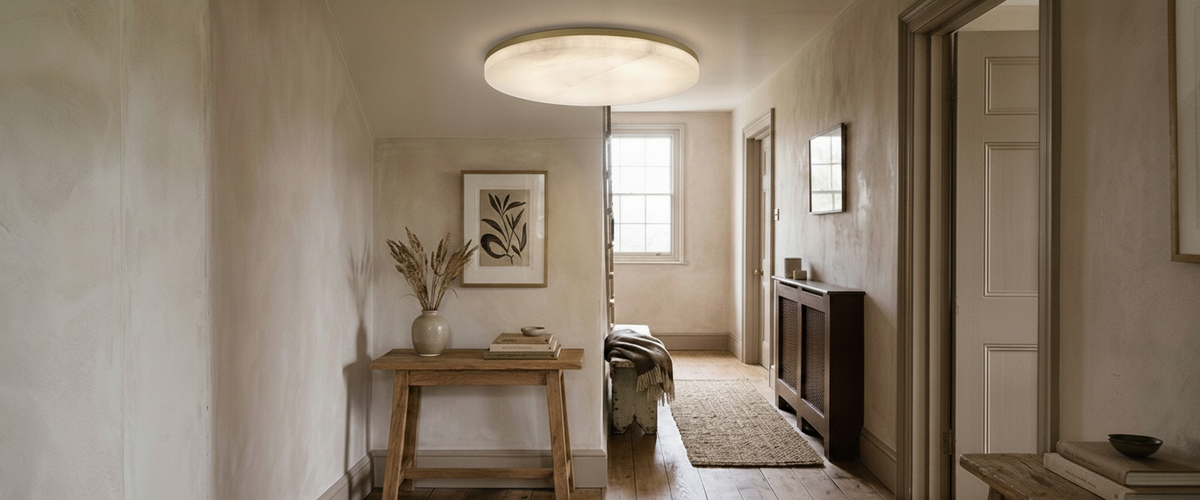

A hallway is the first room anyone reads when they step through your front door, and it is usually the most badly lit space in the house. One harsh downlight, a fitting bought to match nothing, a corridor that feels like a service passage rather than an entrance. Good hallway ceiling lights ideas start with a simple truth: the ceiling here is closer to your eye than in any other room, so whatever you hang has to earn its place at short range. The best hallway ceiling light ideas make a narrow hall read taller, calmer and more considered. Get it wrong and you flatten the whole approach.
At Niori we make alabaster and natural-stone lighting, and halls are where our pieces do quiet, unshowy work. Stone diffuses light instead of throwing it, so a hallway lit through alabaster feels soft rather than clinical. That matters in a space you walk through twenty times a day, and it shapes every one of the hallway ceiling light ideas below.
A flush alabaster fitting keeps headroom while lifting a narrow hall.

Key Takeaways
Measure the ceiling first. Height and corridor width decide whether you go flush, semi-flush or pendant, not the other way round.
Walk the sightline. What you see approaching the door is different from what you see standing still. Light for the movement.
Warm, dimmable light stops a hall reading like a hotel lobby. Aim for a warm colour temperature and put it on a dimmer.
One fixture or a run depends on length. Long corridors need repetition; a square entrance hall usually wants a single anchor.
Contrast is your friend. Pale alabaster against a darker wall lifts the whole space.

How Ceiling Height and Corridor Width Decide the Fixture
Before you look at a single fitting, look up. Most hallway ceiling light ideas fail because they skip this step. A standard hallway with a ceiling around 2.4 metres (roughly 8 feet) has almost no room for a hanging pendant without someone catching it with a raised hand or a tall guest ducking. That is flush or semi-flush territory. A flush alabaster ceiling light sits tight to the plaster and glows like a pane of lit stone; a semi-flush drops a few inches and gives a little more shape without stealing headroom.
Once you climb past about 2.7 metres (9 feet), and certainly in a period hall or a double-height entrance, a pendant becomes an option. A carved alabaster pendant hung well above head height reads as a deliberate object rather than an obstacle. Width matters just as much. A corridor under a metre wide (about 3 feet) wants a compact, contained fixture; in a tight passage a smaller flush light such as the Gemini Flush Ceiling Light 42.5cm in White holds the plane without visually pinching the walls inward. In a generous square entrance hall you can hang something with real presence, where a broader piece like the Gemini Flush Ceiling Light 61cm in Brushed Brass fills the ceiling in proportion to the space.
The rule of thumb we give clients: measure floor to ceiling, subtract the drop of any pendant you like, and keep the lowest point of the fixture at least 2.1 metres (7 feet) off the floor in a walkway. If the maths does not leave that clearance, go flush and put your money into the quality of the stone instead of the drama of the drop.
The Sightline Test: Walking In Versus Standing Still
Here is a habit worth stealing from lighting designers, and it sharpens any of the hallway ceiling light ideas you are weighing up. Stand at your front door and look down the hall as if you have just arrived. Then walk in and stop where you would naturally pause, near the stairs or a console table. Those are two different views, and most halls only get lit for one of them.
Approaching the door, you read the hall as a whole and you notice the ceiling line. A flush alabaster fitting reads as a soft, even panel from that angle, which is exactly what you want; it does not glare back at you. Standing still, you notice pooling on the floor and on the walls. This is where a wall light, or a pair of them, paired with the ceiling fixture, stops the space feeling like a single flat wash. A single ceiling light rarely does both jobs; add two alabaster wall lights at the pause point and a narrow hall reads noticeably taller, without touching the ceiling fitting at all.
A matched run pulls the eye along a long corridor and kills the tunnel effect.
Where One Fixture Works and Where You Need a Run
A short entrance hall, square or nearly so, almost always wants a single anchoring ceiling light dead centre. Splitting the light in a small space just creates competing shadows. A long corridor is the opposite problem, and it is where hallway ceiling light ideas built around a run come into their own. One central fitting leaves the ends in gloom, and gloom at the ends is precisely what makes a hall feel like a tunnel.
For runs, space matching flush fittings evenly along the ceiling. Two or three identical alabaster flush lights, equally spaced, pull the eye along the length and make a corridor feel intentional rather than endless. Keep them genuinely identical; mixing sizes down a single run reads as a mistake, not a feature. You can browse the full range of ceiling and hallway options in our lighting collection to see how the same stone reads at different diameters.
Bulb Temperature and Dimming That Stop a Hall Feeling Like a Lobby
Colour temperature is where hallway ceiling light ideas go wrong most often. Cool white bulbs, anything up towards 4000K and above, throw a bluish light that reads as functional and slightly clinical. It is the light of car parks and office corridors. For a home hall you almost always want a warmer tone, around 2700K, which flatters skin, plaster and timber floors alike. The ENERGY STAR guidance on light bulbs is a useful reference on color temperature and why warmer light suits living spaces.
Alabaster earns its keep here. Because the stone diffuses the source, the bulb behind it is never a hard point of glare, so the warm light spreads as a soft field rather than a spotlight. Put the circuit on a dimmer. A hall wants to be bright and welcoming at 6pm when everyone piles in, and a low, warm glow at midnight when someone comes down for a glass of water. One fitting, two completely different moods, all from a dimmer switch. Ask a qualified electrician to confirm the dimmer is matched to the bulbs; LED and trailing-edge dimmers need to be paired correctly to avoid flicker.
Backdrop and Contrast: Pale Stone Against Shadow
Light does not exist without a surface to land on, and contrast is one of the most underused hallway ceiling light ideas. A pale alabaster fitting against a white ceiling and white walls can disappear; the effect is clean but flat. Set the same fitting against a deeper wall colour, a soft charcoal, a muted green, a warm clay, and the stone reads as a lit object with real depth. The veining in the alabaster becomes visible, and the contrast between the glow and the darker surround makes the hall feel considered.
This is one of the reasons alabaster suits halls so well. Its natural translucency means light travels through the stone rather than bouncing off it. Against a darker backdrop that glow has somewhere to sit. If you are working with brass detailing on the fitting, a darker wall lets the brass catch as a warm line rather than getting lost. For the full spread of stone finishes and how they pair with wall colour, our alabaster lighting collection is the place to compare.
The Placement Mistakes That Make a Hallway Feel Lower
A few errors turn up again and again, and each one steals height from a hall. Whichever of these hallway ceiling light ideas you land on, avoid the following.
Hanging a pendant too low. The single fastest way to shrink a hallway. If in doubt, raise it.
Choosing a fitting that is too small for the run. A tiny flush light on a wide ceiling looks marooned and draws attention to the empty plaster around it.
Cool white bulbs. They read as institutional and make even a well-proportioned hall feel like a corridor to somewhere else.
Lighting only the centre. Dark ends make a hall feel like a tunnel. Extend the light or add wall fittings.
Ignoring the switch position. A beautiful fitting on a single un-dimmed switch can only ever be one thing. Build in control.
Fighting the natural light. If a hall has a fanlight or a window, place the ceiling fixture so it complements rather than competes with the daylight path.
A Quick Buyer's Checklist
Run through this before you commit to any of the hallway ceiling light ideas above.
Measure floor-to-ceiling height and corridor width before shortlisting anything.
Decide flush, semi-flush or pendant from those numbers, not from a photo.
Walk the two sightlines and note where you actually pause.
Choose a single anchor for a square hall, a matched run for a long one.
Specify warm bulbs and a compatible dimmer.
Check your wall colour gives the stone something to contrast against.
Book a qualified electrician for the install and dimmer matching.
None of this needs to be complicated, and the best hallway ceiling light ideas rarely are. A hall lit through alabaster, warm, dimmable, sized to the ceiling and set against a colour that lets the stone glow, is a genuinely good welcome. It reads first, so it is worth getting right first. Budget will depend on the material, the scale, the engineering and the install, so if you want a fitting specified to your exact hall, ask us for a tailored quote and we will size it to the space.