
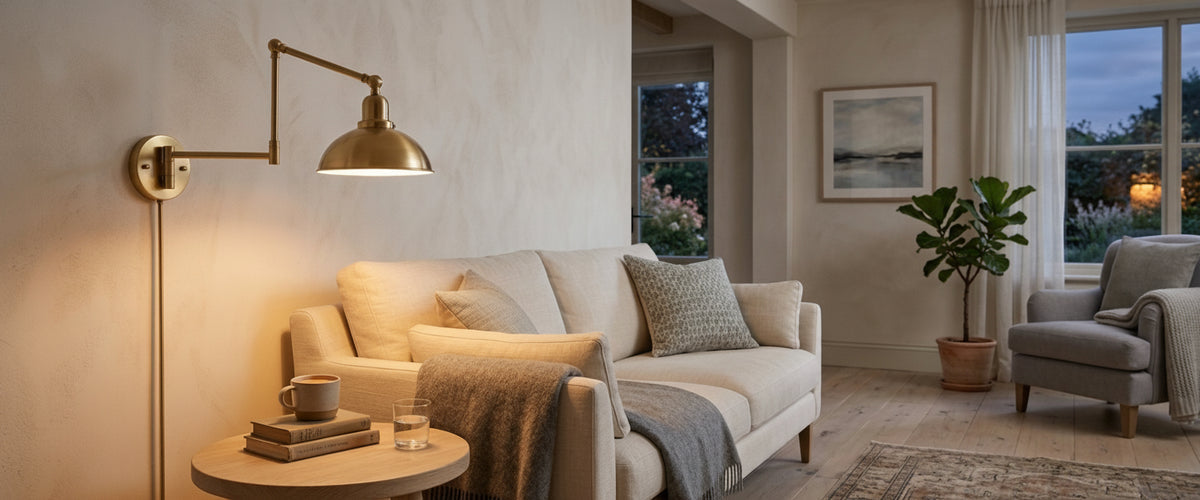

Most gold wall lights look their best in a showroom at noon and their worst in your sitting room at nine o'clock at night. The finish that seemed rich in daylight turns brassy, greenish or oddly flat once the lamps are the only light in the room. The fitting is rarely to blame. The bulb, the height and the wall it sits on usually are. At Niori we work almost entirely with alabaster and natural stone, usually framed in brass or gold-toned metal, so we spend a lot of evenings watching how gold behaves once the sun goes down.

At a Glance
- Finish: polished gold throws sparkle and glare. Satin and brushed gold hold a softer, steadier tone.
- Bulb: stay at 2700K or warmer, with a high colour rendering index (CRI). At 4000K, gold loses its warmth.
- Height: roughly 1.5 to 1.7m (about 5ft to 5ft 7in) to the centre of the fitting in living rooms, and lower beside the bed.
- Metals: choose one dominant metal. Gold should either lead or support, never compete.
- Scale: in a large room, projection and backplate size matter more than the finish.

Polished, Satin and Brushed Gold Wall Lights Under the Same Bulb
Put three gold samples under one lamp and they behave like three different materials. Polished gold acts as a mirror. It reflects the bulb as a bright point and picks up whatever is opposite, so a polished sconce facing a dark sofa can look almost black in places and nearly white at its highlight. That contrast is what people mean by sparkle. In a formal dining room it can be lovely. In a small snug it often reads as glare.
Satin gold scatters light rather than mirroring it. The whole surface glows at a single, even tone, which is why satin finishes tend to look warmer after dark than they do in daylight. Brushed gold sits between the two. The fine directional grain catches light in lines, hides fingerprints well and usually reads slightly more like brass than jewellery. Brushed finishes barely change from one viewing angle to the next. Polished ones change every time you take a step.
Alabaster changes the equation again. A glowing stone shade is already the brightest thing on the wall, so a highly polished frame around it competes for the eye. Satin or brushed detailing lets the stone lead and the gold frame it. That is the balance we aim for with most brass-detailed pieces.
The Colour Temperature That Keeps Gold Warm
Gold reflects the red and yellow end of the spectrum strongly and absorbs much of the blue. Under a warm 2700K bulb there is plenty of long-wavelength light for it to send back, so it glows. Under a 4000K cool white bulb, a larger share of the light is blue, and gold has less of its own colour to work with. The result looks greyish, faintly green or simply cheap. This is the most common complaint we hear about gold wall lights, and it is almost always a bulb problem.
A typical case: a pair of brass-framed alabaster sconces that look sallow because the electrician fitted 4000K LED lamps to match the kitchen downlights. Swapping to 2700K lamps with a CRI above 90 fixes it in minutes. If you want a clear explanation of colour temperature and colour rendering before you buy lamps, the Lighting Industry Association publishes useful guidance.
For evening rooms, warm-dim LEDs are worth the small extra effort. They shift towards 2200K as you dim, which mimics the way an incandescent filament reddens. Gold and alabaster both respond well to that last stretch of the dimmer. Check that your lamps and your dimmer switch are compatible, or you will get flicker at the low end, exactly where you want the room to feel calmest.
Living Room Symmetry: Calm or Hotel Corridor?
A matched pair of gold wall lights either side of a chimney breast, a large mirror or a piece of art is one of the most settled arrangements in interior design. The symmetry works because it is anchored. The eye goes to the centre, and the lights frame it.
The hotel corridor effect happens when identical sconces repeat at even intervals along a wall with nothing between them to hold attention. Four gold fittings marching down a long living room wall feel institutional, however good each one is. If the wall is long, break the rhythm. Pair two lights around a focal point and let a table lamp or floor lamp handle the far end of the room. Mixing fixture types at different heights is what makes a room feel lived in, and browsing a full lighting range with that layering in mind is more useful than buying four of the same sconce.
Bedroom and Hallway Mounting Heights
Height changes the quality of the light far more than most people expect. Mount a fitting high and its glow spreads up the wall and across the ceiling, which reads as general, architectural light. Drop the same fitting lower and the wash pools on the floor, the bedside table and your hands. The room immediately feels closer and more private.
Beside a bed, aim for the light source to sit a little above shoulder height when you are sitting up against the headboard. In practice that is often 50 to 60cm (20 to 24in) above the mattress, but measure your own bed and headboard rather than trusting a rule. In hallways, 1.6 to 1.8m (about 5ft 3in to 5ft 11in) is a sensible range. That is close to eye level for many adults, so choose a shade that hides the lamp and nobody walks into glare. In narrow corridors, watch the projection as well as the height.
Hard-wired gold wall lights need planning before plastering, and new circuits or work in bathrooms are notifiable in England and Wales. Always use a qualified electrician. Ask them to fit back boxes at your chosen heights while the walls are open, not after the decorator has left.
Mixing Gold with Other Metals
Gold sits comfortably alongside other metals as long as the scheme has a clear lead. Decide which metal dominates the room, usually the one on the largest or most visible pieces, and let the others support it. Warm metals blend more easily with one another. Gold with aged brass, bronze or copper reads as a family. Gold with polished chrome is harder because the undertones pull in opposite directions.
Repeat each metal at least twice so it looks deliberate. A single chrome tap in a gold-heavy room looks like an oversight; chrome on the tap and the mirror frame looks like a choice. Natural stone is the most reliable bridge we know. A marble with grey veining connects gold wall lights to nickel or steel elsewhere, while honey-toned alabaster pulls the whole palette warmer. Matt black hardware stays neutral and rarely fragments a gold scheme.
Scale and Projection in Generous Rooms
A shallow, small gold fitting on a wall with 3m (10ft) ceilings looks like an afterthought. It throws a weak scallop of light, it disappears visually, and the gold reads as a fleck rather than a finish. Generous rooms need gold wall lights with presence. That means a taller or wider backplate, more projection from the wall, or a long horizontal form that holds its own against the architecture.
This is where alabaster earns its place. On a broad wall above a sofa or console, a long horizontal form such as the Albatre Alabaster LED Wall Light 800mm in brass gives a wide band of soft, diffused light and enough visual weight to balance the wall, while keeping the brass to a supporting frame rather than the main event. You can compare horizontal bars, carved shades and more sculptural forms across our alabaster lighting pieces. In tight hallways, reverse the logic: keep projection modest and let height and length provide the presence instead.
Buyer Checklist for Gold Wall Lights
- Match the finish to the room's mood. Polished for formal rooms with distance, satin or brushed for living rooms and bedrooms.
- Buy the bulb with the fitting. 2700K or warmer, CRI 90 or above, dimmable, and ideally warm-dim.
- Check the dimmer. Confirm LED compatibility with your electrician before installation.
- Measure the wall, not just the room. Scale the fitting to ceiling height and wall width, and check projection in corridors.
- Plan positions early. Mark heights on the wall with tape and live with them for a day.
- Decide your dominant metal. Make sure gold either leads or clearly supports.
- Think about the shade material. Alabaster softens and warms the light; glass gives a crisper edge.
- Be honest about budget. Material, scale, finishing and installation all shift the cost, so request a tailored quote for larger or bespoke projects.
Caring for Gold and Alabaster Finishes
Most gold wall lights and brass-framed fittings are lacquered. That means you should never use metal polish on them, because it strips the lacquer and leaves patchy tarnish. A dry microfibre cloth is all they need. Unlacquered brass will darken naturally over time, which many clients come to prefer.
Alabaster is a soft, water-sensitive stone, so keep it dry. Dust it with a soft brush or dry cloth, and keep alabaster fittings out of bathrooms and steamy rooms unless a piece is specifically rated for them. The same logic applies outdoors. Beside a front door or along a garden wall, stone is the wrong material, and an IP-rated outdoor fitting such as the Zevi EL GU10 Up Down Outdoor Wall Light is a more sensible way to carry a gold accent outside. Fit it with a warm 2700K GU10 lamp so the gold detailing does not turn grey at night. Turn the light off and let the lamp cool before you clean anything.
Get the bulb right, hang the fitting at a height that suits the room, and size it to the wall. Do that, and gold wall lights will look as warm at midnight as they did when you chose them.