
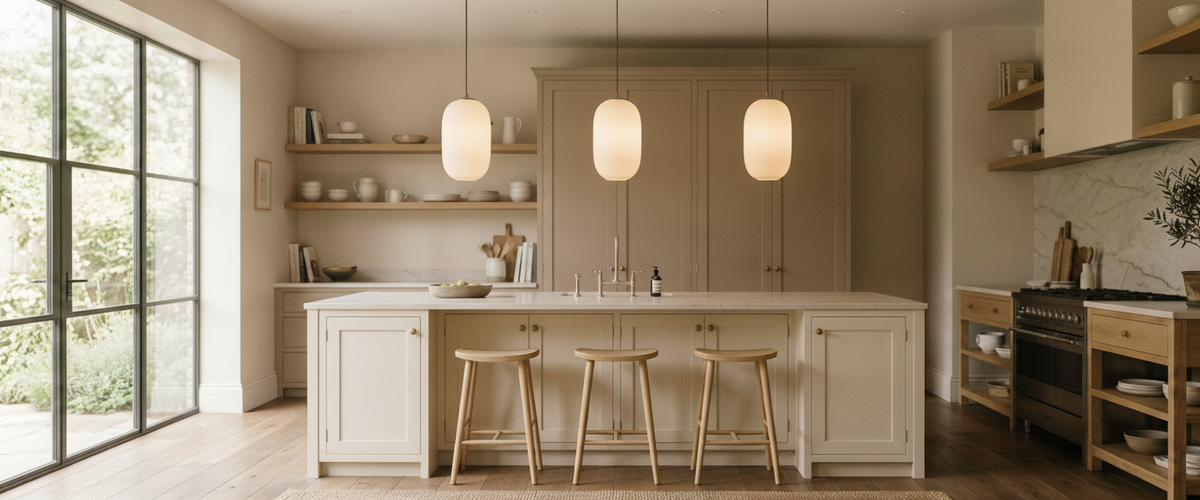

Nine times out of ten, when a client tells us their new pendants look wrong, the shape is fine. The glass is the problem. Clear glass over a breakfast bar with a bare filament lamp inside it will glare straight into the eyes of anyone sitting down, and no amount of styling fixes that. Glass pendant lights are one of the most forgiving fixture types to buy and one of the easiest to specify badly, because the decision that matters most (how the glass handles light) is the one most people make last.

Key Takeaways
- Diffusion first, silhouette second. Clear glass shows the lamp; opal, frosted and ribbed glass show light. Decide which you want before you fall for a shape.
- Drop height rules the room. Over a worktop or island, aim for roughly 75 to 90cm (30 to 36in) from the shade base to the surface. Over a dining table, 80 to 90cm (32 to 35in) is the usual comfort zone.
- Seating position decides glare. If eyes sit below the lamp, you need diffusion or a shade that shields the source.
- Dimming is part of the fixture, not an afterthought. Match a dimmable lamp to a compatible trailing-edge dimmer, and test before signing off.
- Glass and stone work well together. Alabaster gives a warmer, denser glow; glass gives sparkle and lightness. Many of the best schemes we ship use both.

What Glass Pendant Lights Suit, and Who They Are For
Glass earns its keep where you want light without visual weight. A slim brass stem with a small opal globe over a bedside table adds almost nothing to the sightline of a room, which is why glass pendant lights are the default answer in narrow hallways, above compact kitchen islands, in stairwells where a heavier fitting would loom, and in bathrooms where a wall-mounted lamp would crowd a basin.
They also suit anyone renting or renovating in stages. A pendant on a flex can be rehung, shortened or moved to another room far more easily than a large chandelier, and the visual language of glass sits happily with almost any interior style, from a Victorian terrace kitchen to a new-build extension with polished concrete floors.
Designers and venue owners tend to use them differently. In hospitality we see glass pendants specified in runs: three, five or seven over a bar or a long communal table, where repetition creates rhythm and the individual fitting stays quiet. Restaurants in particular lean on smoked or opal glass, because clear glass at low ceiling height turns into a row of hot spots in every photograph a guest takes.
Sizing, Height and Placement That Works
Glass pendant lights are sized from the surface below, not the ceiling above. For an island, a useful rule is to allow around a third of the island length in total fixture width, then divide that between however many pendants you want. Two generous shades usually read better than three small ones on an island under 1.8m (about 6ft), and spacing should be even from the ends, not from the centre outwards, so the run looks deliberate rather than squeezed. Where the shade has to stay small and close to the eye instead, a bedside, a narrow hallway, a slim breakfast bar, an opal-shaded fitting such as the Staring 1 Light Mini Pendant Light in Distressed Gold with Opal Glass keeps the light soft at short range in a way a clear globe cannot.
Height is where most schemes drift. Hang too high and you lose the pool of light that makes a pendant useful; hang too low and you block conversation across a table. On a standard 2.4m (roughly 8ft) ceiling, keep the shade base above sightlines when people are standing in circulation routes, and check the view from a seated position with a torch before the electrician commits to a fixing point.
Stairwells and double-height voids need different thinking. A single glass pendant on a long drop reads best when it sits within the upper third of the void so it can be seen from both levels, and you should always check the bottom of the fitting clears the highest point of the staircase by a comfortable margin. We once had a client in a converted mill flat set on a 2m drop over a stairwell, until we asked how they planned to change the lamp. They went for two shorter pendants at different heights instead, reachable from the landing.
Bathrooms have their own constraints. Pendants near a bath or shower fall into defined zones with specific IP requirements under the UK wiring regulations, so the fitting has to be rated for its position and installed by a qualified electrician. The IET's guidance on BS 7671 is the reference your installer will be working from, and it is worth confirming the intended location with them before ordering.
Materials, Finishes and Light Quality
Glass pendant lights are not all made from the same glass. Clear glass transmits almost everything and hides nothing, so it needs a decorative lamp and a dimmer. Opal and acid-etched glass scatter light evenly and forgive cheap lamps. Ribbed and fluted glass break the source into vertical highlights, which reads well on a bar or in a hallway. Where you want the lamp broken into highlights rather than concealed altogether, a cut shade such as the Windsor 1 Light Pendant Light in Black with Clear Faceted Glass sits between those two extremes. Smoked and bronze-tinted glass drops output noticeably, so plan for a slightly higher lumen lamp or an extra fitting in the run.
Metalwork changes the character as much as the glass does. Brass and antique gold warm the light spilling from the top of a shade, matt black frames the glass and reads more graphic, and graphite or pewter sits comfortably in schemes with darker stone worktops. Over honed granite or slate, a fitting like the Hampton 1 Light Glass Pendant Light in Graphite keeps its outline rather than dissolving into the surface below it. Hand-blown glass carries slight variation in thickness and form by nature, which is part of its appeal; the Corning Museum of Glass documents how much of that character comes from the blowing process itself rather than any finishing step. If you are buying a run of pendants, expect subtle differences between them and treat that as evidence of hand-making, not a fault.
This is also where alabaster changes the conversation. Where glass transmits light, alabaster absorbs and re-emits it, so the surface itself glows and the veining becomes part of the pattern on the ceiling. It is a denser, warmer, quieter light than glass gives, and it never shows a filament. Plenty of our clients pair the two: glass pendant lights over an island for lightness, and an alabaster wall light or table lamp elsewhere in the same room for depth. If you want to see how the stone behaves before committing, the alabaster lighting collection is the clearest way to compare shade densities and veining.
Bulbs and Dimming
Glass pendant lights are only ever as good as the lamps inside them. Warm white in the 2700K range suits both glass and stone in domestic rooms; 2200K to 2400K works for bars and evening dining where you want candlelit warmth. Look for a colour rendering index of 90 or above, especially over food preparation areas, where poor rendering makes vegetables and skin tones look grey. For clear glass, choose a decorative filament lamp with a visible, attractive coil. For opal and etched glass, output matters more than looks.
Specify dimming as a system. A trailing-edge LED dimmer paired with dimmable lamps of the same type across the circuit avoids the flicker and buzz that ruins an otherwise good scheme. Mixed lamp brands on one dimmer are a common cause of that low-level hum people blame on the fitting.
Common Mistakes and How to Avoid Them
- Buying clear glass for a seated position. If people will sit under it, choose opal, etched or ribbed glass, or accept that you will run it dim all evening.
- Ignoring ceiling height. Under 2.4m (8ft), compact shades and tighter drops keep the room feeling open. Save the long theatrical drop for the void.
- Forgetting maintenance access. Ask yourself how the lamp gets changed and how the glass gets cleaned. A high pendant over a stone island is awkward to reach without a scaffold tower.
- Relying on glass pendant lights as the only light source. Pendants pool light. Add wall lights, a floor lamp or discreet task lighting so the room has layers on a dark afternoon.
- Matching every metal in the room. Brass pendants against brass taps, brass handles and brass sockets flattens the scheme. Let one metal lead.
- Skipping the mock-up. Tape cardboard circles at the intended positions and live with them for a day. It takes ten minutes and prevents most regrets.
A Buying Checklist for Glass Pendant Lights
- Measure the surface below and decide fixture count and total width first.
- Confirm ceiling height, joist positions and existing outlet locations with your electrician.
- Choose the glass type based on seating position and glare, then the silhouette.
- Check the drop is adjustable, and whether it comes as rod, chain or flex.
- Match lamp base, colour temperature, CRI and dimmer type across the whole run.
- For bathrooms and outdoor porches, confirm the IP rating suits the zone.
- Plan cleaning and lamp access before installation, not after.
- Decide where warmer stone light belongs in the same room, so glass is not doing every job.
How Niori Can Help With Lighting Projects
Niori works with alabaster and natural-stone lighting: pendants, chandeliers, wall lights, table lamps and floor lamps in alabaster, marble and onyx, usually with brass or blackened metalwork, alongside glass pendant lights where glass is genuinely the better answer. That combination is the reason designers come to us with a room rather than a product code. A kitchen and dining space often wants glass over the island and alabaster over the table, and knowing which way round to do that saves a return.
For multi-room projects, hospitality fit-outs and anything involving custom drops, veining selection or matched runs, budget depends on material, scale, complexity, engineering, installation and finishing, so the sensible route is a tailored quote rather than a guessed figure. Send through plans, ceiling heights and photographs and we will work back from the room. If you are still at the browsing stage, the wider lighting collection is a good place to compare fixture types side by side before narrowing down.
One last studio observation, offered freely: clear glass pendant lights show every fingerprint and every speck of kitchen grease, and they need wiping more often than anyone expects. Alabaster hides all of it and only asks for a dry, soft cloth. If you are choosing between the two for a hard-working kitchen, that unglamorous detail may decide it.