

Type "glass chandeliers dining room" into a search bar and you get thousands of handsome fixtures, almost none of them shown at the height they should hang. Real dining rooms have the same problem. The chandelier hangs too high and is sized to the ceiling, not the table, so it lights the upper half of the room and the tops of people's heads while the food and the faces sit in a flat, slightly gray wash. This guide shows how to fix that when you pick glass chandeliers for the dining room. Size the fixture from the table up. Hang it lower than feels natural. Then match the glass to the light you want on people's faces.
At Niori we spend most of our time with alabaster and natural stone, which diffuse light from the inside out. That gives us a useful outsider's view on glass, and on how the glass chandeliers dining room tables sit under behave once the bulbs are on, which is very differently from stone.
At a glance
Size glass chandeliers for the dining room to the table, not the room. A diameter of one half to two thirds of the table's width is a reliable starting point.
Hang the bottom of the chandelier 30 to 36 inches (76 to 91 cm) above the tabletop under a standard 8-foot (2.4 m) ceiling.
Clear glass gives sparkle and hard shadows. Frosted glass gives soft, flattering light. Smoked glass gives mood but reduces output.
Pair dimmable LED bulbs with a compatible trailing-edge dimmer, and have a qualified electrician fit both.
If you want frosted-glass softness with warmer color, alabaster is worth comparing.

Start With the Table: Sizing Dining Room Glass Chandeliers
Buyers shopping for glass dining room chandeliers usually start with the ceiling height or the room's square footage. That logic suits a hallway, but a dining room is really organized around one object. The table sets the zone the light has to cover, and it is the surface everyone's eyes rest on all evening.
For a round or square table, measure the width and aim for a fixture diameter between half and two thirds of it. A 42-inch (107 cm) round table suits a chandelier of roughly 21 to 28 inches (53 to 71 cm). If your table runs long, the glass chandeliers dining room layouts like this suit best are linear fixtures or a pair of smaller pendants rather than one oversized round piece. Keep about 6 inches (15 cm) between each end of the fixture and the edge of the table so diners never sit directly under an arm or a glass shade.
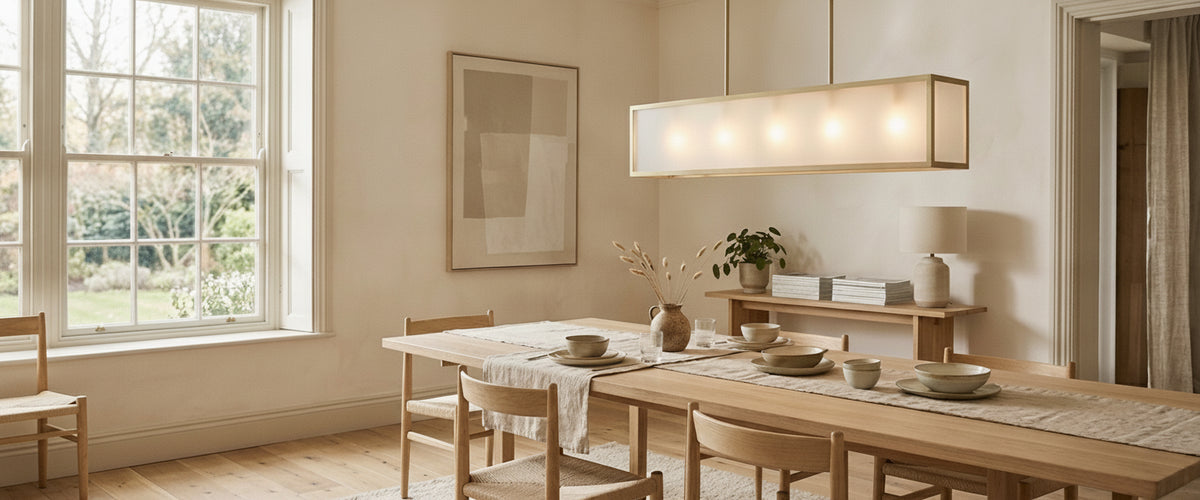
Sized to the table, not the ceiling: a pair of frosted pendants over a long dining table.
Size the room second, as a check. Glass dining room chandeliers that fit the table but feel small in a large, double-height room can be backed up with wall lights. Swapping for a bigger fixture that overhangs the table rarely works. Mass in glass is visually lighter than mass in stone, so a fixture in glass can usually run toward the larger end of the range without feeling heavy. An alabaster pendant at the same diameter will read noticeably more solid.

Clear, Smoked or Frosted: What Each Glass Does to Faces at the Table
This is the choice that decides how dinner actually looks, because the glass chandeliers dining room guests sit under light every face at the table. It gets less attention than finish or arm count.
Clear Glass
Clear glass shows the bulb, so the bulb becomes part of the design. You get crisp sparkle, defined reflections in cutlery and wine glasses, and sharper shadows under noses and chins. It suits rooms with darker walls and a host who likes a bit of theater. It is also the least forgiving of all the glass chandeliers dining room buyers can choose. A bare 2700K filament at full brightness directly in someone's sightline quickly becomes tiring.
Smoked Glass
Smoked glass, in gray, bronze or amber, tints and lowers the output. The smoked glass chandeliers dining room hosts choose for mood come close to candlelight in a restaurant, but you need more lumens behind them than you think, and they will not carry a room on their own. Plan wall lights or lamps on a sideboard to bring up the edges. Where the walls need a gentle lift rather than another bright source, a ribbed glass fitting such as the Olo Ribbed Glass LED Wall Light in Platinum spreads light in soft vertical lines without competing with the chandelier over the table.
Frosted and Opal Glass
Frosted glass scatters light across the whole shade, so the source disappears and faces are lit evenly. Among glass dining room chandeliers, it is the most flattering option for long dinners and the safest choice if guests sit close to the fixture. It is also the glass that comes closest to what alabaster does. Alabaster adds a warmer, slightly honeyed cast and visible veining that frosted glass cannot reproduce.
Drop Height and the Six-Inch Problem
Here is the most common mistake we see in finished projects. The glass chandeliers dining room owners hang end up roughly 6 inches (15 cm) higher than they should be, usually because whoever hung them worried about heads. Nobody walks under a dining chandelier, though. They sit beneath it.
Under an 8-foot ceiling, the bottom of the fixture should sit 30 to 36 inches (76 to 91 cm) above the tabletop. For every extra foot of ceiling height, add roughly 3 inches (about 7.5 cm per 30 cm of ceiling). Hang glass chandeliers in the dining room too high, and the light spreads across the room, the sparkle reads as glare, and the table loses its sense of enclosure. At the right height, the fixture frames the table and keeps the light where the food is.
At the right drop, the fixture frames the table and keeps light on the food and faces.
A typical case: a Victorian terrace with ceilings a little over 10 feet (3 m), and a clear glass chandelier sitting nearly 45 inches (114 cm) above the table. Bringing it down by 6 inches made a bigger difference than the new fixture the owner had been planning to buy. The test for any of the glass chandeliers dining room and kitchen-diner tables sit under is simple: hang it, sit down, and look across the table. If you can see the person opposite clearly and no bare bulb is glaring into your eyes, it is probably right. If the fixture blocks your view of their face, raise it a notch.
Blown, Molded and Cut Glass: Sparkle Versus Shadow
How the glass was made decides the pattern of light that falls on the table, the ceiling and the walls. Of all the glass chandeliers dining room buyers compare, few product pages explain this, yet it is a bigger factor than most let on.
Mouth-blown glass has slight variations in wall thickness, and often tiny bubbles (seeded glass is the deliberate version). It throws soft, irregular caustics across the table and has a handmade quality that suits brass detailing and older houses. Over a smaller round table, a three-light seeded piece such as the Winslow 3 Light Chandelier in Seeded Glass and Natural Brass stays quiet in the day and turns gently textured at night. Expect each shade to differ slightly. We sometimes get messages from clients worried that a blown shade has a flaw. It almost always turns out to be the evidence that a person made it.
Molded or pressed glass is consistent from shade to shade. Ribbed and fluted molded glass breaks light into regular lines, which reads crisp and contemporary over a long table. That is why it shows up in so many modern dining room glass chandeliers.
Cut glass and crystal uses faceted surfaces to split light into small spectral flashes. The Corning Museum of Glass has a good overview of how these techniques developed. Cut crystal gives the most sparkle and the busiest shadows, so pair it with plain walls and a dimmer you will actually use. If sparkle is the whole point, a six-arm fixture like the Murano 6 Light Crystal Chandelier in Chrome suits a more formal room with a generous table better than a tight kitchen-diner.
If you are weighing glass chandeliers for the dining room against stone, look through the wider lighting collection side by side with stone pieces. Seeing blown glass, cut crystal and carved alabaster together makes the difference in shadow quality much easier to judge.
Dimming a Glass Chandelier Over a Dining Table
A glass chandelier over a dining room table should be dimmable. Breakfast, homework and dinner parties all want different levels. Flicker is the usual complaint about the glass chandeliers dining room owners install, and it almost always comes from a mismatch between bulb and dimmer, not from the fixture.
Choose dimmable LED bulbs from one batch. Mixing brands or batches across a multi-arm fixture gives uneven brightness and color at low levels.
Pair them with a trailing-edge (ELV) LED dimmer. Older leading-edge dimmers designed for halogen loads are the main cause of buzzing and shimmer. Check the bulb maker's compatibility list.
Respect the minimum load. A five-light chandelier on low-wattage LEDs can fall below a dimmer's minimum load, which causes flicker at the bottom of the range.
Go warm. 2700K suits most dining rooms. 2200K filament bulbs behind clear glass look close to candlelight when dimmed. Look for a CRI of 90 or above so food and skin tones read properly. The US Department of Energy's LED guidance covers dimmable LED basics clearly.
Use a qualified electrician. Fitting the dimmer, checking the ceiling can take the fixture's weight, and wiring the chandelier are not DIY jobs.
When Alabaster Is the Better Answer
The glass chandeliers dining room buyers shortlist are all about the bulb: you either see it, tint it or blur it. Alabaster works differently. The stone glows from within, softening shadows the way frosted glass does, with a warmer tone and natural veining that changes when the fixture is switched on. In the studio we have photographed an opal glass globe and an alabaster pendant at the same color temperature, and the alabaster consistently reads warmer on skin.
If your glass chandeliers shortlist for the dining room keeps leaning toward frosted or opal shades, it is worth looking at the alabaster lighting collection before you decide. A stone pendant over the table with brass detailing, plus clear glass wall lights for sparkle, is a combination we specify often for kitchen-diners. It also works in country houses from the Cotswolds to Napa. Budget depends on material, scale, engineering, installation and finishing, so request a tailored quote for anything bespoke.
Buyer Checklist for a Dining Room Glass Chandelier
Measure the table width and length first, and size the fixture to roughly half to two thirds of the width.
Leave about 6 inches (15 cm) clearance from the table edges.
Plan a drop of 30 to 36 inches (76 to 91 cm), plus about 3 inches per extra foot of ceiling.
Pick clear, smoked or frosted glass chandeliers for the dining room based on how close guests sit and how much glare you will tolerate.
Choose blown, molded or cut glass based on the shadow pattern you want on walls and ceiling.
Confirm the weight of the glass chandeliers dining room ceilings will have to carry with your electrician before ordering.
Buy dimmable, high-CRI bulbs in one batch and a compatible trailing-edge dimmer.
Plan secondary light (wall lights, lamps) if you choose smoked glass or a smaller fixture.
Ask for care guidance. Glass shades need a soft cloth and mild cleaner, while alabaster should only be dusted dry.
Get the table, the drop and the dimmer right, and almost any well-made glass dining room chandelier will look considered. Get them wrong, and even the finest crystal looks like it is hanging in the wrong room.