
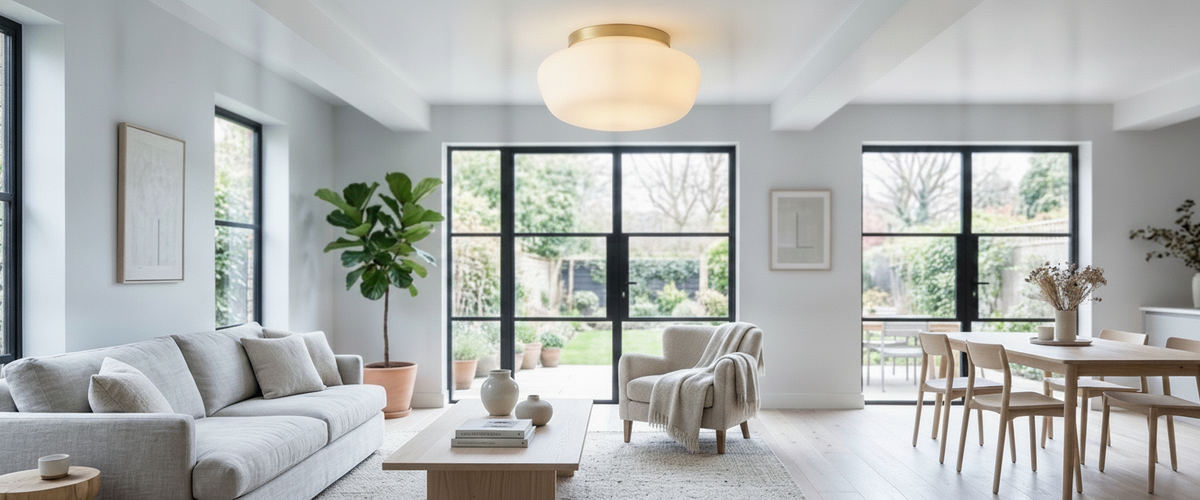

Most glass ceiling lights are chosen for how they look switched off. That is the whole problem. A gallery-perfect globe or a sculptural art glass shade can photograph beautifully in a showroom and then throw a hard, unflattering pool of light across a room the moment the power goes on. The glass itself decides almost everything: how much of the lamp you see, how the light spreads, and whether people sitting under it look rested or exhausted.

Key Takeaways
- Opal and acid-etched glass diffuse; clear glass exposes. If the bulb is visible from a seated position, you will feel it.
- Ceiling height drives format. Under about 2.4m (8ft), flush or semi-flush glass ceiling lights almost always beat a drop pendant.
- Finish matters as much as form. Satin brass warms the light at the edges; chrome and satin nickel keep it cool and crisp; matt black sharpens contrast.
- Dimming is not optional in living and dining spaces. Specify dimmable lamps and a compatible trailing-edge dimmer.
- Glass and stone behave differently. Glass transmits light through a manufactured surface; alabaster transmits it through mineral structure, which is why the glow reads warmer and less even.

What Glass Ceiling Lights Suit, and Who They Are For
Glass earns its place where you need broad, fairly even light without visual bulk. Hallways, landings, kitchens, utility spaces, bedrooms with lower ceilings and any room where a large stone or metal fitting would feel heavy overhead. A flush opal glass fitting reads almost as ceiling architecture rather than an object, which is exactly what you want in a corridor you walk through twenty times a day.
Designers reach for glass ceiling lights for a second reason: they are quiet. In a scheme already carrying a strong material story (fluted oak, a veined marble island, a heavy stone fireplace), a restrained opal globe with a distressed gold or satin brass collar supports the room instead of competing with it. The same logic holds in hospitality work, down long circulation routes where guests need light rather than another feature.
Glass ceiling lights are less convincing when you want a room's single centrepiece. That is where carved stone tends to win. Browsing the wider lighting range is worth doing before you commit, because the decision is often less about glass or stone and more about whether that ceiling position is a workhorse or a statement.
Sizing, Height and Placement That Actually Works
Start with ceiling height, because it eliminates half the options. Below roughly 2.4m (8ft), specify flush or semi-flush. Between 2.4m and 2.7m (8ft to 9ft), a semi-flush or a short-drop pendant works. Above 2.7m, you have room for a proper drop, and a fitting that is too small will look stranded.
For diameter, a rule that has never let us down: add the room's length and width in metres, then multiply by eight for a sensible fitting diameter in centimetres. A 4m by 5m room lands at around 70cm (roughly 28in) across, or two smaller fittings sharing the load. In feet, add the two dimensions and read the result as inches, which gets you to the same place.
Room by Room
- Dining table: aim for a fitting roughly 60 to 75 percent of the table's width, with the lowest point around 75cm to 90cm (30in to 35in) above the tabletop. Sightlines across the table matter more than the ceiling.
- Kitchen: keep ceiling glass for ambient fill and let task lighting come from under-cabinet strips. A single glass fitting doing both jobs will always be too bright for one and too weak for the other.
- Hallways and landings: maintain at least 2.1m (7ft) of clearance below any fitting in a walkway. Flush opal glass ceiling lights are the safe, elegant answer, and a low-profile fitting such as the Star 2 Light Flush Ceiling Light in Distressed Gold with Opal Glass holds its clearance while still spreading light down the full length of a corridor.
- Bedrooms: mount slightly off the bed centre if you can, or choose a fitting with a fully enclosed base so nobody lies down staring into a lamp.
- Bathrooms: check the IP rating against the zone. Enclosed glass helps, but the fitting must be specified for the location and installed by a qualified electrician.
Stairwells deserve their own note. A double-height stairwell is the one place where glass ceiling lights can be genuinely theatrical, because you see the fitting from several levels. Hang the lowest element so it is visible from the upper landing rather than floating uselessly above head height at the bottom.
Materials, Finishes and Light Quality
Not all glass is doing the same job. Opal glass is the workhorse: light passes through a milky layer and comes out soft, with the lamp hidden. Acid-etched or frosted glass sits close behind, slightly cooler and more contemporary. Smoked and tinted glass looks superb switched off and cuts output noticeably switched on, so size up or add a second light source. Clear glass is a decorative choice, not a lighting one; it demands a good-looking filament lamp and a dimmer.
Art glass, with its trapped bubbles and hand-worked irregularities, gives you texture in the shade itself, and no two pieces come out identical. That is the point, and it is also the reason to buy matching fittings in one order rather than adding a third later. Where a ceiling position needs some visible texture but cannot take the drop of a pendant, a semi-flush design like the Sentry 2 Light Semi-Flush Ceiling Light in Black and Art Glass is closer to the right design language.
Metalwork changes the read of glass ceiling lights more than most buyers expect. Distressed gold and satin brass bounce a warm halo onto the ceiling around the fitting, which is why something like the Fomento Glass Ceiling Light in Satin Brass softens the edges of the beam in a way a cooler metal never will. Chrome and satin nickel stay neutral and reflective, which suits cooler schemes and bathrooms. Matt black frames the glass hard and makes the diffused disc look brighter by contrast, useful in a room with pale walls.
How Glass Compares With Alabaster
People often ask us to compare glass ceiling lights with alabaster directly. Glass diffuses at the surface; alabaster diffuses through the material. Alabaster is a fine-grained form of gypsum, soft enough to carve and naturally translucent, which is why light seems to sit inside the stone rather than pass through it. Gypsum is among the softest minerals worked in Britain, as the British Geological Survey records in its mineral profiles, and that softness is precisely what allows the thin sections that let light through.
The practical difference: glass gives you even, predictable output; alabaster gives you a warm, veined, slightly uneven glow with visible movement in the stone. Glass suits rooms that need light. Alabaster suits rooms that need atmosphere. Plenty of our clients use both in one house, and if you are weighing the two, the alabaster lighting collection is the clearest way to see how differently stone handles a warm lamp.
Bulbs, Colour Temperature and Dimming
The lamp inside does half the work, so glass ceiling lights are only ever as good as what you put in them. Specify 2700K for living rooms, bedrooms and dining spaces. 3000K is defensible in kitchens and bathrooms where you want light that feels clean. Anything above 3000K under glass will look clinical fast, and it makes warm metal finishes look grey.
Colour rendering deserves attention. Choose lamps with a CRI of 90 or above; under diffused glass, low-CRI light flattens skin tones and kills the depth in timber and stone. Modern LED lamps handle this well and use a fraction of the energy of the halogens they replaced, as the Energy Saving Trust sets out in its lighting guidance.
On dimming: match dimmable LED lamps with a trailing-edge dimmer rated for the load, and check the minimum load figure. Two small LED lamps on an old dimmer built for 60W incandescents is the single most common cause of flicker we hear about. New circuits are notifiable work under Part P in England and Wales, so bring in a registered electrician rather than improvising.
Common Mistakes and How to Avoid Them
The same handful of errors comes up again and again with glass ceiling lights.
- Choosing by daytime appearance. Always ask what the fitting looks like lit, at low dim levels as well as full output.
- Undersizing. A fitting that looked generous in a showroom shrinks in a real room. Measure, tape the diameter on the floor, then decide.
- Hanging too high over a table. The most frequent correction we make on site.
- Ignoring the ceiling rose position. Existing wiring rarely sits where the furniture wants it. Moving it during a refurbishment is cheap; moving it afterwards is not.
- One fitting doing every job. Layer with wall lights, table lamps or a floor lamp. Ceiling light alone flattens a room.
- Forgetting maintenance access. If you cannot reach the glass with a step ladder, dust will win.
One example that stuck with us: a client refitting a Georgian first-floor drawing room specified beautiful smoked glass fittings, then called three weeks later saying the room felt gloomy at night. The glass was doing its job; there was simply not enough of it. Two alabaster wall lights flanking the chimney breast solved it without touching the ceiling.
Care and Cleaning
Glass ceiling lights gather dust faster than most people expect, and output drops with it.
- Switch off at the wall and let the lamps cool completely.
- Dust glass with a dry microfibre cloth first, before any moisture touches it.
- For marks, use a barely damp cloth and dry immediately. Avoid ammonia-based sprays near brass, gold and antiqued finishes.
- Never clean metal finishes with abrasives. Distressed and living finishes are meant to age; polishing them back looks worse than leaving them.
- Check fixings annually. Vibration from doors and floorboards loosens shades over time.
- Keep alabaster dry. Stone shades take a soft dry brush, never water and never household cleaner.
How Niori Can Help With Lighting Projects
Niori works in alabaster and natural stone, with glass and brass detailing where the design calls for it, across pendants, chandeliers, wall lights, table lamps, floor lamps and glass ceiling lights. The enquiries we enjoy most are the awkward ones: a low-ceilinged snug, a stairwell nobody can measure properly, a restaurant that needs forty consistent fittings by a fixed opening date.
Budget depends on material, scale, complexity and finishing, so the honest answer is always a tailored quote rather than a headline figure. Send ceiling heights, room dimensions, a photograph of the space and any joinery or stone finishes already chosen, and we will come back with a specification that balances glass and stone sensibly. Start with the Niori homepage if you want a feel for the range before you write the brief.