
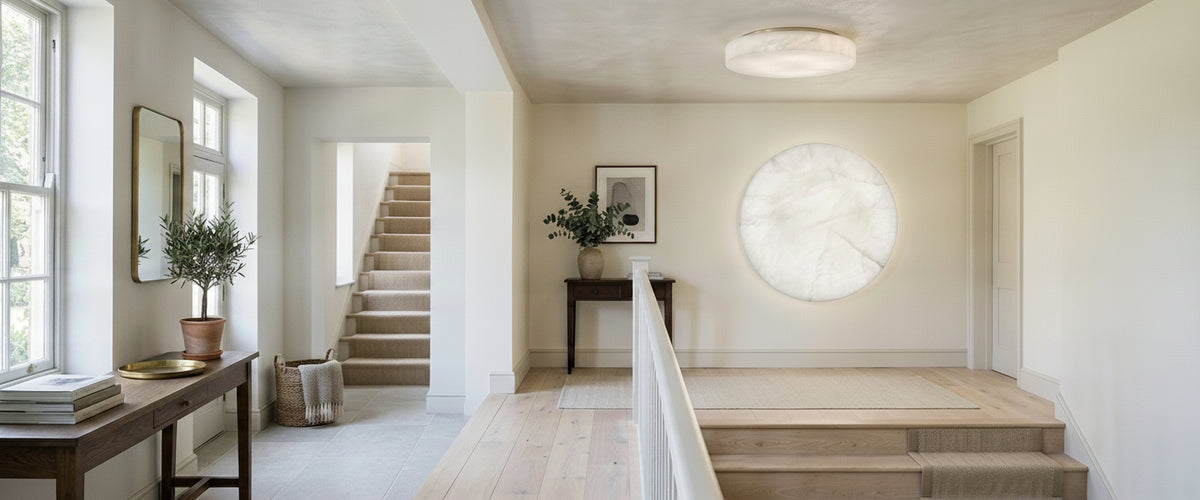

A ceiling at 2.3 metres (roughly 7 ft 6 in) will punish a pendant. Heads clip it, the drop cuts the room in half visually, and every time someone walks past the shade swings. Flush ceiling lights solve that, but they get treated as the boring compromise choice, which is why so many hallways and bedrooms end up with a plastic disc glaring down at head height. The good ones do something better: they sit tight to the plaster, hold the ceiling line clean, and still throw a warm, generous wash of light across the room.

At a Glance: What to Get Right
- Clearance first. Under about 2.4 m (8 ft), go fully flush. Between 2.4 m and 2.7 m (8 to 9 ft), a semi-flush with a short stem usually looks better.
- Size to the room, not the box. Add the room's length and width in metres, multiply by about 8, and you have a sensible fitting diameter in centimetres.
- Diffusion beats brightness. A translucent alabaster or stone shade softens the source; a bare LED panel does not.
- Dim it. Warm-dim or 2700K lamps on a compatible dimmer, always.
- Bathrooms and porches need IP-rated fittings and a qualified electrician, no exceptions.

What Flush Ceiling Lights Suit, and Who Actually Needs Them
Flush ceiling lights sit directly against the ceiling with no visible drop. Semi-flush versions hang on a short stem, usually a few inches, which lets light spill upward and lifts the ceiling visually. Both exist for the same reason: rooms where a pendant would be in the way, in the eyeline, or simply out of scale.
The obvious candidates are hallways, landings, corridors and stairwell half-landings, where circulation makes a hanging fixture a liability. Then come bedrooms in period conversions and new-build flats, where ceiling heights are often tighter than the plans suggested. Bathrooms and en suites nearly always want flush fittings, both for headroom and for moisture zoning. Kitchens use them over walkways and utility areas, leaving pendants for the island. Covered porches and outdoor entries take weather-rated flush fittings, which spare you a lantern that catches wind.
Designers and hospitality clients reach for them for another reason: consistency. A corridor of eight matched flush fittings reads as architecture. Eight pendants at slightly different drops read as a mistake. We have shipped stone flush fittings for guest-room corridors where the brief was simply that the ceiling should feel calm and the guest should never notice the fixture until they look up.
Sizing, Height and Placement That Works
Start with head clearance. In circulation space you want at least 2.1 m (about 7 ft) from floor to the lowest point of the fitting. Under a 2.4 m ceiling that leaves you around 300 mm, which most semi-flush fittings will use up once you add the stem, so a true flush fitting is the honest answer. Push to 2.6 m or 2.7 m and a semi-flush with a 10 to 15 cm stem gains you a halo of reflected light off the ceiling, which makes the room feel taller rather than shorter. That in-between band is where a short-stem fitting such as the Kieran Semi-Flush Ceiling Light in Lacquered Brass earns its place: enough separation from the plaster to throw light upward, not enough to sit in anyone's eyeline.
For diameter, the room-dimension rule gets you close. A 4 m by 5 m bedroom (9 metres combined) suggests a fitting around 70 cm across, which sounds enormous until you see it in place. Most people go two sizes too small. A modest fitting in a large room looks like a smoke alarm with ambition. If the number feels extreme, split the light: two smaller fittings spaced evenly beat one undersized one. Where a single fitting still has to cover the span, a multi-lamp frame like the Sabina 4 Light Large Flush Ceiling Light spreads the output across a wider footprint rather than concentrating it in one bright disc.
Placement is where rooms go wrong. Centring on the ceiling rose left by the previous owner is not a design decision. Centre on the usable space, or on the furniture group, or on the axis of a corridor. In a bedroom with a bed pushed to one wall, centring the fitting between the two walls can leave the light sitting awkwardly over the wardrobe doors. In a corridor, space fittings roughly one ceiling height apart, so around 2.4 m on a standard ceiling, to avoid scalloping and dark patches between them. If you are comparing scale across fixture types before committing, the wider lighting collection shows how a flush fitting reads next to a pendant or a wall light in the same room.
Materials, Finishes and Light Quality
The material of the shade decides everything about how a flush fitting feels once switched on. Opal acrylic gives you even light and a dead, plastic surface by day. Clear glass shows the lamp and glares. Metal shades push light down in a hard pool and leave the ceiling dark.
Alabaster behaves differently. It is a gypsum stone, soft enough to be carved thin, and when cut to a few millimetres it transmits light rather than blocking it. The result is a warm, slightly amber glow with the veining faintly visible from within, which is precisely why the material has been carved for windows and lamps since antiquity. The medieval English alabaster carvings held in collections such as the Victoria and Albert Museum show how finely the stone can be worked.
Marble and onyx are calcium carbonate rather than gypsum. Onyx banding gives dramatic colour when backlit, from honey to green, and reads as decorative even when the light is off. Marble tends to be more opaque, better suited to solid rims, bases and structural elements than to the glowing disc itself. In practice, the best of these fittings combine the two ideas: a stone or alabaster diffuser with brass, bronze or blackened metal detailing to define the edge against the plaster. Where a room wants texture and a broken, dappled light rather than a smooth glowing disc, a woven shade such as the Kai 1 Light Flush Ceiling Light in Brushed Gold and Rattan is closer to the right design language.
One thing worth knowing before you order across a project. Natural stone is not a repeatable finish. Two alabaster discs from different blocks can differ noticeably in warmth and veining. If you need four matched fittings for a corridor, say so at the point of enquiry so panels can be cut from the same block; retrofitting a match later is far harder. You can see the range of stone character across our alabaster lighting pieces, which is the best way to judge how much movement you actually want in the stone.
Bulbs, Dimming and Colour Temperature
Warm light suits stone. Choose 2700K for living spaces and bedrooms, and stay at or below 3000K anywhere you want the veining to look natural; go cooler than that and alabaster starts to look grey and lifeless. Aim for a colour rendering index of 90 or higher so skin tones and timber finishes hold up.
Because a flush fitting has nowhere to hide, heat management matters. Stone tolerates warmth but repeated heat cycling near a hot filament lamp is not kind to a thin diffuser, and older halogen lamps in an enclosed fitting are simply a bad idea. LED lamps rated for enclosed fixtures are the sensible default. Check that any dimmer is compatible with the driver, ideally trailing edge, and test before the plasterers make the fitting permanent. A flush fitting on a switch with no dimmer is a room with one setting.
Common Mistakes With Flush Ceiling Lights
- Treating it as the only light. One ceiling fitting flattens a room. Pair it with table lamps, floor lamps or wall lights so the room has layers at eye level.
- Undersizing. The most common error by a distance. Measure, calculate, then trust the number.
- Ignoring bathroom zones. Fittings above a bath or shower need an appropriate IP rating, and work on circuits close to a bath or shower is notifiable in England. Use a registered electrician and check the current Approved Document P guidance before anyone lifts a floorboard.
- Forgetting the fixing point. Stone fittings weigh more than metal ones. Confirm the ceiling can take the load, especially with lath and plaster or a plasterboard ceiling without noggins.
- Cleaning stone like glass. No sprays, no vinegar, no ammonia, no soaking cloth. Alabaster is water sensitive and will dull or mark.
- Mixing colour temperatures. A 2700K flush fitting next to 4000K downlights makes both look wrong.
Installation and Care Checklist
- Confirm ceiling height and fitting depth before ordering. Note the lowest point, not the average.
- Check fixing substrate and weight; ask about the mounting plate if you are working with an old ceiling.
- Agree lamp type, colour temperature and dimming with the electrician in advance.
- Unpack stone components on a soft surface. Handle the diffuser by the metal rim where possible.
- Dust with a dry, soft brush or a clean microfibre cloth. Nothing wet, nothing abrasive.
- For fingerprints or grease near a kitchen, use a barely damp cloth and dry immediately.
- Recheck fixings after the first heating season; movement in a new-build ceiling is normal.
How Niori Can Help With Lighting Projects
Niori works in alabaster and natural stone across pendants, chandeliers, wall lights, table lamps, floor lamps and flush ceiling lights, and we ship worldwide. Where we tend to be most useful is early, at the point where a designer is still deciding whether a corridor wants six matched flush fittings or three semi-flush fittings with more presence, or whether a bedroom would be better served by a flush fitting plus a pair of stone wall lights than by one large central piece.
Budget on a stone project depends on material, scale, complexity of the carving, metalwork, engineering for the fixing, and finishing, so we quote per project rather than publishing a single figure. Send ceiling heights, room dimensions, a plan if you have one, and any matching requirements across multiple fittings, and we will come back with a tailored quote and honest advice about scale. If you want a feel for the range first, start at the Niori homepage and work through by fixture type.
Get the size and the diffusion right and flush ceiling lights stop being the compromise option. They become the quiet piece that makes a low room feel considered rather than squashed, which is a far harder trick than hanging something impressive from a double-height void.