
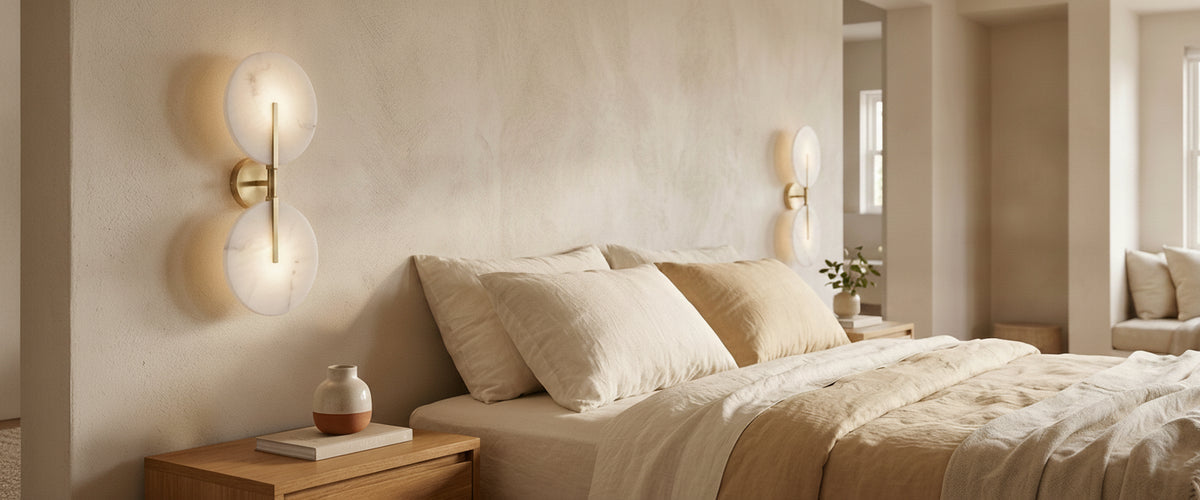

Hang two single sconces 40cm apart and you have made a decision you will keep re-making every time someone re-plasters, re-papers or re-hangs the art. Hang one double wall lights and the geometry is settled: the arms are fixed relative to each other, the light overlaps where the maker intended it to overlap, and the wall reads as one considered gesture rather than two near-misses. That difference sounds small on a drawing. It is very obvious at eye level, in a lit room, at nine in the evening.

Double Wall Lights at a Glance
- What they are: a single fitting carrying two lamp arms or two shades, usually from one backplate.
- Main advantage: the spacing between the two light sources is engineered, not left to a fitter's tape measure.
- Best rooms: above bedheads, flanking or crowning mirrors, and along corridors where rhythm matters more than raw output.
- Material to press on: alabaster or fine marble diffusers soften the two hotspots into one broad wash; opal glass is cleaner but flatter.
- Finish to consider: an antique brass wall light hides fingerprints and warms the reflected light in a way polished chrome never manages.
- Wiring note: one backplate normally means one outlet position, which changes the first-fix drawing. Confirm before the plasterers arrive.

What a Double-Arm Fitting Delivers That Two Sconces Never Quite Replicate
The honest answer is control of the overlap. Two light sources on a wall produce three zones: the pool under the left source, the pool under the right, and the blended band between them. That blended band is where the quality lives. Get it right and the wall looks evenly bathed with a gentle brightening under each shade. Get it wrong and you see two separate scallops with a dull trough in the middle, which the eye reads instantly as a mistake even when the client cannot name what is bothering them.
double wall lights fix that overlap at the factory. The arm centres are set, the shade angles are set, and the relationship between the two beams stays true whether the fitting goes on a smooth plastered wall in a new-build or an uneven lime-plastered wall in a period cottage. Two singles, by contrast, depend on the accuracy of the marking-out and on nobody later deciding that 45cm apart looks better than the 40cm on the drawing.
There is a structural benefit too. Twin arms sharing one backplate spread their load across a wider fixing pattern, which is useful on stud walls where you are hunting for something solid behind the plasterboard. And there is a visual one: the fitting reads as a single object with mass and presence, which suits the weight of a carved stone or alabaster shade far better than two lightweight singles floating near each other.
How Arm Spacing Governs Spread, Shadow and Balance
Arm spacing is the single most underrated specification on double wall lights. Narrow spacing concentrates the two beams into what is effectively one brighter source with a soft double core, which suits tight spaces: a chimney breast, a narrow pier between windows, the wall beside a stair. Wide spacing throws two distinct pools and covers more wall, which suits a broad bedhead or a long console.
The practical test is the wall itself. Measure the clear width you want lit, then look at where the fitting's arms sit within that width. A fitting whose arms span roughly a third to a half of the feature below it usually looks anchored. Much narrower and it looks apologetic on a big wall. Much wider and it starts to compete with the furniture rather than serve it.
Where the pier is genuinely too narrow to take two arms at all, the same doubling instinct can be met vertically instead of horizontally: a slim linear body such as Flara Brass LED Wall Light 12.5W 3000K, 29cm washes up and down from one point without asking the wall for width it does not have, and the longer 75cm version of the same form does the equivalent job on a broad bedhead wall.
Shadow pattern follows spacing as well. Two closely spaced sources cast a softer, less defined shadow behind objects on a shelf or nightstand, because each source partly fills the other's shadow. Push the arms apart and you get two crisper shadows heading in slightly different directions. Neither is wrong. In a bedroom I would take the softer version every time; on a picture wall with textured plaster, the crisper double shadow can be genuinely handsome.
Symmetry in the Fitting Does Not Mean Uniformity in the Light
Buyers often assume a symmetrical fitting will produce a symmetrical result. It will not, and that is worth welcoming rather than fighting. Natural stone is the reason. Every alabaster shade has its own vein structure, density and thickness, so one side of a two-arm fitting will almost always glow slightly differently from the other. Alabaster is a fine-grained gypsum rock, and its translucency comes from crystal structure that formed over geological time rather than in a mould, which you can read about through the British Geological Survey's material resources.
What that gives you is a wall that looks lit rather than switched on. Two identical opal glass globes produce a technically even result that can feel a little clinical. Two alabaster shades from the same block produce a family resemblance with small differences in warmth, veining and brightness, and the eye finds that far more restful. We had a client fitting a pair of double alabaster sconces either side of a bedhead in a converted Somerset barn who queried the mismatch on arrival. Once they were up and dimmed to about a third, the query disappeared. Veining that looks like a defect on a workbench looks like character on a wall.
Marble and onyx behave the same way but more dramatically. Onyx in particular can shift from honey to amber across a single shade. If you want tighter consistency, ask whether the shades on a given fitting are cut from the same block, which is the only reliable way to keep the two halves closely related.
Where Double Wall Lights Earn Their Width
Above and Beside Bedheads
A single double fitting centred above a bedhead gives symmetrical reading light without two separate switch drops. Flanking pairs still work better for couples who read at different hours, but for guest bedrooms, boutique hotel rooms and rooms where the bedhead is against a narrow wall, one wide fitting is the cleaner answer. Keep the light source above eye level when seated upright, and specify a diffuser that hides the lamp entirely; nothing ruins a bedroom faster than a bright filament in your peripheral vision.
Flanking or Crowning a Mirror
For bathroom and dressing mirrors, light needs to come at the face from both sides rather than from directly overhead. A double fitting mounted horizontally above a wide mirror can work if the shades throw generously downward and outward. For anything narrower than about 90cm (35in), two verticals either side of the glass will flatter faces better. Bathroom zones carry their own requirements for ingress protection, so confirm the rating with your electrician before ordering.
Corridor Rhythm
Long corridors are where double wall lights genuinely outperform singles. Space single sconces evenly and you get a series of separate pools with dark gaps between them. Space doubles at wider intervals and each fitting throws a broader, overlapping wash, so the corridor reads as continuously lit with fewer fixing points, fewer outlets and fewer objects on the wall. Hotels and restaurants use this trick constantly. It is also why doubles suit stairwell landings, where you want coverage without a queue of fittings marching up the wall. Browse the broader lighting range if you are trying to match corridor sconces to a pendant or chandelier elsewhere in the circulation space.
One Backplate Versus Two: The Wiring and Mounting Difference
This is the detail buyers underestimate most. A twin fitting on a single backplate typically needs one supply point, positioned centrally behind the plate. Two singles need two supply points, positioned precisely where each backplate lands. Swap one option for the other after first fix and you are chasing new cable routes through finished plaster, which is expensive and messy.
The most economical version of this logic is an up-and-down fitting, where one compact plate and one feed produce two beams travelling in opposite directions. Marley Up Down Wall Light, Antique Brass is that idea in its simplest form, and it is often the right answer on a hallway wall where you want doubled light but only one cable position to negotiate. Outdoors, the same approach needs a weather rating to go with it, which is where something like Eamon Outdoor Up/Down Wall Light IP54 GU10, Brushed Brass belongs rather than an interior brass fitting pressed into service.
Some double fittings use two backplates joined by a bar, which changes the fixing requirements again and may need a specific stud or noggin position. Ask for the fixing centres and the position of the cable entry before the walls are closed up. Ask, too, about the weight. Stone and alabaster shades add mass, and a double carries twice the shade weight on one plate, so plasterboard alone rarely does the job; you want a timber noggin or an appropriate heavy-duty fixing.
All mains work should go to a qualified electrician working to the current wiring regulations, and the IET's BS 7671 guidance is the reference point in the UK. If you are dimming, tell the electrician at the design stage, not on installation day. Driver compatibility and switch type are far easier to sort on paper.
Finish and Diffuser Questions Worth Pressing a Supplier On
Start with the finish. An antique brass wall light is not one thing; it ranges from a light aged lacquer through to a deep, almost bronzed patina. Ask whether the finish is lacquered or living. Lacquered stays as delivered and needs only a dry cloth. Living brass darkens with handling and humidity, which is lovely in a hallway and less predictable in a steamy bathroom. If you are buying doubles for several rooms in one project, order them together so the finish batch matches.
Then the diffuser. Ask how thick the alabaster or marble is, because thickness governs how much light passes through and how much veining shows. Ask whether the two shades are matched from one block. Ask what lamp the fitting is designed around, and whether the shade will hide it from a seated eye line. And ask about the internal reflector or backplate colour, since a brass interior warms the output while a white interior keeps it neutral. Our own alabaster lighting collection is a useful reference for how different stone thicknesses read once lit.
Buyer's Checklist for Double Wall Lights
- Measure the clear wall width and check the fitting's arm span sits comfortably within it.
- Decide narrow spacing for a soft single wash, wider spacing for two defined pools.
- Confirm mounting height against seated and standing eye lines, typically around 1.5m to 1.6m (59in to 63in) for general use.
- Check whether the fitting uses one backplate or two, and get the fixing centres before first fix.
- Confirm the supply point position with your electrician while walls are still open.
- Specify lamp type, colour temperature (2700K suits alabaster well) and dimming method together.
- Ask whether shades are cut from a matched block, and accept some natural variation.
- Clarify lacquered or living brass, and order project quantities in one batch.
- Check IP requirements for bathrooms and any external application.
- Ask for a tailored quote; cost depends on stone selection, scale, metalwork, finishing and installation complexity rather than a fixed list.
Double wall lights are not automatically the better choice. Where you need independently switched reading lights, or where the wall is broken by joinery, two singles win. Where you want one confident object, a settled overlap and fewer holes in the plaster, a twin-arm fitting earns its width. Look at the wall, look at what sits beneath it, and choose the fitting that makes the whole composition look deliberate. If you want help matching sconces to pendants or a chandelier across a scheme, Niori works with alabaster and natural stone across the full range and can advise on finishes and stone matching before you commit.