
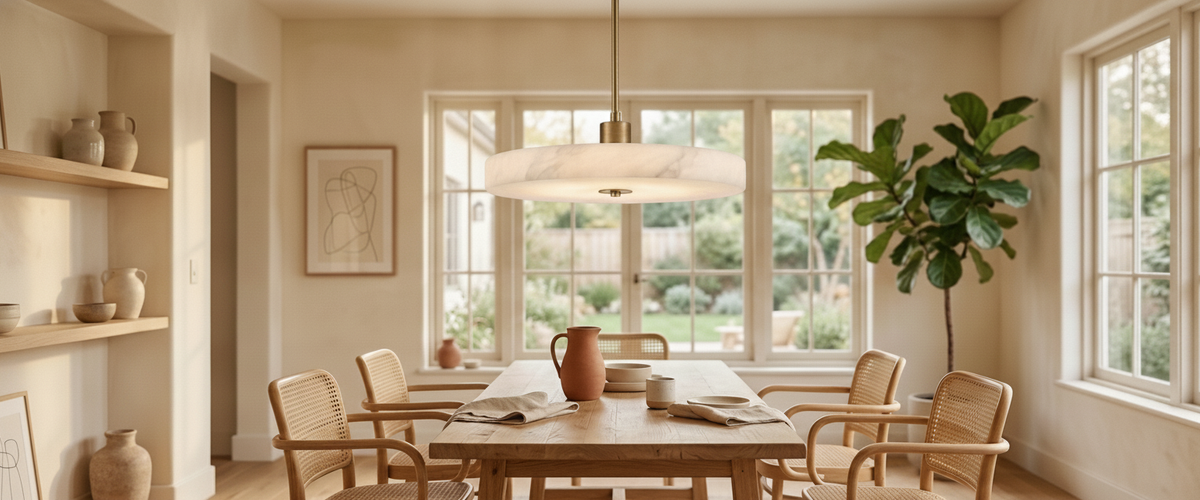

Most dining rooms are lit by a fitting that is too small, hung too high, and switched to full output all evening. The table looks flat, faces look tired, and nobody quite knows why the room never settles. Dining room pendant lights fix all three problems at once, but only if you get scale, drop height and light quality right. That is a design decision before it is a shopping decision, and it is worth ten minutes of thought.

Key Takeaways
Scale: aim for a dining room pendant light roughly one third to one half the width of the table.
Height: 75 to 90cm (30 to 35in) between the tabletop and the base of the shade suits most ceilings.
Material: alabaster, onyx and marble diffuse light through the stone itself, so you get glow rather than glare.
Control: specify warm dimmable LEDs at 2400K to 2700K and a compatible dimmer, fitted by a qualified electrician.
Layering: dining room pendant lights rarely do the job alone. Add wall lights or a table lamp on a sideboard for depth.

What Dining Room Pendant Lights Do, and Who They Suit
A pendant over a dining table has one job that no other fitting does as well: it draws a circle of light around the people sitting under it and lets the rest of the room fall away. Downlights spread light evenly across a ceiling plane, which is useful in a kitchen and deadening over dinner. A pendant creates a centre.
That makes dining room pendant lights the right choice for almost any table that sits in a fixed position, whether that is a walnut six-seater in a Victorian terrace, a long oak refectory table in a converted barn, or a marble-topped round table in a flat where the dining zone shares a room with the sofa. In hospitality work the logic is the same but sharper. Restaurant operators know that a pool of warm light over each table makes covers feel private and food look better, which is why so many dining rooms in good hotels are lit low and warm rather than bright and even.
Two situations call for care. If your table gets pushed against a wall or moved for parties, a fixed dining room pendant light will end up off centre and you may be better served by a pair of wall lights plus a floor lamp. And if the ceiling is under about 2.3m (7ft 6in), a deep pendant will crowd the room; a shallow flush or semi-flush stone fitting is the more graceful answer.
Sizing, Height and Placement
Diameter and Visual Weight
The most common sizing error is buying small. As a working rule, a single dining room pendant light should measure between one third and one half the width of the table. Over a 90cm (35in) wide table, that puts you between roughly 30cm and 45cm (12in to 18in) across. Round tables take the rule better than rectangular ones, where a single small pendant can look marooned in all that timber.
Material changes the maths. A slab of backlit alabaster reads heavier than an open brass frame of the same diameter, so if you are choosing a solid stone bowl or drum you can usually sit at the lower end of the range and still hold the room. Wireframe and glass dining room pendant lights need to be larger to register at all. Over a round four-seater, where one well-proportioned fitting has to carry the whole ceiling, a single medium pendant such as the Larousse 1 Light Medium Pendant in Champagne Bronze gives you more presence per centimetre than a cluster of small shades.
Hanging Height
Set the base of the shade 75 to 90cm (30 to 35in) above the tabletop, a band that suits most dining room pendant lights and most ceilings. Lower feels intimate and works beautifully with an opaque or stone shade that hides the lamp. Higher spreads light more widely but risks putting the bulb in a seated guest's eyeline, which is the fastest way to ruin an otherwise good scheme. On ceilings above 2.7m (9ft), add roughly 7cm for every additional 30cm of ceiling height (about 3in per extra foot) so the fitting does not float.
Before anyone drills anything, cut a paper disc to the pendant diameter, tape it to a length of string, and hang it at your intended drop for an evening. It looks daft. It also settles arguments about scale in about five minutes.
Multiples, Linear Tables and Off-Centre Rooms
Tables longer than about 1.8m (6ft) usually want two dining room pendant lights; beyond 2.4m (8ft), three. Space them evenly along the table's centre line, leave at least 60cm (24in) between centres so the shades do not visually collide, and keep the outermost pendants around 30cm (12in) in from the table ends. A linear suspension is the alternative if you want a single continuous line of light rather than repeated shapes. Where a long table needs that unbroken line and the ceiling above it would benefit from being lifted rather than left dark, the DUOline LED Up Down Linear Pendant in Satin Nickel is closer to the right design language than a row of separate shades.
If the ceiling rose sits off centre from where the table actually lives, do not compromise the table. Either have the ceiling point moved by an electrician, or use a fabric-covered flex and a discreet ceiling hook to swing the drop across. Both are routine; a permanently off-centre dining room pendant light is not.
Materials, Finishes and Light Quality
This is where dining room pendant lights either become the best thing in the room or just another shade. Metal shades throw light down and leave the fitting itself dark. Clear glass exposes the lamp, which needs a genuinely good decorative bulb to survive. Where glass is the right call, in a scheme already carrying plenty of stone and timber, say, a defined dark frame like the DUOline Glass Pendant in Matt Black holds its outline against a pale ceiling far better than a frameless globe does. Stone behaves differently again: alabaster and onyx are translucent, so light travels through the material and the whole shade becomes the light source.
Alabaster is a fine-grained gypsum, soft enough to carve and thin enough to let light pass through at a few millimetres of thickness, which is why it is the material we specify most often for dining room pendant lights. That softness is also why it needs sensible care, since gypsum is slightly soluble in water and should never be cleaned with a wet cloth or household spray. The British Geological Survey is a useful starting point if you want to understand how the mineral forms and why no two panels look alike.
In practice, the differences matter at the table:
Alabaster: warm honey and cream tones, soft veining, glow that is even and never harsh. The most forgiving material for dining room pendant lights.
Onyx: more dramatic banding, amber and green ribbons that come alive when lit from within. Best where you want the fitting to be the event.
Marble: largely opaque, so it works as a solid canopy, disc or body with light thrown down rather than through.
Glass with brass detailing: crisper and more reflective, good in schemes that already have a lot of texture.
We keep offcuts of alabaster on a lightbox in the studio for exactly this reason. Two panels that look near identical in daylight can read completely differently when lit: one goes buttery and even, the next shows a cloud of grey through the middle. It is a natural material and it should look like one. Buyers of dining room pendant lights who want perfect uniformity are usually happier with cast glass, and we say so. If you want to see the range of tones stone can give, the alabaster lighting collection is the clearest place to compare.
Bulbs, Dimming and Colour Temperature
Warm light flatters skin, food and stone. Specify LEDs at 2400K to 2700K and a colour rendering index of 90 or above; below that, reds lose depth and wine and rare beef both look off. Dimming is not optional for dining room pendant lights, and LED dimming still catches people out because not every lamp works with every dimmer. Check the manufacturer's compatibility list, or ask your electrician to specify a trailing-edge dimmer suited to the load, and note that very low wattages sometimes need a minimum-load device to stop flicker. The Energy Saving Trust has straightforward guidance on LED specification if you want a neutral second opinion.
Keep output modest. A dining room pendant light is not the room's workhorse: a low-wattage lamp of good quality, dimmed, will do more for the table than one bright source ever does. Add wall lights or a stone table lamp on a sideboard so the corners of the room are not black, and put them on a separate circuit so you can shift the balance between serving and lingering.
Common Mistakes and How to Avoid Them
Undersized fittings. Most dining room pendant lights are bought a size too small. Measure the table, apply the one third to one half rule, then resist the urge to size down when the box arrives.
Hanging too high. Almost every retrofit we advise on comes down by 10 to 20cm and improves immediately.
Exposed lamps at eye level. If you can see the bulb from a seated position, you will notice it all evening.
No dimmer. A fixed-output pendant gives you one mood, and it is rarely the one you want at 9pm.
Ignoring weight and fixings. Stone fittings are heavy. Ceiling roses and plasterboard need proper support, and a qualified electrician should confirm both the fixing and the circuit.
Cleaning stone with the wrong thing. Dry dust with a soft brush or microfibre cloth. No sprays, no damp wiping, no abrasives.
Forgetting the rest of the room. One pendant over a table in an otherwise dark room reads like an interrogation. Layer it.
A Quick Checklist Before You Order
Table width and length measured, dining room pendant light diameter chosen against it.
Ceiling height measured, drop calculated to give 75 to 90cm clearance above the tabletop.
Paper mock-up hung and lived with for an evening.
Ceiling point checked for position and load, with an electrician booked.
Lamp type, colour temperature and dimmer compatibility confirmed.
Secondary lighting planned: wall lights, sideboard lamp, or both.
Material chosen with an understanding of natural variation in stone.
How Niori Can Help with Your Lighting Project
Niori designs and supplies alabaster and natural-stone lighting: pendants, chandeliers, wall lights, table lamps and floor lamps, with glass and brass detailing where a scheme calls for it. We ship worldwide and work with homeowners, interior designers, architects and venue owners, which means a good part of the week is spent on sizing questions about dining room pendant lights rather than sales ones.
One recent example: a converted mill with a 3.4m ceiling and a 2.6m dining table. The client had specified a single large pendant. We suggested three smaller alabaster drums instead, dropped low on slim brass suspensions, and the room went from cavernous to companionable without touching anything else. That is usually the shape of the conversation, and it costs nothing to have it.
If you are still comparing formats, browse the wider lighting range to see how dining room pendant lights sit alongside wall lights and lamps from the same material family. For bespoke sizing, custom drops, or multiples matched for veining across a long table, send us your plans and elevations. Budget depends on material, scale, complexity, engineering, installation and finishing, so we quote each project individually rather than guessing at a number. Ask for a tailored quote and we will price the real thing.