
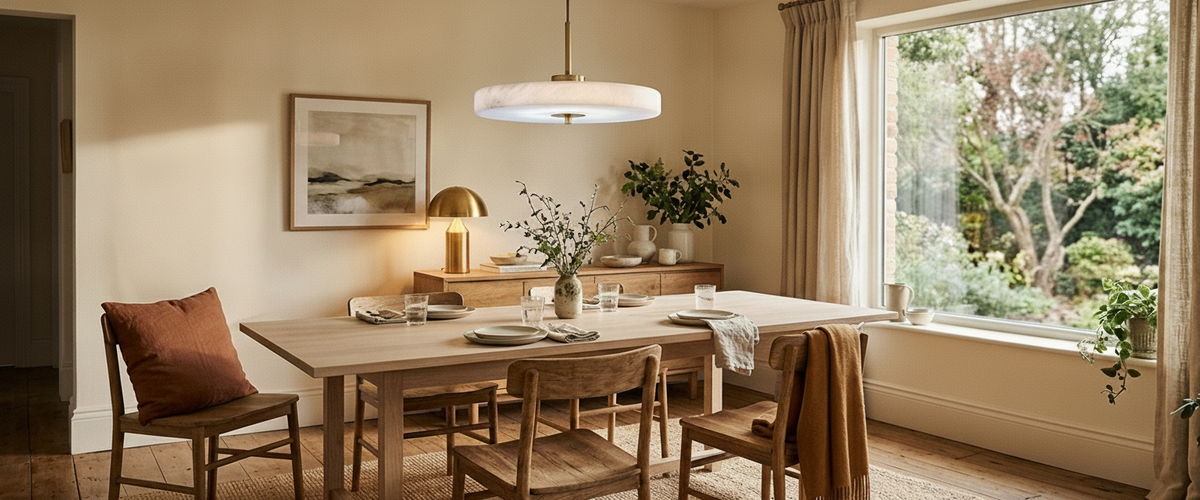

Switch on a single downlight over the table and watch what happens: shadows pool under everyone's eyes, the food goes flat, and the corners of the room disappear into gloom. That one fitting is doing all the work, and it shows. The best dining room lighting ideas start from a simple premise, that a room where people sit and talk for two hours needs light at more than one height, in more than one color temperature, on more than one switch. Good dining room lights ideas begin there and build out.
Niori works in alabaster and natural stone, and the dining room is where those materials earn their keep. Stone diffuses light instead of firing it in a hard beam, so the glow lands on cheekbones and wine glasses rather than glaring off the table. Below is how to layer it properly, and most dining room lighting ideas worth keeping come down to that layering.

Key Takeaways
One overhead fitting is never enough; aim for three layers of light on separate controls.
Hang the main pendant roughly 30 to 36 inches (76 to 91 cm) above the tabletop.
Add light at eye level with wall lights and a lamp on a sideboard, not just above the table.
Use warm 2700K bulbs on dimmers for skin and food that both look their best.
Alabaster and onyx shades soften glare and read beautifully to anyone seated across the table.

Why One Overhead Fitting Leaves the Room Looking Like a Canteen
A lone ceiling light gives you a bright puddle in the centre and darkness at the edges. The contrast is the problem. Your eye adjusts to the bright zone, then everything beyond it reads as murky, so the room feels smaller and colder than it is. Guests hunch toward the light without knowing why. Most dining room lighting ideas exist to fix exactly this.
The correction is layering. Think of three jobs: a feature light over the table, ambient fill that lifts the whole room, and accent light that picks out a sideboard, artwork or an alcove. When those sit on separate dimmers, one room can shift from a bright family lunch to a low, candle-warm dinner in seconds. Most of the best dining room lights ideas are really just clever ways to split light across these three roles.
The Layer People Forget: Light at Eye Level
Everyone remembers the pendant. Almost nobody plans light at seated eye level, which is exactly where faces live. This is the layer that makes a dinner feel intimate rather than clinical, and it is where good dining room lighting ideas separate from the ordinary.
Wall lights mounted at around 60 inches (152 cm) throw a soft wash across the room without shining in anyone's eyes. A table lamp on a sideboard or console does the same job from a lower angle, filling the shadow that a ceiling fitting drops under the brow. In an alabaster wall light, the stone itself becomes the glowing element, a low, honey-coloured plane of light that reads as warmth from across the table. You can see the range of forms this works in across our alabaster lighting collection.
How a Veined Stone Pendant Reads to Someone Seated Across From It
Here is a detail we learned shipping to a client in Napa who wanted one pendant to carry the whole room. Alabaster and onyx are translucent, so when lit from within they glow rather than glare. The mineral veining, those grey and amber threads running through the stone, catches the light and becomes part of the fixture's character. Seated across the table, a guest sees a soft, luminous object rather than a bare bulb. This is one of the quiet dining room lighting ideas that pays off every meal.
That translucency is the whole argument for stone over glass or metal in a dining room. The Natural Stone Institute notes that alabaster's fine, even structure lets light pass through gently, which is precisely why it has been used for lamps and window panes for centuries. In practical terms, it means no hotspot, no hard shadow line, and a colour that flatters skin.
For scale, a long rectangular table usually wants a linear pendant or two smaller pendants spaced evenly, rather than a single round fitting stranded in the middle. A round or square table takes a single central piece happily. Whatever the shape, keep the bottom of the fixture roughly 30 to 36 inches (76 to 91 cm) above the tabletop so it lights the food without blocking the line of sight across it.
Wall Lights and Lamps That Soften the Corners a Chandelier Can't Reach
A chandelier, however handsome, throws most of its light down and across the table. The corners of the room stay dark. That is where wall lights and lamps come in, and where a lot of dining room lighting ideas quietly fail.
Pair the overhead piece with two wall lights on the longest wall, or with a lamp on each end of a sideboard. The goal is to lift the perimeter so the room reads as a whole rather than a lit table floating in a dark box. In natural stone, these secondary fittings tie the scheme together: a marble or alabaster wall light echoes the pendant's material without repeating its form. If you want to compare fixture types before committing, our full lighting range lays out pendants, wall lights, table lamps and floor lamps side by side.
Light is only half of what a guest sees across the table; the chairs sit inside the same glow, so their upholstery and finish matter to the mood as much as the fixtures. Where warm 2700K light meets a soft-textured seat such as the Braxdon Bouclé Dining Chair, Cream, the material picks up the amber tone and reads as warmth rather than reflecting a hard highlight the way a glossy surface would. The best dining room lighting ideas account for what the light lands on, not just the fitting overhead.
Getting the Dim Right So Skin and Food Both Look Their Best
Colour temperature and dimming decide whether dinner looks appetising or embalmed. For dining, stay warm. A bulb around 2700K gives the amber, candle-adjacent tone that makes food look cooked and faces look rested. Cooler light, 3500K and up, pushes everything toward a hospital blue that no roast survives. This step ties every one of your dining room lighting ideas together.
Two technical points worth getting right. First, choose LED bulbs with a high colour rendering index, ideally CRImatched to 90 or above, so reds and browns on the plate read true. The CIBSE guidance on interior lighting treats colour rendering as central to spaces where people gather to eat, and it shows on the plate. Second, make sure the dimmer and the bulb are compatible; a mismatched pair flickers or buzzes at low levels, which is maddening over a long meal. When in doubt, ask a qualified electrician to confirm the driver and dimmer work together before you commit to a scheme.
Set the pendant so it can drop right down for dinner and lift for daytime. The dimmer is what turns one fixture into two moods, and it makes the simplest dining room lighting ideas work harder.
The Mistakes That Leave One End of the Table in Shadow
The most common fault we see is a pendant hung dead-centre in the room rather than centred over the table. Tables rarely sit in the exact middle of a room; centre the light on the furniture, not the walls, or one end of the table will always sit in shadow. Good dining room lighting ideas start with the table, not the ceiling.
A few more traps to avoid:
Hanging too high. A pendant lifted above eye-line stops lighting the food and starts lighting the ceiling. Keep it low over the table.
Undersizing the fixture. A small pendant over a large table looks lost and lights only the middle. Match the fixture's spread to the table's length.
Relying on one switch. Everything on a single circuit means you can have bright or off, and nothing in between. Split the layers.
Ignoring the walls. With no perimeter light, the table glows and the room recedes. Add wall lights or lamps.
Mixing warm and cool bulbs. A warm pendant beside a cool lamp reads as a mistake. Keep colour temperature consistent across the scheme.
A Short Buyer's Checklist
Measure your table length and shape first; the fixture follows the furniture, not the room.
Decide your three layers: feature pendant, ambient fill, accent light.
Confirm mounting height at 30 to 36 inches (76 to 91 cm) above the tabletop.
Specify 2700K, high-CRI bulbs on compatible dimmers.
Choose alabaster or onyx where you want glow without glare, and plan the wiring with a qualified electrician.
Budget for stone lighting depends on material, scale, engineering and finishing rather than any single figure, so the honest advice is to request a tailored quote once you know the fixture types and quantities your room needs. Work through these dining room lighting ideas, get the layers and the dimming right, and even a modest scheme will make the food, and the people, look their best.